
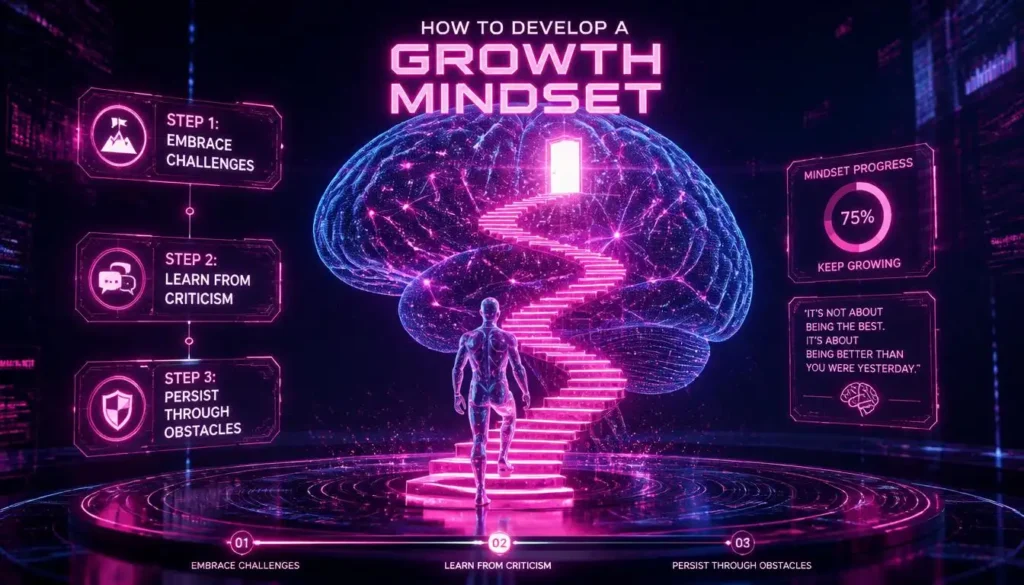

If you’ve ever thought “I’m just not good at this” and stopped there, you’ve bumped into what psychologist Carol Dweck calls a fixed mindset. The good news: your brain is wired for change. Thanks to neuroplasticity, the ability to learn, adapt, and grow isn’t a personality trait you’re born with — it’s a skill you build. This guide walks you through exactly how to develop a growth mindset, step by step, with real habits you can start today.
Quick Answer: The Growth Mindset Action Plan
Here’s the short version before we go deep:
- Identify your fixed mindset triggers — notice when you avoid challenges out of fear.
- Use the power of “yet” — replace “I can’t do this” with “I can’t do this yet.”
- Reframe failure as feedback — treat setbacks as data, not verdicts.
- Adopt growth-oriented language — change your self-talk and how you describe effort.
- Build daily habits that reinforce growth — small, repeated actions rewire the brain.
- Seek constructive feedback — invite input rather than avoid it.
- Value effort over innate talent — praise and reward the process, not just results.
Now let’s break each one down.
What Is a Growth Mindset?

A growth mindset is the belief that abilities, intelligence, and talents can be developed through effort, strategy, and learning from others — rather than being fixed traits you either have or don’t. The term was coined by Stanford psychologist Carol Dweck, whose decades of research on self-theory and motivation reshaped how educators, athletes, and business leaders think about achievement.
People with a growth mindset don’t assume they’ll master something instantly. They expect the process to involve mistakes and see those mistakes as part of learning rather than as proof of inadequacy.
If you want a deeper foundation on this topic before diving into the steps, our personal development guide covers the broader framework that growth mindset fits into.
Growth Mindset vs. Fixed Mindset: What’s the Difference?
Understanding the contrast helps clarify what you’re actually shifting away from.
| Fixed Mindset | Growth Mindset |
| Believes talent and intelligence are static | Believes abilities can be developed |
| Avoids challenges to protect self-image | Embraces challenges as growth opportunities |
| Sees effort as pointless if talent is lacking | Sees effort as the path to mastery |
| Ignores or resents feedback | Uses feedback to improve |
| Feels threatened by others’ success | Finds inspiration in others’ success |
What is the difference between a fixed mindset and a growth mindset? A fixed mindset treats intelligence and talent as unchangeable, so people avoid risk to protect their self-image. A growth mindset treats ability as something built through effort and learning, so people take on challenges even when failure is possible.
Recognizing which mindset is driving a specific reaction — say, avoiding a hard conversation at work or refusing to try a new skill — is the first real step toward change. This is closely connected to self-awareness, which is why building it through targeted activities often accelerates mindset work.
The Science Behind It: Neuroplasticity and Carol Dweck’s Research
Growth mindset isn’t just a motivational idea — it’s grounded in neuroscience. Neuroplasticity refers to the brain’s ability to reorganize itself by forming new neural connections throughout life. Every time you practice a skill, struggle through a problem, or learn from a mistake, your brain physically adapts.
Dweck’s research at Stanford, along with related work published through the American Psychological Association, found that students who were taught about neuroplasticity and told that intelligence could grow performed better academically and showed more resilience after setbacks than students who believed intelligence was fixed. According to the American Psychological Association, mindsets shape whether people interpret challenges as threats or as opportunities to grow, which in turn affects motivation and performance.
This matters because it means a growth mindset isn’t wishful thinking. It’s a trainable cognitive pattern backed by measurable changes in behavior and brain function.
Why a Growth Mindset Matters
A growth mindset affects nearly every area of life:
- Career growth — people who believe skills are learnable pursue promotions, new roles, and skill-building more actively.
- Relationships — growth-minded people handle conflict as something to work through rather than something to win.
- Mental resilience — setbacks feel temporary and specific rather than permanent and personal.
- Learning and education — students with a growth mindset put in more effort after failure instead of giving up.
- Innovation and creativity — willingness to experiment increases when failure isn’t seen as catastrophic.
Harvard Business Review has reported that organizations with growth-minded cultures see higher employee engagement and more internal innovation, since employees at companies with a strong growth-minded culture report feeling more empowered and committed and believe their company supports risk-taking and innovation.
How to Develop a Growth Mindset: Step-by-Step Guide
This is the practical core of the article — the exact sequence to follow.
Step 1: Identify Your Fixed Mindset Triggers
Before you can shift your mindset, you need to notice when the fixed mindset shows up. Common triggers include:
- Being criticized in front of others
- Comparing yourself to someone more skilled
- Facing a task with a real chance of failure
- Feeling behind compared to peers
Keep a simple log for one week. Every time you notice avoidance, defensiveness, or the thought “I’m just not a [X] person,” write it down. Awareness alone weakens the automatic reaction.
Step 2: Embrace the Power of “Yet”
Why is the power of “yet” so important in developing a growth mindset? Adding “yet” to a limiting statement — “I don’t understand this yet” instead of “I don’t understand this” — reframes a fixed judgment into a temporary, changeable state. It signals to your brain that the current gap is a stage, not a permanent condition.
This single-word habit is one of the most cited techniques from Dweck’s research because it’s simple enough to use in the moment, whether you’re learning a new skill or recovering from a mistake at work.
Step 3: Reframe Failure as Feedback
Growth-minded people don’t avoid failure — they extract information from it. Instead of asking “why did I fail,” ask:
- What specifically didn’t work?
- What would I try differently next time?
- What did this attempt teach me that success wouldn’t have?
This reframing reduces the emotional sting of setbacks and turns them into a practical resource. Over time, this is what builds real mental resilience, not the absence of failure but a different relationship with it.
Step 4: Use Growth-Oriented Language
Language shapes thought patterns. Small wording shifts compound over time:
| Fixed Language | Growth Language |
| “I’m bad at this.” | “I’m still learning this.” |
| “This is too hard.” | “This will take more time and strategy.” |
| “I failed.” | “That approach didn’t work — next.” |
| “They’re just naturally talented.” | “They’ve clearly put in the work.” |
Practice self-talk reframing daily, especially right after a mistake, since that’s when fixed-mindset language tends to surface automatically.
Step 5: Build Daily Habits That Reinforce Growth
What are daily examples of a growth mindset in action? Examples include asking a clarifying question instead of pretending to understand, trying a new approach after a failed attempt, requesting feedback proactively, and choosing a slightly harder task over an easy one to build skill.
Practical daily habits:
- Spend 10–15 minutes on deliberate practice for a skill you’re building
- Reflect at the end of each day on one thing you learned, not just what you accomplished
- Read or listen to material outside your comfort zone once a week
- Replace one fixed-mindset phrase with a growth phrase each day
For a broader system of habit-building that supports this kind of daily consistency, see our guide to structuring your daily tasks for sustainable routines.
Step 6: Seek Constructive Feedback
Fixed mindsets treat feedback as judgment. Growth mindsets treat it as data. Actively ask people you trust — a manager, mentor, or peer — for specific, actionable feedback rather than general praise. Then apply at least one piece of that feedback within a week so the practice becomes concrete rather than theoretical.
Step 7: Value Effort and Strategy Over Innate Talent
Dweck’s research consistently shows that praising effort (“you worked hard on that”) builds more resilience than praising fixed traits (“you’re so smart”). Apply this to yourself: when you succeed, credit the strategy and persistence involved, not just natural ability. This keeps motivation intact even when a task becomes harder than expected.
How Adults Can Develop a Growth Mindset at Work
How can adults develop a growth mindset at work? Adults can build a growth mindset at work by treating new responsibilities as skill-building opportunities, asking for feedback after projects, documenting lessons from mistakes, and avoiding comparison with peers whose experience or resources differ from their own.
For managers and leaders specifically, growth mindset culture starts with how success and failure are discussed on the team:
- Normalize discussing what didn’t work in retrospectives, not just wins
- Reward experimentation and calculated risk-taking, not just flawless output
- Give feedback focused on process and growth trajectory, not fixed labels like “not a strategic thinker”
- Model vulnerability by openly discussing your own learning curve
Growth mindset habits at work connect directly to broader personal development strategies — our article on personal development tips expands on habits that translate well into professional growth.
How Do You Overcome Fixed Mindset Triggers?
Overcoming a fixed-mindset trigger in the moment involves three steps: notice the reaction (defensiveness, avoidance, or comparison), pause before responding, and consciously choose a growth-oriented reframing (using “yet” language or asking what can be learned). Repetition of this pattern is what gradually reduces the trigger’s intensity.
This process overlaps significantly with self-development activities that build emotional regulation, since the ability to pause before reacting is itself a trainable skill.
Practical Exercises to Develop a Growth Mindset
- Mistake journal: Write down one mistake per day and one lesson from it.
- “Yet” reframe list: Keep a running list of fixed statements you’ve converted to growth statements.
- Skill-stretch challenge: Pick one task slightly outside your comfort zone each week.
- Feedback request habit: Ask one specific feedback question after any completed project.
- Progress tracking over outcome tracking: Track effort invested (hours practiced, attempts made) alongside results.
These exercises work well alongside broader energy and self-care practices — burnout undermines mindset work fast, which is why restoring energy through self-care is often a prerequisite for sustained mental resilience.
Real-World Examples of a Growth Mindset in Action
- A student who receives a low grade and asks the teacher specifically what to improve, rather than assuming they’re “bad at the subject.”
- An employee who volunteers for a stretch project despite lacking full experience, framing gaps as things to learn on the job.
- An athlete who reviews game footage after a loss to identify specific technical adjustments, instead of attributing the loss to lack of talent.
- A manager who asks their team, “What did we learn from this quarter’s missed target?” instead of only assigning blame.
- Someone learning a language who treats grammar mistakes as necessary steps in fluency rather than embarrassing failures.
What Are the 5 Steps to Develop a Growth Mindset?
If you need the condensed version: identify fixed mindset triggers, use “yet” language, reframe failure as feedback, build daily growth habits, and value effort over innate talent. These five cover the core mechanism; the additional steps in this guide (seeking feedback, workplace application) build on that foundation.
How Long Does It Take to Shift From a Fixed to a Growth Mindset?
There’s no fixed timeline, but most people notice measurable shifts in self-talk and reaction to setbacks within 4–8 weeks of consistent practice, especially when daily habits like reflection and reframing are applied deliberately. Full internalization — where growth responses become automatic rather than effortful — often takes several months of sustained practice, particularly under stress or in high-stakes situations.
Frequently Asked Questions
What is a growth mindset in simple terms?
A growth mindset is the belief that your abilities and intelligence can improve through effort, learning, and persistence, rather than being fixed traits you’re stuck with.
What is the difference between a fixed mindset and a growth mindset?
A fixed mindset assumes ability is static and avoids challenges that risk failure. A growth mindset assumes that ability develops through effort and that challenges are actively sought out as learning opportunities.
How can I develop a growth mindset quickly?
Start with the “yet” reframe and a daily mistake journal. These two habits require no special training and start shifting self-talk within days, though bigger change builds over weeks.
Can adults really change their mindset, or is it set early in life?
Adults can absolutely shift their mindset. Neuroplasticity continues throughout life, and Dweck’s research shows adults respond to the same growth-mindset training techniques used with students.
Does a growth mindset mean you’ll never fail?
No. A growth mindset doesn’t eliminate failure — it changes how you interpret and respond to it, treating setbacks as feedback rather than identity-defining verdicts.
How is growth mindset different from just “positive thinking”?
Positive thinking focuses on optimism about outcomes. A growth mindset focuses on the belief that abilities can be developed through effort and strategy, making it a more targeted, action-oriented belief system.
Conclusion: Start Building Your Growth Mindset Today
Developing a growth mindset isn’t a one-time decision — it’s a daily practice of noticing fixed-mindset reactions, reframing them, and reinforcing growth-oriented habits until they become automatic. Start small: pick one step from this guide, whether it’s the “yet” reframe or a daily mistake journal, and apply it this week.
If you’re ready to build a complete personal development routine around this mindset shift, explore our full personal development guide or browse self-development activities to keep the momentum going. For more on why this kind of consistent, intentional growth matters long-term, check out why personal development matters.



Pingback: Life Is Growth: How to Embrace Continuous Self-Improvement
Pingback: Professional Development Plan:Proven Step-by-Step Guide 2026
Pingback: 25 Best In-Demand Skills to Learn in 2026 (High-Paying)
Pingback: 7 Reasons to Never Stop Learning: The Power of Lifelong Growth
Pingback: 15 Top Personality Development Topics to Transform Your Life
Pingback: How to Learn Anything Fast: Best Science-Backed Strategies
Pingback: 10 Proven Ways to Foster Personal Growth at Work (2026)