

Personal development doesn’t have to feel overwhelming. The best life coaches don’t hand out complicated theories — they teach small, repeatable habits that quietly reshape how you think, work, and show up every day. Here are 15 personal development tips inspired by the methods top life coaches actually use with their clients, so you can apply them starting today.
What Personal Development Tips from Life Coaches Really Mean
When people search for personal development tips from life coaches, they’re not looking for generic motivation. They want the actual frameworks coaches use behind closed doors — the questions, habits, and mindset shifts that move clients from “stuck” to “in motion.”
Life coaching draws from psychology, behavioral science, and real coaching experience to help people clarify goals, build discipline, and remove the mental blocks that keep them stagnant. This ties directly into the broader idea of personal development—the lifelong process of improving your habits, mindset, and skills.
Why This Advice Actually Works
Life coaches aren’t guessing. Much of modern coaching is built on established psychological research—growth mindset theory, habit-formation science, and emotional intelligence models. Organizations like the International Coaching Federation set professional standards for evidence-based coaching, which is part of why coaching advice tends to be more practical than generic self-help content.
Understanding why personal development is important helps explain why this advice keeps resurfacing across different coaches and different frameworks — the fundamentals rarely change, even when the language does.
15 Personal Development Tips from Top Life Coaches
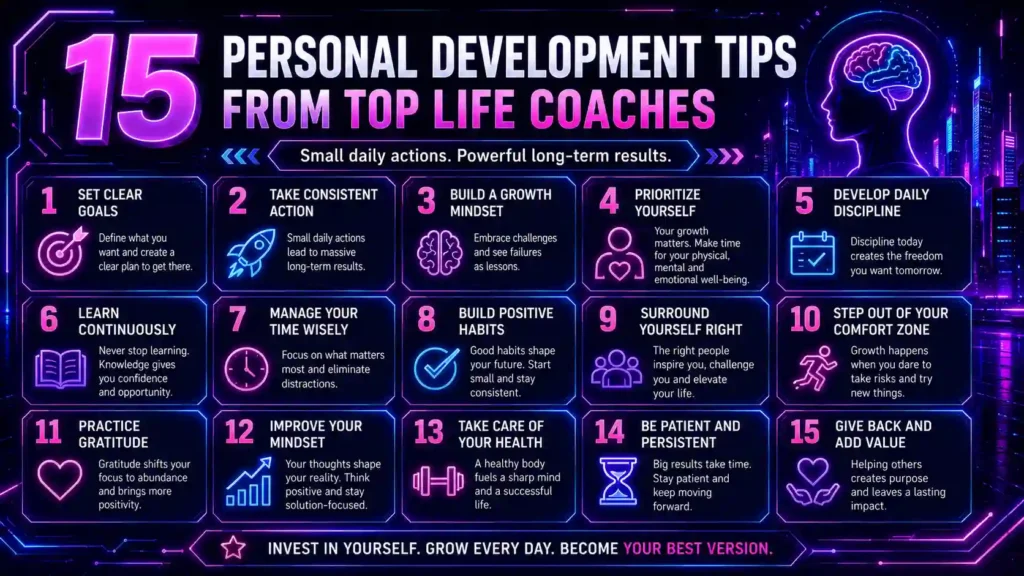
1. Get Radically Clear on What You Actually Want
Most coaches start every session the same way: by asking what the client actually wants—not what they think they should want. Vague goals (“be happier,” “be more successful”) rarely lead to action. Clear, specific goals do.
Try this: Write down one specific outcome you want in the next 90 days, not the next 10 years.
2. Focus on Identity, Not Just Outcomes
A recurring theme across modern coaching and habit research—popularized in books like Atomic Habits—is that lasting change comes from shifting identity, not chasing results. Instead of “I want to exercise more,” the shift becomes “I’m becoming someone who moves daily.”
This single reframe is one of the most repeated personal development tips because it removes the pressure of instant results.
3. Set SMART Goals, Not Wishes
Coaches consistently push clients toward specific, measurable, achievable, relevant, and time-bound goals. “I want to grow” becomes “I want to read 12 books this year, one per month.” Specificity creates accountability.
4. Build a Non-Negotiable Morning Routine
Almost every high-performance coach emphasizes the first hour of the day. It doesn’t need to be elaborate—water, a few minutes of movement, and a moment of quiet reflection are enough to set a consistent tone before the day gets noisy.
5. Use Habit Stacking to Build Consistency
Attaching a new habit to an existing one makes it far easier to remember and repeat. For example, “After I pour my morning coffee, I’ll write down three priorities for the day.” This is one of the simplest personal development habits coaches teach because it requires no extra willpower.
6. Track Progress Weekly, Not Daily
Daily tracking often creates pressure and guilt. Coaches frequently recommend a short weekly review instead — five minutes to ask: What worked? What didn’t? What’s one adjustment for next week?
7. Challenge Limiting Beliefs Directly
A major part of coaching work involves identifying the quiet stories people tell themselves—”I’m not disciplined” and “I always quit halfway.” Coaches teach clients to question these beliefs rather than accept them as fact.
Try this: Next time a limiting belief shows up, ask, “Is this actually true, or just familiar?”
8. Practice Self-Awareness Through Journaling
Journaling remains one of the most recommended self-improvement tools among coaches because it turns vague emotions into clear, workable thoughts. Even five minutes a day builds noticeable self-awareness over a few weeks.
9. Build Emotional Intelligence Before Building Skills
Coaches often prioritize emotional intelligence — the ability to recognize and manage your own emotions and read others accurately — before diving into productivity or leadership skills. Without it, technical skills tend to underperform in real-world situations.
10. Choose Discipline Over Motivation
Motivation fades. Every coach knows this. That’s why the advice consistently shifts toward building discipline through small, boring, repeated actions rather than waiting to “feel ready.”
This is one of the clearest personal development tips that actually work because it removes reliance on mood or energy levels.
11. Set Boundaries Without Guilt
Many coaching sessions revolve around boundaries—with work, with family, with time. Coaches teach that saying no to the wrong commitments is what creates space for meaningful growth.
12. Find an Accountability Partner or System
Accountability is one of the strongest predictors of follow-through. Coaches often recommend pairing with a friend, mentor, or tracking system so progress isn’t relying purely on internal motivation.
13. Practice Gratitude to Reframe Setbacks
A short daily gratitude habit is a common coaching recommendation — not as a feel-good exercise, but as a practical tool to reduce negativity bias and make consistency easier during difficult weeks.
14. Invest in Continuous Learning
Coaches consistently push clients toward lifelong learning — reading, courses, or mentorship — because staying adaptable is one of the biggest predictors of long-term personal and career growth. Platforms like Coursera offer accessible ways to build new skills alongside personal development work.
15. Revisit Your “Why” Regularly
When motivation dips — and it always does — coaches redirect clients back to their core reason for pursuing change. A clear sense of purpose is often what separates people who quit from people who transform.
If you want to go deeper into practical exercises tied to these ideas, this list of self-development activities offers hands-on ways to put them into practice.
How to Apply These Tips Without Hiring a Coach
You don’t need a certified life coach to benefit from these frameworks. Here’s a simple way to apply them on your own:
- Pick 2–3 tips, not all 15. Trying everything at once leads to burnout, not growth.
- Attach each tip to an existing routine. Use habit stacking so new behaviors have a natural trigger.
- Review weekly. A short check-in keeps you honest without creating daily pressure.
- Expect setbacks. Missing a day isn’t failure — coaches treat it as data, not defeat.
This mirrors how real coaching relationships work, minus the price tag.
Common Mistakes People Make With Personal Development Advice
- Trying to implement all 15 tips at once instead of choosing a focused starting point.
- Copying someone else’s exact routine without adjusting it to their own schedule or personality.
- Measuring growth only by outcomes instead of noticing identity-level shifts.
- Quitting after one bad week, when consistency is actually built over months.
- Waiting for motivation instead of building small systems that work without it.
Real-World Example: How Coaching Advice Plays Out
Consider someone struggling with consistency at work. Instead of forcing a two-hour focus block immediately, a coach-informed approach looks like this: start with 25 focused minutes (identity-based habit), track it weekly instead of daily, and stack it after an existing routine like morning coffee.
Within a month, the habit feels automatic — not because motivation increased, but because the system made consistency easier than inconsistency. This is the same principle behind personality development — small, repeated actions shape identity over time far more than occasional bursts of effort.
FAQs
What do life coaches recommend for personal development?
Most coaches recommend starting with clarity—a specific goal, one or two supporting habits, and a simple weekly review system—rather than trying to overhaul everything at once.
What is the number one tip life coaches give?
Focus on identity, not just outcomes. Becoming “someone who shows up consistently” creates more lasting change than chasing a single result.
How do life coaches help with personal growth?
Coaches provide structure, accountability, and an outside perspective—helping clients identify blind spots and limiting beliefs they can’t easily see on their own.
Is hiring a life coach worth it for personal development?
It depends on your goals. Coaching accelerates progress through accountability and personalized feedback, but many of the core principles can be self-applied with consistency.
What’s the difference between a life coach and a therapist?
Therapists typically address mental health and past experiences, while life coaches focus on present goals, habits, and future-focused action steps.
How often should you meet with a life coach?
Many coaching relationships work on a weekly or biweekly basis, giving enough time to apply advice while maintaining accountability.
Conclusion: Start With One Tip, Not All 15
You don’t need a certified coach or a complete life overhaul to benefit from this advice. Pick one tip from this list, apply it consistently for two weeks, and build from there. That’s exactly how real coaching progress happens — one small, repeated action at a time.
If this guide was helpful, explore the full personal development guide for a deeper foundation or browse more practical strategies in the mindset, motivation, habits, and productivity categories on Rise By Inches. You can also learn more about the mission behind this content on the About page or reach out with any questions about starting your own growth journey.



Pingback: 20 Productivity Tools to Optimize Your Daily Workflow
Pingback: 50+ Best Skills to Learn Right Now to Boost Your Career
Pingback: Best Self Improvement Blogs (2026):Top Personal Growth Sites
Pingback: Personal Wellness Plan: How to Build Yours in 7 Days
Pingback: Self Improvement Plan: How to Build One That Actually Works
Pingback: How to Learn Anything Fast: Best Science-Backed Strategies
Pingback: Best Personality Characteristics:Definition,Types & Examples