
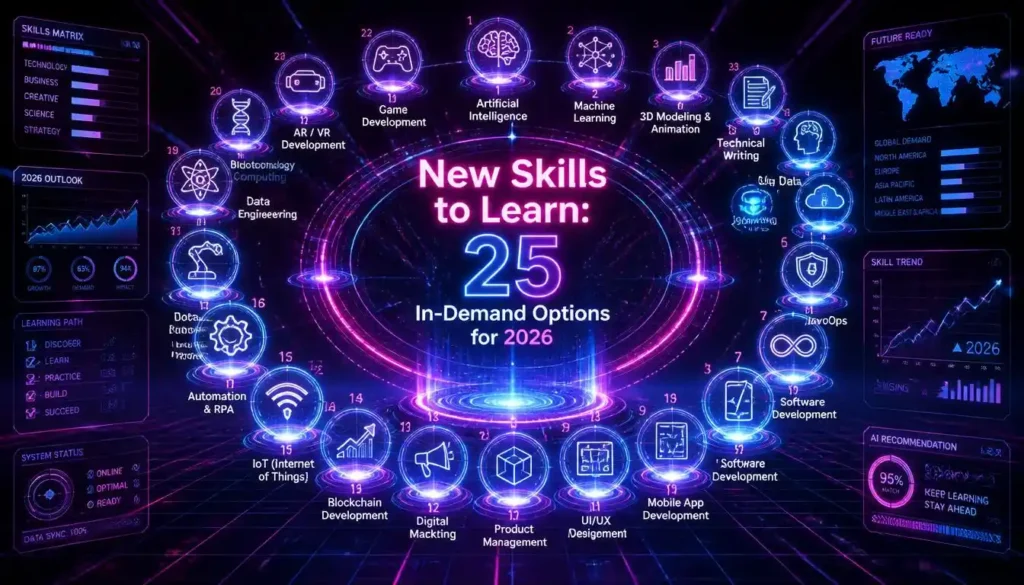

New Skills to Learn: 25 In-Demand Options for 2026
Job security doesn’t come from tenure anymore. It comes from relevance. The most in-demand skills for 2026 split roughly evenly between AI-adjacent technical abilities and human skills like communication, adaptability, and leadership — and the professionals landing offers right now are the ones who’ve built both sides of that equation, not just one.
What Are the Top 5 Most In-Demand Skills in 2026?
The five fastest-growing skills in 2026 are AI engineering, operational efficiency, AI business strategy, AI literacy, and conflict mitigation, according to LinkedIn’s Skills on the Rise report. AI engineering, operational efficiency, and AI business strategy topped the list of fastest-growing skills, alongside strong demand for leadership, executive communication, and financial operations. Soft skills aren’t an afterthought here — soft skills account for seven of the top ten spots on this year’s in-demand list, which tells you something important: technical fluency gets you noticed, but it’s the human skills that get you hired and promoted.
Here’s why this matters beyond one report. The World Economic Forum’s Future of Jobs Report 2025 projects that 39% of core job-market skills will be transformed by 2030. That’s not a distant prediction. That’s the next four years.
Will AI Replace Technical Skills in 2026?
No — AI is reshaping which technical skills matter, not eliminating the need for them. Demand is shifting away from routine execution and toward oversight, strategy, and judgment. Employers want an AI-ready workforce, but less than half of U.S. professionals feel adequately supported to advance their AI training, which is exactly the gap this list is built to help you close.
The 12 Tech and AI Skills Worth Learning Right Now

1. Prompt Engineering
Writing instructions that get consistent, high-quality output from AI models is now a distinct, teachable skill. It’s less about clever tricks and more about structured thinking — breaking a vague goal into precise, testable instructions.
2. AI Engineering
This goes beyond using AI tools. It means building, fine-tuning, and deploying AI-powered systems inside a real product or workflow. AI engineering currently sits at the top of LinkedIn’s fastest-growing skills list, and salaries reflect it.
3. AI Literacy
Not everyone needs to build AI systems. Everyone needs to understand what they can and can’t do. AI literacy — knowing where models hallucinate, where bias creeps in, when to trust output and when to verify it — sits at the top of the technical skills list for 2026.
4. Data Analytics
Turning raw numbers into a decision is a durable skill regardless of which AI tools rise or fall. Companies still need someone who can look at a dataset and say what it actually means for the business.
5. Python
Still the default language for data work, automation, and AI tooling. If you’re only learning one programming language this year, this is the safe bet.
6. Cybersecurity
As more operations move to AI-assisted, cloud-based systems, the attack surface grows with it. Security professionals who understand both traditional threats and AI-specific vulnerabilities are in short supply.
7. Automation Workflows
Robotic process automation and workflow orchestration tools let non-engineers automate repetitive tasks. This is a high-leverage skill for anyone in operations, finance, or admin-heavy roles.
8. Cloud Infrastructure
AWS, Azure, and Google Cloud fluency remains foundational. More companies are moving operations to the cloud, and demand for cloud-proficient professionals keeps growing, especially around deployment and migration.
9. Vibe Coding
Using AI assistants to generate, debug, and iterate on code through natural-language prompts rather than manual syntax. It’s lowering the barrier to entry for building software — useful for founders, PMs, and career switchers alike.
10. DevOps
Bridging development and operations, with a growing overlap into AI model deployment and monitoring. Companies scaling AI products need people who can keep those systems running reliably.
11. Machine Learning Fundamentals
You don’t need a PhD to be useful here. Understanding how models are trained, evaluated, and where they break down makes you a far more effective collaborator on any AI-adjacent team.
12. Financial Data Analysis
Companies want professionals who can turn financial data into decisions — budgeting, forecasting, and cash reporting skills that translate numbers into direction rather than just dashboards.
The 13 Human Skills Employers Are Actually Hiring For
13. Emotional Intelligence
Despite the rise of automation, human interaction remains essential — recognizing and managing emotions, both your own and others’, underpins strong workplace relationships. This isn’t soft in the dismissive sense. It’s a measurable predictor of team performance.
14. Conflict Mitigation
Disagreement is unavoidable in any team scaling fast or navigating change. The ability to de-escalate, mediate, and find workable middle ground is now explicitly tracked as a top-growth skill.
15. Public Speaking
Whether it’s a client pitch or an internal town hall, the ability to explain complex ideas clearly, out loud, under pressure, still separates people who get promoted from people who stay technically excellent but invisible.
16. Strategic Thinking
Seeing three moves ahead instead of reacting to what’s directly in front of you. This is the skill that turns a good individual contributor into someone trusted with ambiguous, high-stakes decisions.
17. Cross-Cultural Intelligence
Distributed teams span time zones, cultures, and communication norms. Professionals who can navigate that without friction are disproportionately valuable in remote-first companies.
18. Adaptability
Given that a third of core skills are shifting by 2030, the actual skill isn’t any single competency — it’s the capacity to learn the next one quickly.
19. Change Management
Formally guiding a team or organization through a transition — new tools, new structure, new leadership — without losing morale or output along the way.
20. Leadership and Talent Development
Leadership, mentorship, and talent development are skills that humanize the digital experience, helping teams thrive amid transformation. This shows up on every in-demand list, every year, for a reason.
21. Executive and Stakeholder Communication
Translating technical or operational detail into language a non-technical stakeholder can act on. This alone can be the difference between a project getting funded or shelved.
22. Risk and Compliance Management
Risk and compliance management is showing high demand as companies scale AI and other new technologies responsibly, particularly in regulated industries.
23. Business Development and Go-to-Market Strategy
Professionals who can grow revenue through account development and go-to-market strategy are increasingly valued, especially at companies expanding into new markets or product lines.
24. Data-Driven Problem Solving
Analyzing information to identify opportunities, mitigate risk, and reach sensible conclusions is critical in any field — this spans forecasting, diagnostics, and reporting, not just formal data science roles.
25. Time Management
Unglamorous, but foundational. Without solid time management, results suffer regardless of how skilled you otherwise are — setting daily priorities and minimizing distractions is still a competitive advantage.
How Can Career Switchers Learn In-Demand Skills Fast?
Career switchers move fastest by picking one technical skill and one human skill to develop in parallel, rather than trying to learn everything at once. Stacking skills — what LinkedIn calls being a “skill stacker,” someone who builds capability across multiple in-demand clusters at once — outperforms chasing a single hot skill in isolation.
A practical approach:
- Pick one AI-adjacent skill (prompt engineering or data analytics are the fastest to get functional in).
- Pick one human skill you’re weakest in, and treat it as seriously as the technical one.
- Use free or low-cost structured courses rather than scattered YouTube videos — completion rates matter more than exposure.
- Apply the skill inside your current job before you ever put it on a resume. Employers trust demonstrated use over a certificate alone.
If you’re not sure where your own gaps sit, our growth mindset guide is a useful starting point — most people underestimate how learnable “soft” skills like conflict mitigation and executive communication actually are.
What Are High-Income Skills I Can Learn Online?
High-income skills are capabilities that command premium pay because they’re in short supply relative to demand — currently AI engineering, cloud infrastructure, cybersecurity, and financial data analysis lead that list. Most of these can be learned through structured online programs without a traditional degree, though portfolio proof of applied work matters more than the credential itself.
Which Hard Skills Pay the Highest Salaries in 2026?
AI engineering, cybersecurity, and cloud infrastructure currently command the highest salaries among hard skills, driven by a shortage of qualified candidates relative to employer demand. Nearly two-thirds of tech leaders report it has become more complex to hire skilled professionals compared to a year ago, with AI and machine learning topping the list of hardest-to-find skills. Scarcity, not just usefulness, is what drives the premium here.
How Rise By Inches Helps You Build the Right Skill Stack
Picking a skill from a list is the easy part. Actually building it into a habit, without abandoning it three weeks in, is where most people stall. That’s the exact gap Rise By Inches was built to close. Our skills-to-learn resource walks through a broader, evergreen set of options beyond this year’s trend list, paired with realistic timelines for building each one. And because skills-based hiring is now used by 70% of employers, up from 65% the year before, our career development plan example shows exactly how to document new skills in a way hiring managers actually notice.
If motivation is the real obstacle — not information — our piece on staying motivated at work tackles the follow-through problem directly, and our productivity tools roundup covers the tracking systems that keep a new skill from quietly disappearing off your to-do list.
Frequently Asked Questions
What are the top 5 most in-demand skills in 2026?
AI engineering, operational efficiency, AI business strategy, AI literacy, and conflict mitigation top the current lists from major hiring platforms.
Will AI replace technical skills in 2026?
No. AI is shifting demand toward oversight, strategy, and integration skills rather than eliminating the need for technical expertise.
What are high-income skills I can learn online?
AI engineering, cloud infrastructure, cybersecurity, and financial data analysis are among the highest-paying skills currently learnable through online, non-degree programs.
Which hard skills pay the highest salaries in 2026?
AI engineering, cybersecurity, and cloud infrastructure lead on salary, largely due to a persistent shortage of qualified candidates.
How can career switchers learn in-demand skills fast?
By pairing one technical skill with one human skill and applying both inside a current role before adding them to a resume, rather than trying to learn everything at once.
Do soft skills still matter if I already have strong technical skills?
Yes — current data shows soft skills making up the majority of top in-demand slots, meaning technical skill alone rarely accounts for who gets hired or promoted.
Final Thoughts
The skills gap in 2026 isn’t really about AI outpacing people. It’s about people trying to learn everything at once and mastering nothing. Pick one technical skill. Pick one human skill. Build both in parallel, apply them where you already work, and let the resume update come later.
Ready to build a skill-development plan that actually sticks? Book a seat at Advance Services, offered by Rise By Inches, and turn this list into a plan with real deadlines attached.



Pingback: Best Online Courses for Skill Development, Ranked (2026)
Pingback: 20 Real Personal Development Examples & Growth Stories
Pingback: How to Learn Anything Fast: Best Science-Backed Strategies
Pingback: How Can You Develop Personally? Proven Strategies for Growth