
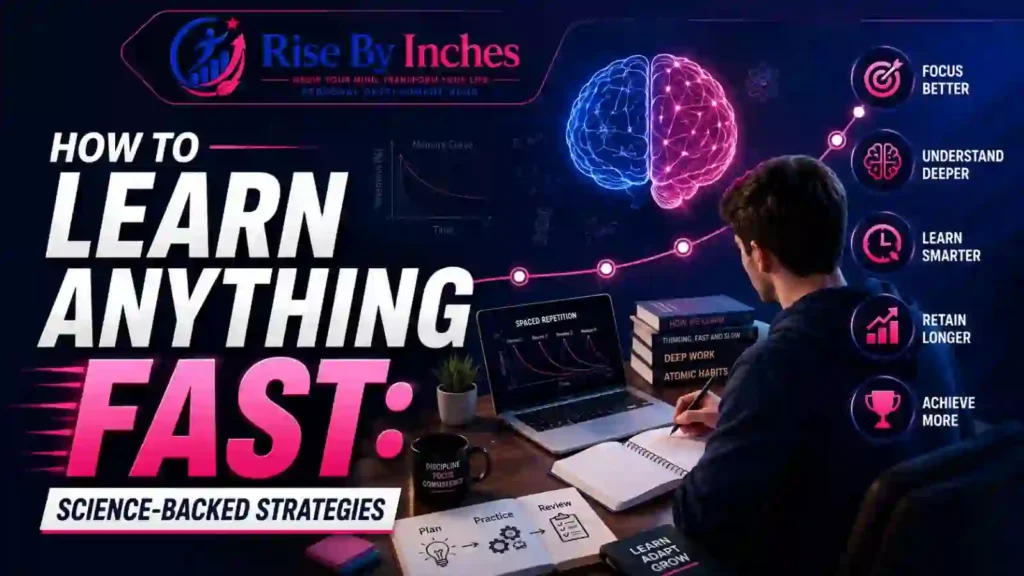

If you want to learn anything fast, forget the way you were taught to study in school — reread the notes, highlight the textbook, hope it sticks.None of that reflects how memory actually works. Cognitive scientists have spent over a century mapping what genuinely speeds up learning, and the answer has almost nothing to do with rereading. This guide breaks down the research-backed methods — active recall, spaced repetition, the Feynman Technique, interleaving, and deliberate practice — and shows you exactly how to apply them starting today.
How Do You Learn Anything Fast? What the Science Says
Learning speed comes down to how efficiently your brain moves information from working memory into long-term memory. Working memory can only hold a handful of items at once — roughly four chunks of information, according to cognitive load research. Everything you “learn fast” is really information that got converted into a stable long-term schema before working memory ran out of room.
Three concepts explain almost every fast-learning technique that works:
- Neuroplasticity — your brain physically rewires itself in response to repeated, effortful practice, strengthening the neural pathways tied to a skill or fact
- Cognitive load — the amount of mental effort your working memory is handling at any given moment; overload it and nothing sticks
- Metacognition — your ability to accurately judge what you do and don’t actually know, which is usually worse than people assume
Once you understand these three forces, every technique below is really just a different lever for pulling on one of them.
What Is Active Recall and Why Does It Beat Rereading?
Active recall — testing yourself on material instead of rereading it — produces better long-term retention than passive review. Also called retrieval practice, this is one of the most heavily replicated findings in learning science. Closing the book and forcing your brain to pull information out of memory strengthens that memory trace far more than simply looking at the answer again.
Retrieval practice research reviewed by the National Institutes of Health shows the effect is strong and consistent enough that entire fields, including medical education, have restructured how they train students around it. The mechanism is straightforward: rereading creates a false sense of familiarity (“I recognize this, so I must know it”), while retrieval forces your brain to actually reconstruct the information, which is what builds durable memory.
How to apply it:
- Close your notes and write down everything you remember about a topic before checking your source
- Turn every reading session into self-generated questions instead of highlighted sentences
- Use blank-page recall: write a topic at the top of a page and dump everything you know underneath it, then compare to your notes
If you’re building any consistent study habit, pairing active recall with the routines in structuring your daily tasks makes it much easier to keep the habit alive past week one.
How Does Spaced Repetition Prevent the Forgetting Curve?
Spacing your review sessions out over increasing intervals dramatically outperforms cramming for long-term retention. German psychologist Hermann Ebbinghaus documented this back in 1885 with his forgetting curve, showing that people lose a large share of new information within the first day unless it gets reinforced. A large meta-analysis covering 254 separate studies later confirmed that distributed practice beats massed practice (cramming) by a wide margin.
The forgetting curve isn’t flat — it’s steep. Left alone, you can lose roughly half of newly learned material within hours. But each well-timed review flattens the curve a little more. After several spaced reviews, the material becomes far more resistant to being forgotten, according to research published in the Annals of Otology, Rhinology & Laryngology on spaced-effect learning.
A practical spacing schedule that mirrors what the research supports:
| Review Number | Timing After Initial Learning |
| Review 1 | Within 1 hour |
| Review 2 | Within 24 hours |
| Review 3 | Within 1 week |
| Review 4 | Within 1 month |
Apps like Anki and Quizlet automate this schedule using an algorithm, so you don’t have to calculate intervals by hand — you show up and answer the cards it queues for you.
What Is the Feynman Technique and How Do You Use It?
The Feynman Technique forces you to explain a concept in plain language, and the gaps you hit while explaining reveal exactly what you don’t actually understand. Named after physicist Richard Feynman, it’s less a memorization trick and more a diagnostic tool — it exposes shallow understanding before an exam or a real-world situation does it for you.
The four steps:
- Choose a concept and write its name at the top of a blank page
- Explain it as if teaching a twelve-year-old — plain words, no jargon, no borrowed textbook phrasing
- Identify where you got stuck, vague, or had to reach for jargon — that’s the exact spot where your understanding is thin
- Go back to the source material for those specific gaps, then simplify your explanation again until it flows without hesitation
This technique pairs naturally with a growth mindset approach to learning — the entire method depends on treating confusion as useful data instead of a personal failure.
Why Does Interleaving Beat Blocked Practice?
Mixing different but related topics or problem types within a single study session builds more flexible, transferable knowledge than studying one topic in isolation for a long block of time. This is counterintuitive — blocked practice (drilling one skill repeatedly before moving to the next) feels more productive in the moment, but interleaving consistently produces better performance on delayed tests.
The reason comes down to discrimination: when you interleave, your brain has to actively figure out which strategy or concept applies to which problem, rather than running the same pattern on autopilot. That extra effort is what cognitive scientists call a “desirable difficulty” — it feels harder in the session but pays off in retention.
Simple ways to interleave:
- Instead of doing 20 practice problems of the same type, mix three or four problem types in the same session
- Rotate between two or three related subtopics every 20–30 minutes rather than finishing one before starting the next
- When studying a language, mix vocabulary, grammar, and listening practice in the same sitting instead of dedicating full sessions to each
How Can You Reduce Cognitive Load While Studying?

Reducing unnecessary mental clutter frees up working memory for actual learning, which is the entire premise behind cognitive load theory. Psychologist John Sweller’s research, cited widely in instructional design including a government-published review from the New South Wales education department, splits mental effort into three types: intrinsic load (the natural difficulty of the material), extraneous load (unnecessary complexity from poor formatting or distractions), and germane load (the productive effort of actually building understanding).
Fast learners aren’t necessarily smarter — they’re often just better at stripping out extraneous load so more working memory capacity goes toward germane load. Practical ways to do that:
- Break complex topics into smaller chunks before attempting to combine them
- Eliminate multitasking during study sessions — task-switching taxes working memory even when it feels efficient
- Use worked examples before independent practice on unfamiliar material, then fade the scaffolding as competence builds
- Remove visual clutter from notes and study materials — dense, disorganized pages increase extraneous load without adding any learning value
If you’re managing this alongside a busy schedule, the strategies in overcoming procrastination and organizing your day directly support keeping cognitive load manageable, since a chaotic schedule is itself a source of extraneous load.
What Role Does Deliberate Practice Play in Skill Acquisition?
Deliberate practice — focused, feedback-driven effort just beyond your current ability level — is what separates fast skill acquisition from years of unproductive repetition. Psychologist K. Anders Ericsson’s research, summarized in his Harvard Business Review article “The Making of an Expert,” found that expert-level performers across surgery, chess, music, and writing consistently engaged in practice specifically designed to push past their current limits, rather than simply repeating what they already knew how to do.
The difference between deliberate practice and ordinary practice comes down to three elements:
- A specific, narrow goal (not “get better at Spanish,” but “correctly conjugate irregular past-tense verbs”)
- Immediate, honest feedback on what went wrong
- Repetition at the edge of your ability, adjusted continuously as you improve
This is why passive hours — reading a textbook cover to cover, watching tutorial videos without pausing to apply anything — rarely translate into fast skill gains. The practice has to be structured, uncomfortable, and corrected in real time.
What Tools Can Speed Up Science-Backed Learning?
The right tools automate the scheduling and structure that spaced repetition and active recall require, removing the manual effort of tracking what to review and when.
| Tool | Best For |
| Anki | Algorithm-driven spaced repetition flashcards |
| Quizlet | Quick flashcard creation and group study modes |
| Obsidian | Networked note-taking that mirrors how schemas connect in memory |
| Notion | Structuring a personal learning system, tracking progress and goals |
| Pomodoro Technique | Time-boxing focused study blocks (typically 25 minutes) to manage cognitive fatigue |
None of these tools teach you anything by themselves — they remove the friction that normally causes people to abandon evidence-based study habits within the first week.
How Do You Build a Daily Learning System?
A sustainable fast-learning system combines a fixed time block, a spaced review queue, and a way to track what’s actually sticking versus what only feels familiar. Most people fail to learn quickly not because the techniques are complicated, but because they never turn them into a repeatable daily structure.
A simple framework:
- Time-block a consistent daily or near-daily session — even 25–30 focused minutes outperforms irregular multi-hour sessions
- Start each session with retrieval of material from previous sessions before introducing anything new
- Introduce new material in small chunks, explained in your own words using the Feynman approach
- Log what you struggled to recall and feed it back into your spaced repetition schedule
- Review your system weekly — this is where personal development tips around consistency and habit-tracking make the biggest difference
This kind of structure matters whether you’re picking up new skills for personal growth or working through a formal professional development plan at work — the underlying cognitive mechanics don’t change based on context.
Frequently Asked Questions
What is the fastest scientifically proven way to learn?
Active recall combined with spaced repetition consistently outperforms other single techniques in controlled studies. Testing yourself on material at increasing intervals builds stronger, more durable memory than any passive review method.
How does active recall improve long-term retention?
It forces your brain to reconstruct information from memory rather than simply recognizing it on a page, which strengthens the neural pathway associated with that memory far more than rereading does.
What are the 4 steps of the Feynman Technique?
Choose a concept, explain it in plain language as if teaching a beginner, identify where your explanation breaks down, then return to the source material to fill those specific gaps.
Why is cramming ineffective according to cognitive science?
Cramming relies on massed practice, which research shows produces weaker long-term retention than distributing the same amount of study time across spaced sessions, sometimes by a margin of 10–30%.
How many hours a day can the brain effectively learn new skills?
There’s no universal number, but research on deliberate practice suggests quality and focus matter more than raw hours — short, high-effort sessions with real feedback outperform long, unfocused ones.
Do I need special apps to use these techniques?
No. Pen and paper work fine for active recall and the Feynman Technique. Apps like Anki mainly help automate the scheduling math behind spaced repetition, which is convenient but not required.
Start Learning Faster Today
Fast learning isn’t a personality trait — it’s a set of testable techniques that anyone can apply starting with the next thing they study. Pick one method from this guide, whether that’s active recall, spacing your reviews, or running a new concept through the Feynman Technique, and build it into tomorrow’s study session before adding another. For more on turning techniques like these into lasting habits, explore Rise by Inches’ guide to self-improvement plans and start building a system that actually compounds over time.



Pingback: What Are the three Types of Personal Growth? Best Guide 2026