
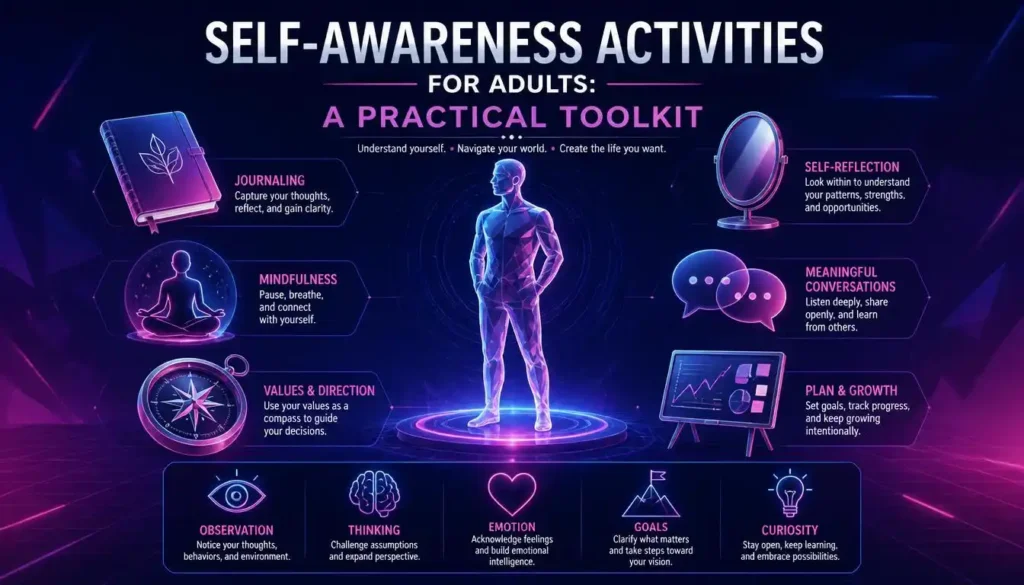

Self-awareness is the ability to clearly see your own thoughts, emotions, values, and behavior patterns — and understand how they shape your actions and relationships. It sounds simple, but most adults go through entire decades on autopilot, reacting to life instead of understanding themselves within it.
The good news is that self-awareness isn’t a fixed trait you either have or don’t — it’s a skill you build through practice. This toolkit walks through practical, real-life self-awareness activities for adults, backed by psychological frameworks, that you can start using today, whether you have five minutes or an hour.
What Is Self-Awareness?

Self-awareness is the conscious understanding of your own character, feelings, motives, and desires. It’s what allows you to notice a reaction as it happens instead of realizing it after the damage is done — the pause between feeling irritated and snapping at someone, or the recognition that you’re procrastinating out of fear rather than laziness.
Psychologist Tasha Eurich’s research on self-awareness identifies two distinct types that work together:
- Internal self-awareness — how clearly you understand your own values, passions, aspirations, and emotional patterns
- External self-awareness — how accurately you understand how others perceive you
Most people are strong in one and weak in the other. Someone can have deep internal clarity about their values but be completely unaware of how their tone comes across in meetings. True self-awareness requires both.
| Internal Self-Awareness | External Self-Awareness | |
| Focus | Your own values, emotions, patterns | How others perceive you |
| Built through | Journaling, reflection, solitude | Feedback, 360-degree reviews, honest conversations |
| Common blind spot | Overestimating your own consistency | Assuming others see you the way you see yourself |
| Example | Realizing you avoid conflict because of past experiences | Learning that colleagues find your directness abrasive, not confident |
If you want the bigger picture of how this fits into overall growth, our personal development guide covers how self-awareness anchors nearly every other personal development skill.
Why Self-Awareness Matters in Adulthood
Self-awareness isn’t just an abstract psychological concept — it directly affects your relationships, career, and mental health.
In relationships, understanding your own triggers helps you avoid projecting old wounds onto new people. Self-aware adults can say, “I’m reacting strongly because this reminds me of something else,” rather than blaming their partner for the intensity of their response.
At work: Self-awareness improves leadership, collaboration, and decision-making. Leaders who understand their own blind spots ask for feedback instead of assuming their perspective is complete.
For mental health: Recognizing emotional patterns early — like noticing anxiety building before it spirals — makes it far easier to respond constructively rather than being overwhelmed.
For personal growth: You can’t change a pattern you can’t see. Self-awareness is the starting point for every behavior change, habit shift, or goal you’ll ever pursue.
Our article on why personal development matters explores this connection between self-understanding and long-term growth in more depth.
What Are 5 Examples of Self-Awareness Activities for Adults?
Before diving into the full toolkit, here’s a quick answer: journaling with reflective prompts, the Johari Window exercise, body-emotion scanning, tracking emotional triggers, and requesting structured feedback from trusted people are five of the most effective self-awareness activities for adults. Each targets a different layer of self-understanding — thoughts, blind spots, physical sensations, patterns, and outside perspective.
The Practical Self-Awareness Toolkit
Each activity below includes how to do it, the time required, and the key takeaway — so you can pick what fits your schedule and start immediately.
Activity 1: The Daily Thought Log
How to do it: At the end of each day, write down one situation that triggered a strong emotional reaction. Note what happened, what you felt, and what thought ran through your mind right before the feeling hit.
Time required: 5–10 minutes daily
Key takeaway: Most emotional reactions are driven by an automatic thought, not the event itself. Seeing this pattern in writing, repeatedly, makes it easier to catch in the moment.
Activity 2: The Johari Window Exercise
How to do it: The Johari Window divides self-knowledge into four quadrants: what you know about yourself and others know too, what you know but others don’t, what others see but you don’t, and what neither of you know yet. Ask three trusted people to describe you in a few words, then compare their answers to your own self-description.
Time required: 30–45 minutes
Key takeaway: The gap between how you see yourself and how others see you reveals your external blind spots — often the most valuable insight in the entire exercise.
Activity 3: Body-Emotion Scanning
How to do it: Sit quietly and scan your body from head to toe, noticing any tension, tightness, or discomfort. Ask what emotion might be connected to that physical sensation — a tight chest is often anxiety, clenched fists often frustration.
Time required: 5 minutes
Key takeaway: Emotions live in the body before they reach conscious thought. Somatic awareness often catches feelings that pure mental reflection misses entirely.
Activity 4: The Emotional Trigger Inventory
How to do it: List the last five times you felt an intense negative emotion. For each, write down what happened right before, what you felt, and what you needed in that moment but didn’t get.
Time required: 20 minutes
Key takeaway: Triggers are rarely random — they usually stem from unmet needs such as respect, control, or security. Naming the need behind the reaction reduces its power over you.
Activity 5: Personal Values Inventory
How to do it: Write a list of 10–15 values that matter to you (honesty, freedom, achievement, connection, security). Narrow it down to your top five, then reflect on whether your daily choices actually align with them.
Time required: 20–30 minutes
Key takeaway: Misalignment between stated values and daily behavior is one of the most common sources of low-grade dissatisfaction in adulthood.
Activity 6: The Life Timeline Exercise
How to do it: Draw a horizontal line representing your life so far. Mark major turning points — both positive and painful — above and below the line based on emotional impact.
Time required: 30–60 minutes
Key takeaway: Seeing your life visually often reveals recurring patterns — repeated relationship dynamics, career choices, or emotional responses — that are harder to spot in day-to-day thinking.
Activity 7: Mindful Sensory Check-In
How to do it: Pause and name five things you see, four things you hear, three things you can physically feel, two things you smell, and one thing you taste. This is the well-known 5-4-3-2-1 grounding technique.
Time required: 2–3 minutes
Key takeaway: This interrupts spiraling thoughts by anchoring attention in the present moment, making space for clearer self-observation.
Activity 8: Requesting 360-Degree Feedback
How to do it: Ask a small group — a partner, a close friend, a coworker, a family member — the same question: “What’s one thing I do that you think I’m not fully aware of?”
Time required: Ongoing, low daily effort
Key takeaway: External self-awareness can’t be built alone. Direct, specific questions get far more useful answers than a vague “be honest with me.”
Activity 9: The Proust Questionnaire
How to do it: Answer a set of reflective personality questions (originally popularized by Marcel Proust) such as “What is your idea of perfect happiness?” and “What do you consider your greatest achievement?”
Time required: 20 minutes
Key takeaway: Answering questions you wouldn’t normally ask yourself often surfaces values and desires you hadn’t consciously articulated.
Activity 10: Weekly Wheel of Life Review
How to do it: Draw a circle divided into life categories — career, health, relationships, finances, personal growth — and rate your satisfaction in each area from 1 to 10. Repeat weekly and track the shifts.
Time required: 10 minutes weekly
Key takeaway: Visualizing satisfaction across categories highlights which areas of life are quietly being neglected.
For more structured daily practices like these, our roundup of self-development activities pairs well with this toolkit.
Internal vs. External Self-Awareness: Which Should You Build First?
Both matter, but they require different tools:
- Build internal self-awareness through: journaling, solitude, meditation, values inventories, and thought logs
- Build external self-awareness through: feedback requests, the Johari Window, honest conversations with people who won’t just tell you what you want to hear
According to research highlighted by Harvard Business Review, people who are strong in internal self-awareness are not automatically strong in external self-awareness — the two often develop independently, and deliberately training both produces far better results than focusing on just one.
How Can an Adult Practice Self-Awareness Daily?
The simplest daily practice is a two-minute morning or evening check-in: ask yourself what you felt today, when you felt it most strongly, and what triggered it. Pairing this with one weekly practice — like the Wheel of Life review or a values check — builds both moment-to-moment awareness and bigger-picture clarity over time.
Consistency matters more than intensity. Five minutes daily builds more lasting self-awareness than one long session per month.
How Do You Identify Your Personal Emotional Triggers?
Start by tracking your last several strong emotional reactions and looking for patterns in what preceded them — a tone of voice, a specific type of criticism, a feeling of being ignored. Most triggers connect to a core unmet need, such as respect, control, or belonging, and naming that need directly reduces the trigger’s intensity over time.
Common Barriers to Self-Awareness
Even with the right activities, a few obstacles tend to get in the way:
- Constant busyness — self-awareness requires stillness, and a packed schedule leaves no room for reflection
- Fear of what you’ll find — some people avoid introspection because they’re afraid of confronting uncomfortable truths
- Surrounding yourself only with people who agree with you — this blocks external self-awareness because no one challenges your self-perception
- Confusing rumination with reflection — replaying a situation with anxiety isn’t the same as objectively examining it; reflection asks “what can I learn,” rumination just repeats the pain
Building better structure into your day can directly address the first barrier. Our guide on structuring daily tasks shows how a more intentional schedule creates space for this kind of reflection.
Self-Awareness in Group Settings
Self-awareness activities aren’t limited to solo journaling. In team or workshop settings, try:
- Values-sharing circles — each person shares one core value, and a moment it showed up in their life
- Peer feedback rounds — structured, time-boxed feedback where each person gives one honest observation to another
- Group Johari Window exercises — teams describe each other anonymously, then compare against self-perception
These formats work particularly well in leadership development or team-building contexts, where shared vulnerability tends to accelerate trust.
Why Is Self-Awareness Important in Adulthood?
Self-awareness is important in adulthood because it’s the foundation for intentional change — you cannot adjust a behavior, heal a pattern, or align your life with your values if you can’t first see them clearly. Without it, adults tend to repeat the same relationship dynamics, career frustrations, and emotional reactions indefinitely, often without understanding why.
Building Self-Awareness Into Long-Term Habits
Self-awareness isn’t built in a single weekend retreat — it’s built through small, repeated practices:
- A daily two-minute emotional check-in
- A weekly values or satisfaction review
- A monthly conversation asking for honest feedback
- Regular journaling, even briefly, several times a week
This mirrors the same principle behind most sustainable change: small, consistent actions compound over time. Our list of 30 proven strategies to better yourself covers this same approach in more detail, and our productivity tools roundup can help you build the structure to stay consistent with these practices.
Developing self-awareness is also closely tied to broader emotional and interpersonal skills. Our guide to essential skills to learn includes several that reinforce this same foundation.
According to the American Psychological Association, self-reflective practices are strongly associated with improved emotional regulation and better interpersonal functioning over time — reinforcing that this isn’t just a personal development trend, but a well-supported psychological practice.
Frequently Asked Questions
What are 5 examples of self-awareness activities for adults?
Daily thought logging, the Johari Window exercise, body-emotion scanning, tracking emotional triggers, and requesting structured feedback from trusted people are five effective self-awareness activities for adults.
How can an adult practice self-awareness daily?
A short daily check-in — noticing what you felt, when, and why — combined with a deeper weekly reflection, like a values review, builds self-awareness over time.
What is the difference between internal and external self-awareness?
Internal self-awareness is understanding your own values, emotions, and motivations. External self-awareness is understanding how others actually perceive you. Both are necessary for a complete, accurate self-picture.
What are the best self-reflection tools for emotional intelligence?
Journaling, the Johari Window, emotional trigger inventories, and 360-degree feedback requests are among the most effective tools for building the self-reflection that underlies emotional intelligence.
How do you identify your personal emotional triggers?
Track recent strong emotional reactions, look for what preceded them, and identify the unmet need — such as respect or control — connected to each pattern.
Why is self-awareness important in adulthood?
It’s the foundation for intentional change. Without self-awareness, adults tend to repeat the same emotional and relational patterns without understanding why, making lasting growth much harder.
Final Thoughts
Self-awareness isn’t a destination you arrive at once and keep forever — it’s an ongoing practice of checking in, reflecting, and staying open to what you find, including the parts that are uncomfortable. The activities in this toolkit aren’t meant to be done all at once. Pick one or two, practice them consistently, and let the insight build gradually.
The adults who grow the most aren’t the ones who never struggle with self-understanding — they’re the ones who keep showing up to look honestly at themselves anyway.
If you’re ready to build on this foundation, explore our full personal development guide or browse our personal growth basics category for more practical tools. You can also learn more on our about page or get in touch with any questions.



Pingback: How to Develop a Growth Mindset: Step-by-Step Guide 2026
Pingback: Life Is Growth: How to Embrace Continuous Self-Improvement
Pingback: Professional Development Plan:Proven Step-by-Step Guide 2026
Pingback: Best Inner Work Guide 2026:How to Understand Yourself
Pingback: 20 Real Personal Development Examples & Growth Stories
Pingback: Why Taking a Mental Health Day: When, and How to Do It?
Pingback: Life Planning 101:How to Design Your Ideal Future best guide
Pingback: How to Be More Self-Aware: 10 Proven Exercises That Actually Work
Pingback: 60 Deep Quotes About Self to Spark Reflection & Growth
Pingback: 50 Best Self-Discovery Questions to Find Your True Self