

Most people set goals in January and abandon them by February. Top performers don’t have more willpower — they use better systems. This guide breaks down the exact goal-setting strategies used by high achievers, from OKRs to mental contrasting, so you can build goals that actually survive contact with a busy, distracted life.
What Is Goal Setting, and Why Do Most Approaches Fail?
Goal setting is the process of defining a specific, desired outcome and building a structured path to reach it. In theory, it’s simple. In practice, most goal setting fails not because people lack ambition, but because the goals are vague, disconnected from daily action, or too focused on outcomes instead of process.
Why do traditional goal setting methods fail for high achievers? Traditional goal setting often fails because it focuses only on the outcome (“get promoted,” “lose 20 pounds”) without building the daily systems, tracking mechanisms, or obstacle-planning needed to get there. High achievers succeed by pairing ambitious goals with disciplined execution frameworks.
This is where the real difference between amateurs and top performers shows up: not in the size of the goal, but in the structure behind it.
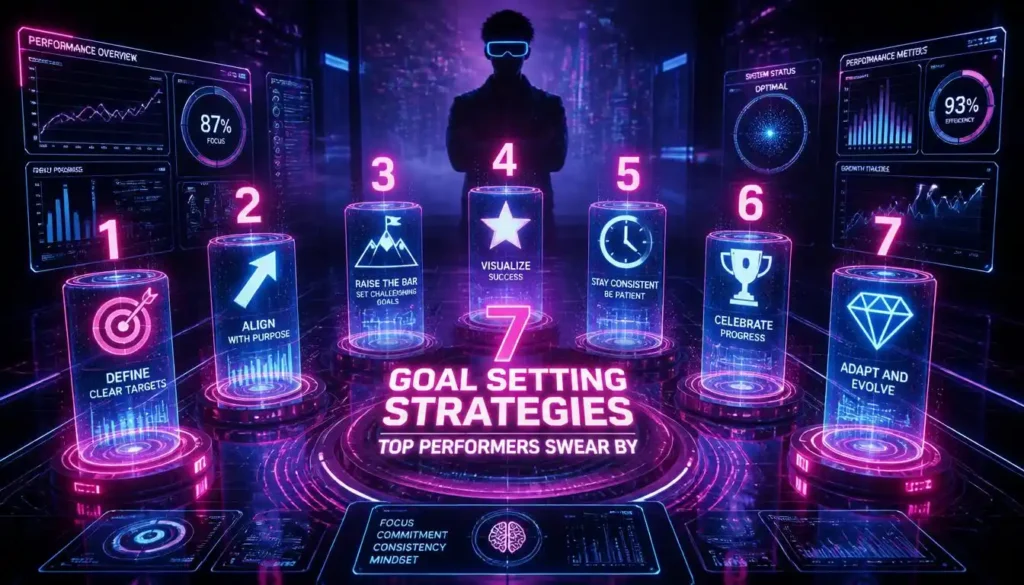
The 7 Goal Setting Strategies Top Performers Use

1. Focus on Lead Measures, Not Just Lag Measures
Borrowed from the 4 Disciplines of Execution (4DX) framework, this is one of the most important shifts in how high performers think about goals.
Lag indicators are the results you want — revenue, weight lost, a completed certification. Lead indicators are the daily behaviors that predict those results — calls made, workouts completed, hours studied.
Top performers track lead measures obsessively because lag measures update too slowly to guide daily behavior. If your goal is a $50,000 sales quarter, tracking “calls made per day” tells you today whether you’re on pace — the revenue number won’t tell you that until it’s too late.
Practical tip: For every outcome goal you set, identify one or two lead measures you can track daily or weekly.
2. Implement OKRs for Stretch Goals
OKRs (Objectives and Key Results) were popularized by Andy Grove at Intel and later championed by investor John Doerr in his book Measure What Matters. The framework structures goals into:
- Objective — a qualitative, ambitious statement of what you want to achieve
- Key Results — 2–4 measurable outcomes that indicate progress toward that objective
What is the difference between OKRs and SMART goals? SMART goals are typically used for individual, near-term, well-defined tasks, while OKRs are designed for ambitious, often stretch-level objectives at a team or organizational level, paired with measurable key results. SMART goals ask “is this specific and achievable?” OKRs intentionally allow for goals that might only be 70% achieved, because the stretch itself drives higher output.
Example OKR:
- Objective: Become a recognized expert in my field
- Key Result 1: Publish 12 in-depth articles this year
- Key Result 2: Speak at 3 industry events
- Key Result 3: Grow newsletter subscribers to 5,000
3. Use the WOOP Method for Mental Contrasting
Developed by psychologist Dr. Gabriele Oettingen, WOOP stands for Wish, Outcome, Obstacle, Plan.
What is the WOOP method in goal setting? WOOP is a goal-setting technique where you state your Wish, visualize the positive Outcome, honestly identify the Obstacle standing in your way, and create an if-then Plan to overcome it. Research on mental contrasting shows this combination of optimism and realism outperforms pure positive thinking alone.
Example:
- Wish: Finish my certification by year-end
- Outcome: More career options and higher pay
- Obstacle: I lose motivation after a long workday
- Plan: “If I feel too tired after work, then I’ll study for just 15 minutes instead of skipping entirely.”
This method works because it forces you to plan for resistance instead of assuming your motivation will stay constant.
4. Practice Backcasting Instead of Forward Planning
Backcasting means starting from your desired end result and working backward to identify the exact steps needed, rather than starting from today and hoping your daily actions eventually add up.
To backcast a goal:
- Define the end result clearly, with a date.
- Identify the milestone that must happen right before that result.
- Keep working backward until you reach an action you can take this week.
This strategy is especially useful for long-term goals, because it prevents the common trap of vague, distant ambitions with no clear near-term action.
5. Build Identity-Based Goals, Not Just Outcome Goals
Instead of only asking “what do I want to achieve,” top performers ask “who do I need to become to achieve this.” A goal like “write a book” is an outcome goal. “Become a person who writes daily” is an identity-based goal.
Identity-based goals tend to survive setbacks better because a missed day doesn’t threaten your entire goal — it’s just one data point against an identity you’re still building. This mindset overlaps closely with the deeper personal growth patterns covered in our personal development guide, which explores how identity shifts drive sustainable change.
6. Create a Visible Scoreboard and Cadence of Accountability
Top performers rarely rely on memory or motivation alone. They build:
- A visible scoreboard — a tracker, spreadsheet, or app showing progress at a glance
- A cadence of accountability — a recurring check-in (weekly, biweekly) where progress is reviewed honestly
How often should you review your personal and professional goals? Most high performers review weekly for short-term execution and monthly or quarterly for broader strategic goals, since weekly reviews catch small deviations before they compound, while quarterly reviews assess whether the overall direction still makes sense.
Without a visible scoreboard, it’s easy to feel busy while actually drifting off-target for weeks.
7. Use Habit Stacking to Remove Friction
How does habit stacking help in achieving long-term goals? Habit stacking works by attaching a new goal-related behavior to an already-established habit, using the existing habit as an automatic trigger. This reduces the willpower needed to start, which is often the biggest barrier to consistency.
Example: “After I pour my morning coffee, I will review my top 3 priorities for the day.”
Reducing friction matters more than most people realize — top performers design their environment so the desired action is the easiest one available, not the one requiring the most discipline.
SMART Goals vs. OKRs vs. WOOP: A Quick Comparison
| Framework | Best For | Core Focus |
| SMART Goals | Specific, near-term tasks | Specific, Measurable, Achievable, Relevant, Time-bound |
| OKRs | Ambitious, stretch-level goals | Qualitative objective + measurable key results |
| WOOP | Overcoming internal resistance | Mental contrasting and if-then planning |
| 4DX (Lead Measures) | Daily execution and consistency | Tracking predictive daily behaviors |
| Backcasting | Long-term, multi-step goals | Working backward from the end result |
What goal setting framework do top performers use? Most top performers don’t rely on a single framework — they combine OKRs for ambitious direction, lead measures for daily tracking, and WOOP or mental contrasting to plan around obstacles, adapting the mix based on whether the goal is short-term or long-term.
Real-World Examples of These Strategies in Action
- A startup founder uses OKRs quarterly to set company direction, then breaks key results into weekly lead measures for the team to track.
- A marathon runner backcasts from race day, working backward to build a 16-week training plan with weekly mileage targets.
- A sales professional uses WOOP each Monday to plan around the specific obstacle of Monday call-reluctance.
- A writer stacks a daily 500-word habit onto their existing morning coffee routine, removing the need for motivation entirely.
- A manager builds a visible team scoreboard so lead measures are reviewed together every Friday, catching problems before quarter-end.
Avoiding Burnout While Pursuing Ambitious Goals
Ambitious goal setting without recovery planning is one of the fastest paths to burnout. Top performers build in deliberate recovery, not as an afterthought but as part of the system itself. This is closely tied to sustainable energy management — our guide on restoring energy through self-care covers practical ways to protect your capacity while still pursuing demanding goals.
It also helps to structure your days intentionally rather than reactively. If your goal-tracking constantly gets crowded out by daily chaos, our guide on how to structure your daily tasks can help you build a routine where lead measures actually get done.
Frequently Asked Questions
What goal setting framework do top performers use?
Most combine several: OKRs for ambitious direction, lead measures for daily tracking, and WOOP for planning around obstacles, adjusting the mix based on the goal’s timeframe.
What is the difference between OKRs and SMART goals?
SMART goals suit specific, well-defined near-term tasks, while OKRs are built for ambitious, stretch-level objectives paired with measurable key results.
Why do traditional goal setting methods fail for high achievers?
They typically focus only on the outcome without building daily systems, tracking, or obstacle-planning, so motivation fades before the goal is reached.
What are lead and lag indicators in goal execution?
Lag indicators are the final results you want; lead indicators are the daily behaviors that predict those results and can be tracked in real time.
How does habit stacking help in achieving long-term goals?
It attaches a new goal-related action to an existing habit, using that habit as an automatic trigger and reducing the willpower needed to start.
How often should you review your personal and professional goals?
Weekly for short-term execution, and monthly or quarterly for bigger strategic goals, so small deviations get caught early and direction gets reassessed periodically.
Conclusion: Build Your Own Goal Setting System
Top performers don’t rely on motivation alone — they build systems that make consistent action almost automatic: lead measures instead of just outcomes, OKRs for stretch ambition, WOOP for obstacle planning, and habit stacking to remove friction.
Pick one or two strategies from this list and apply them to a single goal this week. For a deeper foundation on building the habits and self-awareness that support long-term goal achievement, explore our self-development activities or read more on why personal development matters.


Pingback: How to Stay Motivated at Work: 13 Tactics That Stick
Pingback: Best Staff Development Plans: Complete Manager’s Guide2026