
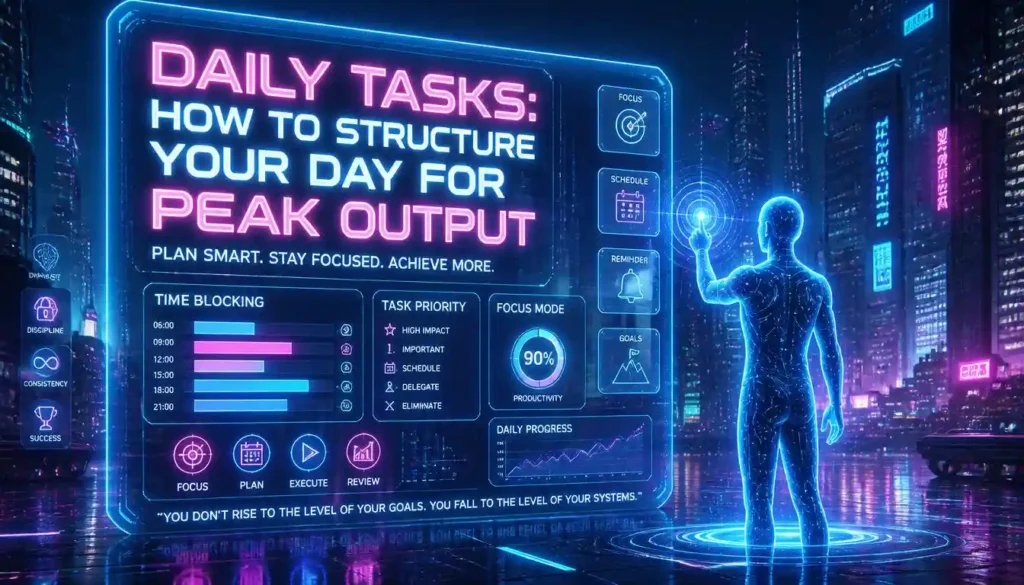

The difference between a day that feels productive and one that feels like a blur usually isn’t how many hours you worked—it’s how those hours were structured. Most people don’t have a task problem; they have a sequencing problem. In this guide, you’ll learn exactly how to structure your day for peak output using proven frameworks, energy science, and simple daily habits you can start using today.
What Does It Mean to Structure Your Day for Peak Output?
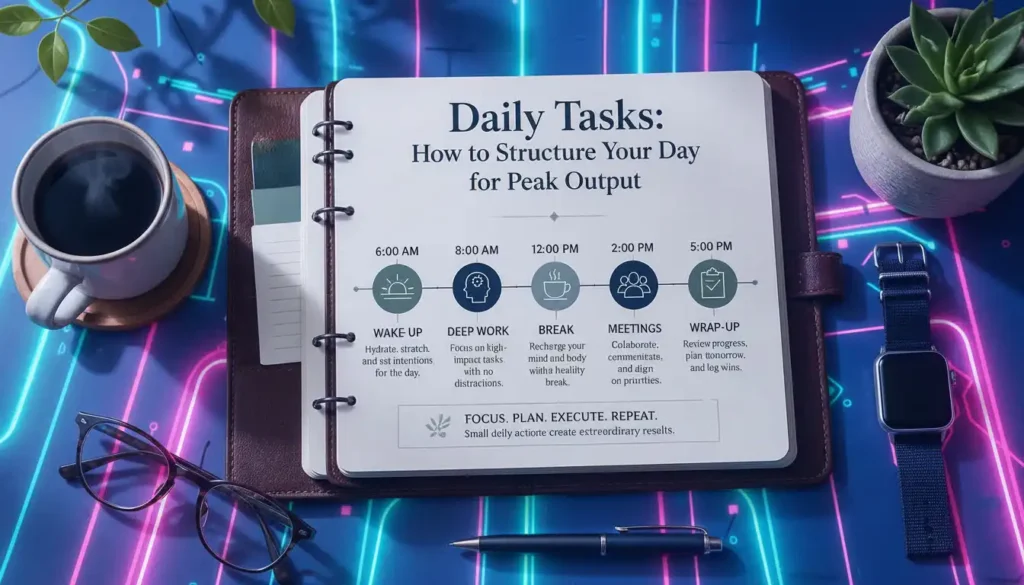
Structuring your day means intentionally organizing your daily tasks around your energy levels, priorities, and available time—instead of reacting to whatever lands in your inbox first.
In short: Structuring your day for peak output means matching your hardest tasks to your highest-energy hours, protecting blocks of uninterrupted time for deep work, and building in rest so your focus doesn’t collapse by mid-afternoon.
This is different from simply making a to-do list. A to-do list tells you what needs to get done. A structured day tells you when, how long, and in what order, which is where most productivity breaks down.
Daily Tasks vs. Daily Schedule: What’s the Difference?
- Daily tasks are the individual items you need to complete (write a report, answer emails, go to the gym).
- A daily schedule is the container that organizes those tasks into a timeline.
You can have a perfect task list and still have a wasted day if the schedule around it is chaotic. That’s why daily task management and time blocking work best together, not separately.
Why Structuring Your Day Actually Matters
It’s tempting to think productivity is about willpower. It isn’t. According to research published by the American Psychological Association, multitasking and constant task-switching can reduce productive time by as much as 40%. That’s nearly half a workday lost — not to laziness, but to poor structure.
A structured daily routine matters because it:
- Reduces decision fatigue — you stop re-deciding what to work on every 20 minutes
- Protects your best hours for your hardest, highest-value work
- Creates predictable rhythm, which lowers stress and mental clutter
- Makes progress visible, so you end the day knowing what actually got done
- Prevents burnout by building in recovery instead of running on empty until 6 p.m.
If you’re just starting to build better daily habits, our guide on the importance of personal development explains why small structural changes like this compound into major long-term growth.
The Science Behind Peak Output: Energy, Not Just Time
Most people plan their day around the clock. High performers plan their day around their energy curve. Two concepts matter here:
Circadian Rhythm and Your Daily Energy Levels
Your circadian rhythm is your internal 24-hour clock, and it dictates when your brain is naturally sharpest. For most people, cognitive performance peaks in the late morning, dips after lunch (the well-documented “post-lunch dip”), and has a smaller secondary peak in early evening.
Ultradian Rhythm: The 90-Minute Focus Cycle
Within each day, your brain also cycles through roughly 90-minute periods of high alertness followed by a natural dip. This is why working in focused blocks—rather than grinding for 4 hours straight—produces better output with less fatigue.
Practical takeaway: Structure your day in 60–90 minute focus blocks, separated by short breaks, and schedule your most demanding tasks during your personal peak window (often 9–11 a.m. for most people, though this varies).
How to Structure Your Day for Peak Output: Step-by-Step
Here’s a practical framework you can implement starting tomorrow morning.
Step 1: Do a Nightly Brain Dump and Prioritize
The night before, write down every task on your mind. Then apply the Rule of 3: pick the three tasks that would make tomorrow a success even if nothing else got done.
This single habit — planning your day the night before instead of the morning of — removes decision fatigue before you even wake up.
Step 2: Use the Eisenhower Matrix to Prioritize Daily Tasks
Sort your tasks into four categories:
| Urgent | Not Urgent |
|---|---|
| Important – Do now | Important – Schedule |
| Not Important – Delegate | Not Important – Eliminate |
Most people spend their day trapped in the “urgent but not “important”—the emails, the pings, the small fires. Peak output comes from spending more time on the “important, not “urgent”—the strategic work that actually moves the needle.
Step 3: Time Block Your Calendar (Don’t Just List Tasks)
Time blocking means assigning a specific start and end time to each task, rather than leaving it as an open-ended item on a list.
Example structure:
- 7:00–8:00 a.m. – Morning routine, no screens
- 8:00–9:00 a.m. – Review priorities, quick admin
- 9:00–11:00 a.m. – Deep work block (your #1 priority task)
- 11:00–11:15 a.m. – Break
- 11:15 a.m.–12:30 p.m. – Second focus block
- 12:30–1:30 p.m. – Lunch (away from your desk)
- 1:30–2:30 p.m. – Meetings, calls, collaborative work
- 2:30–3:00 p.m. – Buffer/admin block
- 3:00–4:30 p.m. – Lighter tasks (email, planning, review)
- 4:30–5:00 p.m. – Shutdown ritual (see below)
A study cited by Harvard Business Review found that employees who scheduled dedicated, uninterrupted focus time completed high-priority projects up to 20% faster than those without structured blocks.
Step 4: Protect a Daily Deep Work Block
Deep work is cognitively demanding, distraction-free work on your most important task. Shallow work is everything else—email, scheduling, minor admin.
Peak performers protect at least one 90-minute deep work block per day, treating it like a non-negotiable meeting. Turn off notifications, close extra tabs, and let people know you’re unavailable.
If you want to explore tools that help enforce this kind of focus, our breakdown of the best productivity tools covers apps built specifically for time blocking and distraction management.
Step 5: Build in Buffer Time
Buffer time, unscheduled white space between blocks, absorbs the inevitable overruns, interruptions, and unexpected tasks. Without it, one delayed meeting cascades into a ruined afternoon.
Step 6: Batch Similar Tasks Together
Task batching means grouping similar small tasks (emails, calls, admin) into one dedicated block instead of scattering them throughout the day. Every time you switch task types, your brain pays a “switching cost” in lost focus—batching minimizes how often you pay that cost.
Step 7: End With a Shutdown Ritual
A shutdown ritual is a short, consistent routine—reviewing what got done, noting what’s left, and planning tomorrow’s top 3—that signals to your brain the workday is complete. This directly combats the Zeigarnik Effect, our tendency to keep mentally replaying unfinished tasks.
Common Daily Structuring Mistakes to Avoid
- Overloading your task list. Six major tasks in one day is unrealistic; three focused priorities are achievable.
- Scheduling meetings during your peak energy hours. Save your sharpest window for your hardest work, not calls.
- Multitasking. It feels productive but measurably slows completion time and increases errors.
- No buffer time. A single delay shouldn’t derail your entire schedule.
- Skipping breaks. Working through your natural ultradian dip leads to lower-quality output, not more of it.
- Planning in the morning under time pressure. Nightly planning is calmer and more accurate.
Tools That Support a Structured Daily Routine
You don’t need expensive software to structure your day well, but the right tool can remove friction:
- Time-blocking apps (Google Calendar, Motion, Reclaim.ai) for visual scheduling
- Task managers (Todoist, Notion, Trello) for capturing and organizing tasks
- Focus timers (Pomodoro-style apps) for enforcing focus/break cycles
- Analog options—a simple notebook or planner works just as well if it’s used consistently
If you’re still exploring which tools fit your workflow, our productivity tools guide breaks down options for different working styles, from minimalists to power users.
How Structuring Your Day Connects to Long-Term Growth
Daily structure isn’t just about getting more done today — it’s a personal development skill that compounds. The habits you build around time, energy, and priorities shape your capacity for growth in every other area of life.
If daily structure is new territory for you, start with our foundational personal development guide, which covers the mindset and habit-building principles that make routines like this stick. Pairing structure with strong self-development habits tends to produce the most lasting change.
Frequently Asked Questions
What is the best way to structure your day for peak output? Plan the night before, prioritize your top three tasks, time block your calendar around your natural energy peaks, and protect at least one uninterrupted deep work session.
When is the best time of day to do deep work? For most people, late morning (roughly 9–11 a.m.) is when focus and cognitive performance peak, though this varies by individual chronotype.
How long can the brain focus before needing a break? Most people can sustain high focus for about 60–90 minutes before a natural dip in attention occurs, aligning with the body’s ultradian rhythm.
What’s the difference between deep work and shallow work? Deep work is cognitively demanding, high-value work that requires uninterrupted focus, while shallow work includes routine tasks like email or scheduling that don’t require deep concentration.
How do I stop procrastinating on daily tasks? Break tasks into smaller, time-boxed chunks, tackle your hardest task during your highest-energy hour, and remove visible distractions before starting.
What is a shutdown ritual, and why do I need one? A shutdown ritual is a short end-of-day routine—reviewing progress and planning tomorrow—that helps your brain mentally close out the workday instead of carrying unfinished tasks into your evening.
Final Thoughts: Structure Is a Skill You Build, Not a Rule You Follow
You don’t need a perfect schedule on day one. Start with one change — time blocking your top priority, or adding a real shutdown ritual — and build from there. Structure isn’t about rigidity; it’s about giving your energy and attention a clear place to go each day.
For more on building habits that support consistent daily output, explore our personal development tips or learn how small, structural changes can help you better yourself over time.
Ready to build a daily routine that actually works? Explore more practical, research-backed guides on Rise By Inches—or get in touch if you’d like personalized guidance on structuring your days for peak performance.



Pingback: Best Self Improvement Blogs (2026):Top Personal Growth Sites
Pingback: Personal Wellness Plan: How to Build Yours in 7 Days
Pingback: Best Apps for Planning: Top 30 Picks for 2026
Pingback: 10 Best Time Management Methods Ranked: Every System
Pingback: Best Time Management Tools for Every Work Style (2026 Guide)
Pingback: Top Development Skills Every Professional Needs in 2026
Pingback: How to Learn Anything Fast: Best Science-Backed Strategies
Pingback: Cool Productivity Apps You Need to Download in 2026
Pingback: Best Stress Management Books (2026 Expert Picks)
Pingback: Top Time Management & Organizational Skills Guide (2026)
Pingback: Mental Health Internships 2026: Salary & Career Guide
Pingback: How to Improve Employee Productivity: 10 Proven Strategies
Pingback: 10 Best Books on Organizing for a Clutter-Free Life (2026)
Pingback: Time Management Goals: Best Key Qualities Guide 2026
Pingback: How to Develop Yourself Personally: 5 Best Steps guide
Pingback: Time Management Goals: Key Qualities best guide 2026