
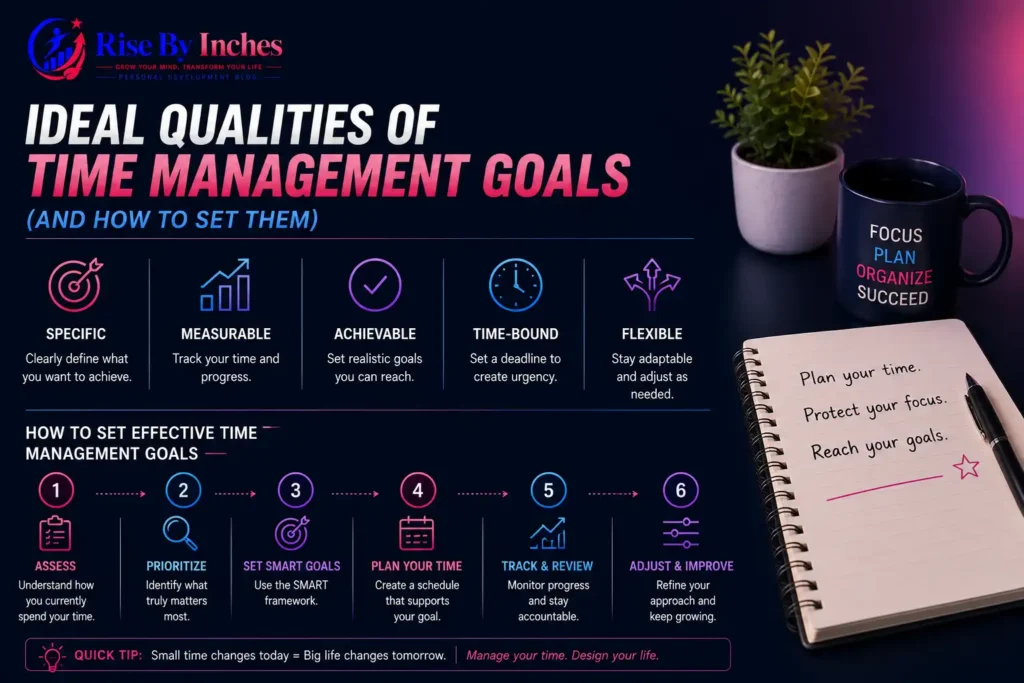

Most people don’t fail at time management because they lack willpower. They fail because their goals were vague from the start. Setting time management goals that actually stick requires more than good intentions — it demands specificity, measurability, and realistic scope. This guide breaks down the core qualities every effective time goal needs, walks through proven frameworks like SMART and OKRs, and shows you how to build a system that reduces burnout instead of adding to it.
What Are the 5 Key Qualities of Effective Time Management Goals?
Effective time management goals share five core qualities: specificity, measurability, actionability, a defined time-bound scope, and realistic adaptability. Miss any one of these, and the goal tends to collapse under real-world pressure — either because it’s too fuzzy to act on, or too rigid to survive a chaotic week.
Here’s what each quality actually looks like in practice:
- Specificity — “Answer emails faster” isn’t a goal; “clear inbox to zero by 4 PM daily” is.
- Measurability — You need a number, a percentage, or a clear yes/no outcome to track progress.
- Actionability — The goal should point to a concrete task you start today, not a vague aspiration.
- Time-bound scope — Every goal needs a deadline, whether it’s a day, a sprint, or a quarter.
- Adaptability — Life shifts. A goal that can’t flex around a sick day or a client emergency will get abandoned entirely rather than adjusted.
Skipping any one of these usually means the goal either never gets started or gets quietly dropped by week two.
Why Does Specificity Matter So Much in Time Goals?
Vague goals fail because the brain can’t act on ambiguity — specificity converts a wish into a task list. When a goal names the exact action, the exact output, and the exact deadline, there’s no interpretation gap left for procrastination to exploit.
Consider the difference between these two statements:
| Vague Goal | Specific Goal |
| “Be more productive at work” | “Complete three priority tasks before checking email each morning” |
| “Manage my time better” | “Block 90 minutes for deep work between 9–10:30 AM, no meetings” |
| “Stop procrastinating” | “Start the report within 5 minutes of opening my laptop, using a 2-minute rule” |
Specificity also makes a goal easier to defend against interruptions. A specific commitment (“no meetings before 10:30 AM”) gives you language to protect your calendar. A vague one gives you nothing to point to when someone tries to book over it.
If you want a deeper walkthrough of the mechanics behind this, Rise By Inches’ guide to structuring your daily tasks covers how to translate broad intentions into an hour-by-hour plan.
How Do You Set Time Management Goals Using the SMART Model?
The SMART framework — Specific, Measurable, Achievable, Relevant, Time-bound — remains the most widely taught method for building time goals that survive contact with a real schedule. It maps almost directly onto the qualities time-management researchers recommend.
Here’s how to apply it step by step:
- Specific — Name the exact task, project, or behavior you’re targeting. “Improve focus” becomes “reduce phone checks during work blocks to twice per hour.”
- Measurable — Attach a number. Minutes saved, tasks completed, or a percentage reduction in overdue items all work.
- Achievable — Compare the goal against your actual calendar and energy levels, not an idealized version of your week.
- Relevant — Tie the goal to a bigger outcome you care about, like protecting evening time for family or hitting a project deadline without a last-minute scramble.
- Time-bound — Set a review date. Weekly check-ins work well for time-management goals specifically, since habits shift fast.
A worked example: instead of “get better at deadlines,” a SMART version reads — “Submit all client deliverables 24 hours before the due date for the next four weeks, tracked in my project tool.” That single sentence hits all five criteria and gives you something to review Friday afternoon.
Worth noting: SMART isn’t the final word on goal design. MIT Sloan researchers have argued that SMART goals can encourage people to aim too low, since they reward hitting a target rather than stretching toward one — and have proposed an alternative framework built around frequent discussion and ambition instead of rigid metrics. For personal time-management goals specifically, SMART still works well because the stakes are usually about consistency, not moonshot ambition — but it’s a useful caveat if you’re setting team-wide goals.
For readers building out a broader SMART goal-setting habit beyond time management specifically, the Rise By Inches piece on work development goals applies the same framework to career growth targets.
What Other Frameworks Work Besides SMART?
Beyond SMART, OKRs, the Eisenhower Matrix, time blocking, and the Pomodoro Technique each solve a different piece of the time-management puzzle — pick based on whether your problem is prioritization, focus, or follow-through.
OKRs (Objectives and Key Results)
Originally developed inside Intel and later popularized by Google, OKRs pair a qualitative objective (“Own my mornings”) with 2–3 measurable key results (“No meetings before 10 AM,” “Inbox cleared by noon three days a week”). This framework suits people managing multiple overlapping goals at once, since it forces you to separate the aspiration from the metric.
The Eisenhower Matrix
This tool sorts tasks into four quadrants based on urgency and importance — do first, schedule, delegate, eliminate. It’s less a goal-setting framework and more a triage system, which makes it useful as a first step before you set any time goals. You can’t set a realistic deadline for a task you haven’t yet decided matters.
Time Blocking
Time blocking assigns a job to every hour of your day in advance, rather than working from a reactive to-do list. This matters more than it might seem: research from UC Irvine’s informatics department has found that it takes over 23 minutes on average to fully regain focus after an interruption — which is exactly the cost that time blocking is designed to prevent, by front-loading focus periods before the day gets reactive.
Pomodoro Technique
This method breaks work into 25-minute focus intervals separated by short breaks. It pairs naturally with time-blocked calendars, since each block can be subdivided into two or three Pomodoro cycles.
If you’re deciding which of these to adopt first, the Rise By Inches comparison of time management methods ranks them against each other by use case and difficulty of adoption.
What Is the Difference Between Short-Term and Long-Term Time Goals?
Short-term time goals govern hours or days and focus on task completion, while long-term goals span weeks or months and focus on systemic habit change. Both need to exist simultaneously — a long-term goal without short-term checkpoints tends to drift, and short-term goals without a long-term anchor tend to feel random.
A short-term time goal might read: “Finish the quarterly report draft by end of day Thursday.” A long-term goal supporting it might read: “Reduce average project turnaround time by 20% over the next quarter by adopting time blocking for all deep-work tasks.”
The relationship works best as a nested structure:
- Long-term goal (quarter): Cut overtime hours by half.
- Mid-term goal (monthly): Complete a time audit and eliminate the two lowest-value recurring tasks.
- Short-term goal (weekly): Block two 90-minute deep-work sessions daily and track completion rate.
Without the short-term layer, the long-term target is just a hope. Without the long-term layer, the short-term wins don’t add up to anything.
Why Is Flexibility an Important Quality in Goal Setting?
Flexibility keeps a time goal alive after the first bad week — rigid goals tend to get abandoned entirely the moment they’re broken, while adaptable goals get adjusted and continued. This is one of the most overlooked qualities in goal-setting advice, largely because “specific and measurable” gets all the attention while “adaptable” sounds like it contradicts discipline. It doesn’t.
A flexible time goal builds in a buffer or a fallback condition from the start. Instead of “work 8 focused hours daily, no exceptions,” a flexible version reads: “Complete at least 5 focused work hours daily, with a stretch target of 8 on low-interruption days.” The floor keeps you accountable. The stretch target keeps you ambitious. Neither one collapses the whole system when a meeting runs long, or a kid gets sick.
This matters more in a hybrid or remote work context, where interruption patterns vary day-to-day far more than they did under a fixed office schedule.
How Can Time Management Goals Prevent Workplace Burnout?
Well-structured time-management goals prevent burnout by making workload visible before it becomes overwhelming — vague time habits let overcommitment build silently, while measurable goals surface imbalances early. The Centers for Disease Control and Prevention’s National Institute for Occupational Safety and Health identifies heavy workload and unclear job responsibilities as consistent contributors to occupational stress, and both of those factors are exactly what specific, measurable time goals are designed to address.
Here’s the mechanism: when you track time goals weekly — hours worked, deep-work blocks completed, tasks deferred — you generate a data trail. That trail shows you creeping overtime or chronic task deferral weeks before it turns into exhaustion. Without that tracking, the first sign of trouble is often the burnout itself.
Practical burnout-prevention goals to consider:
- Cap total daily focused-work hours and track actual versus planned.
- Set a hard stop time for email/Slack response, with an “after-hours” auto-reply.
- Schedule one recurring buffer block per day for unplanned work, so overflow doesn’t eat into personal time.
- Review weekly whether task load matched available hours — and adjust the following week’s commitments accordingly.
For a broader look at protecting personal time against overwork, Rise By Inches’ guide to work-life balance covers boundary-setting strategies that pair well with time-goal tracking.
How Do You Set Realistic Time Management Goals at Work?
Realistic workplace time goals start with a time audit — tracking actual hours spent for one week before setting any new targets — because most people’s estimate of where their time goes is significantly off from reality.
Follow this sequence:
- Audit first. Log your actual time in 30-minute increments for 5 workdays before making any changes. No goal-setting yet — just observation.
- Identify the gap. Compare where you thought your time was going against where it actually went. The gap is usually in meetings, context-switching, and low-value email.
- Set one goal at a time. Trying to overhaul your entire schedule at once usually fails. Pick the single biggest time leak and set one SMART goal against it.
- Build in review checkpoints. Weekly, not monthly — time habits drift fast enough that a month-long gap between reviews lets bad patterns re-establish.
- Adjust, don’t abandon. If a goal isn’t working after two weeks, narrow its scope rather than scrapping it outright.
This audit-first approach also solves a common failure mode: setting time goals based on how you wish you worked rather than how you actually work. A goal built on a false baseline is set up to fail, regardless of how well-structured it is otherwise.
For readers who want a structured, multi-day approach to this kind of audit-and-adjust process, the Rise By Inches 7-day mindset reset offers a condensed version of the exact sequence.
Time Management Goal Examples for Professionals
For a manager juggling meetings:
“Reduce total weekly meeting hours from 20 to 14 within one month by declining or delegating meetings without a clear agenda.”
For a freelancer managing multiple clients:
“Track billable hours daily and maintain a minimum 70% billable-to-total-hours ratio each week, reviewed every Friday.”
For a remote employee managing distractions:
“Complete two uninterrupted 90-minute deep-work blocks daily, phone in another room, tracked via a simple checklist.”
For a student balancing coursework:
“Study in three 45-minute focused sessions per day, five days a week, with a 15-minute break between sessions.”
For an entrepreneur scaling a team:
“Delegate at least three recurring tasks per month that don’t require founder-level decision-making, tracked in a delegation log.”
Each of these follows the same underlying pattern: a specific action, a number to track, and a review cadence.
Frequently Asked Questions
What makes a time management goal different from a regular goal?
A time management goal specifically targets how you allocate hours and prioritize tasks, rather than a broader outcome like revenue or weight loss. It’s process-focused — the goal is the behavior itself, not just the result.
How many time management goals should I set at once?
Most productivity coaches recommend starting with one to three active time goals. Trying to overhaul every habit simultaneously tends to overwhelm the tracking system and leads to abandonment within the first two weeks.
Can time management goals be personal, not just work-related?
Yes. Time goals apply just as well to protecting personal time — for example, “no work email after 7 PM” or “30 minutes of reading before bed, four nights a week.” The same SMART structure applies regardless of domain.
What’s the biggest mistake people make when setting time goals?
Skipping the measurement piece. A goal like “manage my time better” has no way to be evaluated, so there’s no signal telling you whether it’s working or when to adjust it.
How often should I review my time management goals?
Weekly reviews tend to work best for time-specific goals, since daily habits shift quickly and a monthly gap lets bad patterns re-establish before you notice them.
Do time management goals need to be written down?
Written goals are significantly easier to track and revisit than goals held only in memory. A simple weekly log — even three lines in a notes app — is enough to create the accountability loop that makes these goals stick.
Putting It All Together
Effective time management goals aren’t complicated — they’re specific, measurable, tied to a deadline, and flexible enough to survive a rough week. Whether you build yours around SMART criteria, OKRs, or a simple time-blocked calendar, the underlying discipline is the same: audit your actual time first, set one goal against the biggest gap, review it weekly, and adjust rather than abandon when it breaks.
Start smaller than feels ambitious. A single well-structured time goal, tracked consistently for a month, will teach you more about your own patterns than five vague resolutions ever will. Pick one from the examples above, write it down, and check back on it this Friday.