
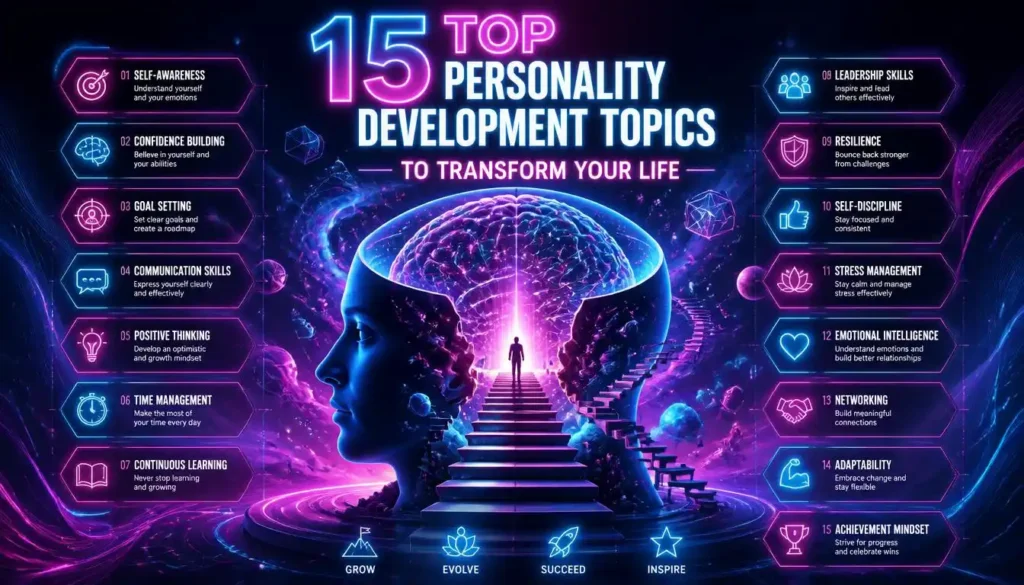

Most people chase personality development the wrong way. They read a quote, feel inspired for an afternoon, then slide back into old patterns by dinner. Real change isn’t a mood. It’s a structure. This guide breaks personality development into 15 concrete, trainable topics — the same ones psychologists, executive coaches, and workplace trainers actually use — so you can build a version of yourself that holds up under pressure, not just under good lighting.
What Are the Main Areas of Personality Development?

Personality development centers on five core areas: self-awareness, emotional intelligence, communication skills, mindset, and behavioral habits. Each area shapes how you think, react, and connect with others. Together, they form the architecture of character — not fixed traits, but skills you can deliberately strengthen through practice, feedback, and repetition over time.
Below, each of those areas breaks down into specific, actionable topics. Fifteen of them, to be exact.
1. Self-Awareness: The Starting Point for Everything
You can’t improve what you can’t see. Self-awareness is the practice of accurately observing your own thoughts, emotional triggers, and behavioral defaults — without the usual filters of ego or denial.
Psychologists distinguish between internal self-awareness (knowing your values and reactions) and external self-awareness (knowing how others perceive you). Most people are strong in one and blind in the other. A useful starting exercise: keep a short daily log of moments when you reacted more strongly than the situation warranted, then look for the pattern. If you want a structured entry point, Rise By Inches has a full inner-work framework built around exactly this kind of pattern-spotting.
2. Emotional Intelligence (EQ): Managing Reactions, Not Just Feelings
Emotional intelligence isn’t about suppressing emotion. It’s about recognizing what you feel, understanding why, and choosing your response instead of defaulting to it. Psychologist Daniel Goleman’s framework breaks EQ into self-regulation, motivation, empathy, and social skill — and research consistently links high EQ to better Leadership outcomes and workplace relationships.
Here’s the practical version: the three-second pause. Before responding to criticism, conflict, or bad news, count to three. That gap is where emotional intelligence actually lives. It’s small. It’s also the difference between a reaction you regret and a response you’re proud of.
3. Growth Mindset vs. Fixed Mindset
A growth mindset treats ability as something built through effort, while a fixed mindset treats it as something you either have or don’t. Stanford psychologist Carol Dweck’s research found that people with a growth mindset recover faster from setbacks and take on harder challenges, because failure reads as data instead of a verdict.
The switch is linguistic before it’s psychological. “I’m not good at this” becomes “I’m not good at this yet.” That single word rewires the sentence from a dead end into a direction. Rise By Inches maps the full transition in its guide on how to develop a growth mindset, including the specific thought patterns that keep people stuck in fixed thinking without realizing it.
4. Interpersonal Communication
Communication is the delivery mechanism for everything else on this list. You can have excellent self-awareness and still damage a relationship if you can’t express what you’re noticing. Strong interpersonal communication combines clarity, timing, and tone-matching — saying the right thing, at the right moment, in a way the other person can actually hear.
One overlooked skill here: matching your communication style to the listener, not to your own comfort zone. A direct communicator softening their delivery for a sensitive colleague isn’t being fake. They’re being effective.
5. Active Listening
Most conversations are two people waiting for their turn to talk. Active listening flips that. It means listening to understand, not to reply — tracking the other person’s actual point instead of mentally drafting your rebuttal while they’re still mid-sentence.
The technique that separates active listeners from everyone else is reflection: briefly restating what you heard before responding. “So what you’re saying is…” It costs five seconds and prevents entire arguments built on misunderstanding.
6. Soft Skills and Assertiveness
Assertiveness sits in the space between passive and aggressive. It means stating your needs, boundaries, and opinions clearly, without apologizing for having them and without steamrolling the other person’s.
This is one of the most requested workplace soft skills, and for good reason — teams with assertive-but-respectful communicators resolve conflict faster and burn out less. A simple assertiveness script: state the observation, state the impact, state the request. “When meetings run over, I miss my next call. Can we hard-stop at the hour?” No blame. No vagueness. Just structure.
7. Public Speaking and Body Language
Confidence isn’t just internal — others read it through posture, eye contact, pacing, and vocal tone before you’ve said anything substantive. Body language research (notably Amy Cuddy’s work at Harvard) suggests that expansive, open posture correlates with feeling more confident, not just appearing it.
Practical fix: record yourself giving a two-minute explanation of something you know well. Watch it once for content, once with the sound off for body language only. Most people are startled by how much they fidget, shrink, or avoid eye contact — and startled again by how easy it is to correct once they can see it.
8. Time and Energy Management
Personality development stalls without the bandwidth to practice it. Time management isn’t about cramming more into a day — it’s about protecting the hours where your energy and focus are highest for the work that actually matters.
Energy management matters just as much as time management. A perfectly scheduled day still fails if you’re running on empty by 2 p.m. Rise By Inches breaks down proven scheduling frameworks in its piece on time management methods ranked, and pairs well with its guide to structuring your daily tasks around actual energy patterns instead of arbitrary time blocks.
9. Habit Loops and Behavioral Consistency
Personality isn’t what you do once. It’s what you repeat. Behavioral scientists describe habits as loops: a cue triggers a routine, which delivers a reward, which reinforces the cue next time. Personality development sticks when you redesign these loops instead of relying on willpower alone.
The fastest lever is the cue. Change what triggers a behavior, and the behavior often follows without a fight. Want to journal more? Put the notebook on your pillow each morning so making the bed means seeing it. Small mechanical shifts outperform big motivational speeches almost every time.
10. Stress Resilience
Resilience isn’t the absence of stress. It’s the capacity to recover from it without spiraling into avoidance or burnout. This topic sits closer to physiology than most people expect — sleep, breathing patterns, and recovery routines directly shape how well you handle pressure.
A practical resilience habit: build in a deliberate reset after high-stress events, not just after the workday ends. Five minutes of quiet, a short walk, or slow breathing before moving to the next task prevents stress from compounding hour over hour. Rise By Inches covers restoration-focused routines in its guide on restoring energy through self-care.
11. Confidence Building Through Competence
Confidence built on hype collapses under scrutiny. Confidence built on competence doesn’t. The most durable version comes from stacking small proven wins — skills you’ve actually tested against reality — rather than affirmations alone.
This is why deliberate skill-building matters as a personality topic in its own right. Picking up a new capability, even a small one, gives you evidence instead of just belief. Rise By Inches’ roundup of new skills worth learning is a practical starting point if you’re looking for where to direct that effort.
12. Executive Presence and Professional Ethics
Executive presence is the combination of gravity, composure, and communication clarity that makes people trust your judgment before you’ve proven it in a specific instance. It’s built from consistency: doing what you say, admitting what you don’t know, and staying level under pressure.
Professional ethics anchors this. Presence without integrity reads as manipulation eventually — people notice when confidence isn’t backed by consistency. Rise By Inches’ professional development plan and career development plan example both build executive presence into their frameworks as a trainable, staged skill rather than an innate trait.
13. Continuous Learning as a Personality Trait
People who keep growing share one habit: they treat not-knowing as normal, not embarrassing. Continuous learners ask more questions, tolerate more ambiguity, and adapt faster when circumstances shift — which is precisely what makes this a personality trait and not just an educational preference.
The topic connects directly to identity. If you see yourself as “someone who’s still figuring things out,” setbacks stop feeling like proof you’re inadequate. Rise By Inches explores this shift in why you should never stop learning, alongside a curated list of self-improvement blogs worth following for ongoing input.
14. Goal Setting and Direction
Personality development without direction turns into aimless self-improvement — busy, but not building toward anything specific. Clear goals give your other skills somewhere to point. Confidence, communication, and time management all sharpen fast once there’s a concrete outcome to apply them to.
The strongest goals are specific and time-bound, not vague aspirations like “be better.” Rise By Inches’ collection of personal goals examples and its breakdown of top performer goal-setting habits both show what specificity looks like in practice.
15. Emotional Health and Self-Regulation
The final topic ties everything together: sustained emotional health. This is the daily maintenance layer underneath all the others — sleep, mood regulation, and recovery from setbacks without letting them define you.
Real-world emotional health rarely looks like the wellness-brand version. It looks like recognizing a bad day early and adjusting your expectations instead of pushing through and making it worse. Rise By Inches documents what this actually looks like day to day in its piece on emotional health examples in real life.
How Do Soft Skills Influence Personality Growth?
Soft skills act as the delivery system for personality traits — they turn internal qualities like patience or empathy into behaviors other people can actually experience. Someone can be deeply self-aware internally, but without communication and assertiveness skills, that awareness never reaches the people around them. Soft skills are what make personality growth visible and functional in real relationships and workplaces.
What Personality Development Topics Are Most Critical for Career Success?
For career growth specifically, emotional intelligence, assertive communication, and executive presence matter most. These three topics determine how you’re perceived in high-stakes moments — performance reviews, Leadership transitions, and conflict resolution — far more than technical skill alone does past a certain seniority level.
How Long Does It Take to Transform Your Personality Traits?
Meaningful personality change typically takes 3 to 6 months of consistent practice, though small behavioral shifts can show up within a few weeks. Traits built on repeated habits (like active listening or assertiveness) change faster than deeply wired patterns (like core self-esteem), which often benefit from longer-term work or professional support.
Why Rise By Inches Is Built for This Kind of Growth
Most self-improvement content sells a moment. Rise By Inches builds a system. Every guide on the site — from personal development guides to self-development activities — is written around the same principle behind this article: personality traits aren’t fixed, and they respond to structured, repeatable practice better than they respond to motivation alone.
If you’re not sure where to start, the site’s breakdown of personal development tips and its explanation of why personal development matters both work as entry points before diving into the 15 topics above.
FAQs
What are the main areas of personality development?
Self-awareness, emotional intelligence, communication, mindset, and behavioral habits — these five areas cover the full range of trainable personality skills.
How do soft skills influence personality growth?
Soft skills translate internal traits into visible behavior, making personality growth functional in relationships and at work rather than just internal.
What personality development topics matter most for career success?
Emotional intelligence, assertive communication, and executive presence carry the most weight, especially as responsibility and visibility increase.
How long does it take to transform your personality traits?
Small habits shift within weeks; deeper traits typically take 3 to 6 months of consistent, deliberate practice.
Can introverts develop strong personality traits without becoming extroverted?
Yes. Personality development isn’t about becoming louder — it’s about becoming more effective within your natural temperament, whatever that is.
Is personality development the same as self-improvement?
They overlap but aren’t identical. Self-improvement is broader and can include skills or knowledge; personality development specifically targets character traits and interpersonal behavior.
Start Where You Are
None of these 15 topics require a personality transplant. They require attention, repetition, and a willingness to notice your own patterns without flinching away from them. Pick one. Practice it for a month. Then pick the next one. That’s the whole method — start your journey to improve yourself with us at Rise By Inches.



Pingback: Best Personality Characteristics:Definition,Types & Examples