

You don’t need a personality overhaul to feel better. You need a plan — one that fits into the life you already have. A personal wellness plan is a structured, realistic map for improving your physical, mental, and emotional health over a defined period, and building one in just seven days is entirely possible if you focus on small, compounding actions rather than sweeping resolutions. This guide walks you through exactly how to create a wellness routine, day by day, using a framework grounded in the real dimensions of human wellbeing.
What Is a Personal Wellness Plan?
A personal wellness plan is a written, actionable strategy that addresses your physical, emotional, social, and mental health needs through specific daily habits, measurable goals, and a realistic timeline. Unlike a vague New Year’s resolution, it breaks wellness down into concrete categories — sleep, nutrition, movement, stress management — and assigns small, trackable actions to each. Think of it less as a lifestyle transformation and more as a working document, one you’ll revise as you learn what actually works for your body and your schedule.
The idea isn’t new. Corporate wellness programs, healthcare providers, and behavioral psychologists have used structured wellness planning for decades because it works better than willpower alone. What’s changed is how accessible the framework has become — you don’t need a coach or a clinic to start one this week.
What Are the 8 Dimensions of Wellness?

The 8 dimensions of wellness are physical, emotional, social, intellectual, spiritual, occupational, environmental, and financial health — a model developed by SAMHSA and widely used in preventive health strategies. Most people think about wellness only in terms of diet and exercise, but true balance requires attention to all eight. A 7-day plan can’t fully optimize each one, but it can establish an anchor habit in the four or five areas most relevant to your current stress points.
For most beginners, the highest-leverage dimensions to start with are physical (sleep, movement, nutrition), emotional (stress management, mindfulness), and social (connection and support). If you’re building your first plan, focus there before expanding into occupational or financial wellness later. Our guide to personal development fundamentals breaks down how these dimensions connect to long-term growth, not just short-term mood.
How Do You Create a Wellness Routine That Actually Sticks?
The routines that last are built around habit stacking, not willpower — attaching a new behavior to an existing one, tracking it visibly, and starting with a version so small it feels almost too easy. Behavioral researchers, including those cited by the American Psychological Association, have consistently found that habit success depends more on environmental design and consistency than on motivation. If your wellness routine depends on feeling inspired every morning, it will collapse by Thursday.
Three principles make the difference between a plan that survives past day 7 and one that doesn’t:
- Anchor new habits to existing ones. Pair a two-minute breathing exercise with your morning coffee, not with an entirely new 6 a.m. wake time.
- Track visibly, not perfectly. A simple checkbox system beats an app you’ll abandon in a week.
- Reduce the first step to almost nothing. “Walk for five minutes” gets done. “Start a fitness routine” doesn’t.
This is the same logic we cover in structuring your daily tasks — small, sequenced actions outperform ambitious overhauls almost every time.
Your 7-Day Wellness Plan Template
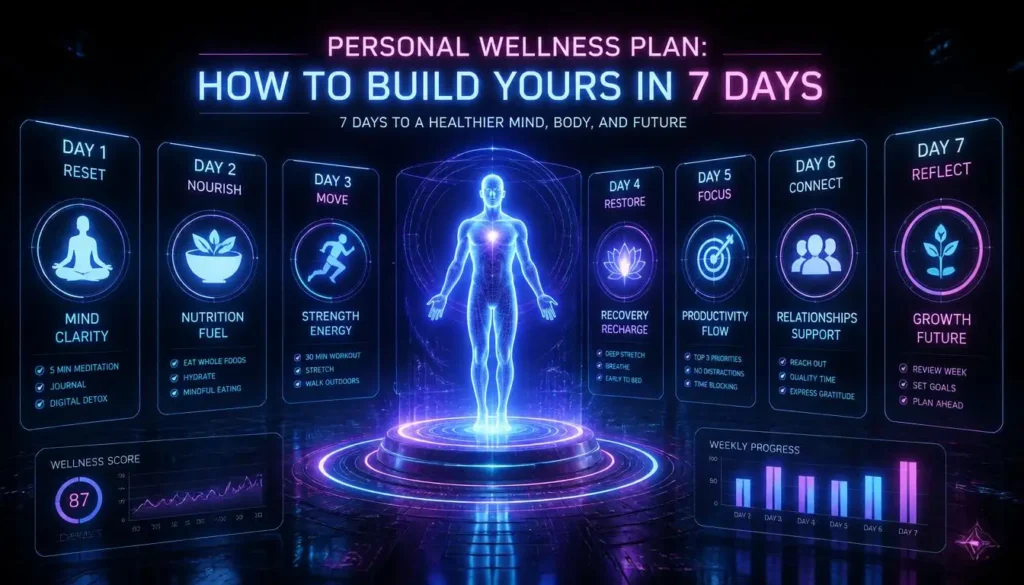
Here’s a day-by-day framework you can copy directly into a notebook, spreadsheet, or planner app. Each day targets one dimension of wellness with a single, specific action — not a checklist of ten things you’ll abandon by Wednesday.
Day 1: Assess and Set Your Intentions
Start by writing down your current state across four categories — sleep, mood, energy, and stress — on a scale of 1 to 10, then choose one specific, measurable goal for the week. Don’t skip this step. Most wellness plans fail not because the habits were bad, but because there was never a clear baseline to measure progress against. Keep your goal narrow: “sleep 7 hours four nights this week” beats “sleep better.”
Day 2: Fix One Sleep Hygiene Habit
Sleep hygiene refers to the specific behaviors and environmental factors that affect sleep quality — consistent bedtime, reduced screen exposure, and a cool, dark room are the three with the strongest evidence supporting them. The National Sleep Foundation and sleep researchers consistently point to circadian rhythm optimization — keeping a consistent wake time, even on weekends — as more impactful than any supplement or gadget. Pick one lever: a fixed wake-up time, no screens 30 minutes before bed, or a cooler room temperature. Don’t try all three at once.
Day 3: Set a Realistic Nutrition Anchor
Nutritional goals for a 7-day wellness plan should focus on one addition, not a full diet overhaul — adding a vegetable to one meal, or drinking water before your first coffee, builds momentum without triggering restriction-based burnout. Hydration tracking is a simple, high-leverage habit here: even mild dehydration is linked to reduced concentration and mood dips. A basic marked water bottle does more than any tracking app.
Day 4: Build a Physical Fitness Routine You’ll Actually Repeat
A physical fitness routine for beginners should prioritize frequency over intensity — three 15-minute walks are more sustainable and more likely to become a permanent habit than one exhausting hour-long workout. The World Health Organization recommends at least 150 minutes of moderate activity weekly for adults, but that number is a destination, not a starting line. On day 4, commit to one movement session you can realistically repeat, whether that’s a walk, a stretching routine, or a short strength session using bodyweight only.
Day 5: Practice a Stress Management Technique
Mindfulness meditation and structured breathing exercises are two of the most researched stress management techniques, both shown to lower cortisol reactivity when practiced consistently, even in sessions as short as five minutes. You don’t need a meditation app or a silent retreat. Box breathing — four seconds in, four seconds hold, four seconds out, four seconds hold — takes two minutes and works in a parking lot as easily as it does at home. This pairs directly with the somatic exercises we discuss in self-development activities for building emotional regulation over time.
Day 6: Strengthen One Social Connection
Social wellness — one of the 8 dimensions most often neglected in personal wellness plans — improves measurably through even brief, intentional contact, such as a 10-minute phone call or a shared meal, rather than passive scrolling through social feeds. Pick one person. Reach out with intention, not obligation. This single action often produces a bigger mood lift than an entire day of solo self-care.
Day 7: Review, Adjust, and Build Your Weekly Wellness Checklist
The final day of your 7-day wellness plan should be spent reviewing what worked, not starting something new — rate each daily habit from Day 1 through Day 6, keep what worked, and quietly drop what didn’t. This is where your plan becomes a real system rather than a one-time experiment. Turn your five strongest habits into a repeatable weekly wellness checklist, and give yourself permission to keep it imperfect. For a deeper look at sustaining these gains, our piece on restoring energy through self-care covers the recovery side most 7-day plans skip entirely.
Weekly Wellness Checklist: Your Daily Self-Care Routine at a Glance
| Day | Focus Area | Micro-Habit |
| Mon | Assessment | Rate sleep, mood, energy, stress (1–10) |
| Tue | Sleep hygiene | Fixed wake time, no screens pre-bed |
| Wed | Nutrition | One vegetable added, hydration tracked |
| Thu | Physical fitness | 15-minute walk or bodyweight session |
| Fri | Stress management | Box breathing or 5-minute mindfulness |
| Sat | Social wellness | 10-minute intentional connection |
| Sun | Review | Score the week, keep top 5 habits |
Copy this table directly into a notes app, a printed planner, or a spreadsheet. The format matters less than the consistency of checking it daily.
How Rise By Inches Helps You Build a Wellness Plan That Lasts
A 7-day plan is a starting point, not a finish line. Where most people get stuck is week two, when the novelty fades, and old patterns start pulling back. That’s the gap Rise By Inches is built to close. Rather than one-size-fits-all templates, the resources here focus on the psychology behind habit formation — why certain routines survive contact with a busy week, and others quietly disappear by day nine.
If your wellness plan touches on bigger personal growth goals — career clarity, confidence, structured daily habits — pair this plan with our personal development tips and better yourself guides, both built around the same small-step philosophy used above. For readers specifically working through low mood or emotional fatigue, our breakdown of emotional health in real life offers concrete examples rather than abstract advice, and our guide to self-awareness activities for adults pairs well with the Day 1 assessment step above.
Frequently Asked Questions
What is a personal wellness plan?
A personal wellness plan is a structured, written approach to improving your physical, emotional, and social health through specific daily habits and measurable short-term goals. It’s different from a general resolution because it breaks wellness into distinct categories and assigns concrete, trackable actions to each one.
How do I start a wellness plan?
Start by assessing your current sleep, mood, energy, and stress levels on a simple 1–10 scale, then choose one specific, measurable goal for the week rather than several vague ones. From there, assign one small habit per day for each of sleep, nutrition, movement, stress, and social connection.
What are the 5 areas of personal wellness?
The five areas most commonly prioritized in a beginner wellness plan are physical, emotional, social, mental, and occupational wellness, drawn from the broader 8-dimension model used in public health and preventative care frameworks. Most 7-day plans focus on the first three, since they show the fastest measurable improvement.
How can I improve my well-being in 7 days?
Improving well-being in a week comes down to consistency in small actions, not intensity — a fixed sleep schedule, one nutrition change, short daily movement, a stress management technique, and one meaningful social interaction. The compounding effect of these five habits, tracked daily, produces measurable shifts in mood and energy by day seven.
Do I need an app or wellness plan template to get started?
No — a printed checklist, a notes app, or a simple table like the one above works just as well as a dedicated wellness app and often leads to better adherence by removing friction and subscription fatigue. Tools only help if you actually open them daily.
Can a wellness plan work for remote workers with no fixed schedule?
Yes — remote workers often benefit more from habit-stacking wellness plans because they control their own schedule, allowing sleep, movement, and stress-management habits to be placed at natural transition points in the day, like the start and end of work. The lack of a commute actually creates more flexible anchor points, not fewer.
Building Momentum Beyond Day 7
Seven days won’t fix everything, and it isn’t supposed to. What it does is prove to you that structure beats motivation, that small, specific actions produce results faster than sweeping overhauls, and that a wellness plan is something you build, test, and revise — not something you download once and follow blindly. Keep the habits that worked. Quietly retire the ones that didn’t. Then build week two.
If you’re ready to take this further, explore the full library of guides at Rise By Inches — including productivity tools and skills to learn that build directly on the foundation this 7-day plan establishes. Have questions about a specific step? Reach out here — we read every message.



Pingback: 20 Real Personal Development Examples & Growth Stories
Pingback: Work-Life Balance Defined:Perfect 7 Real Steps to Achieve It
Pingback: What Are the three Types of Personal Growth? Best Guide 2026