
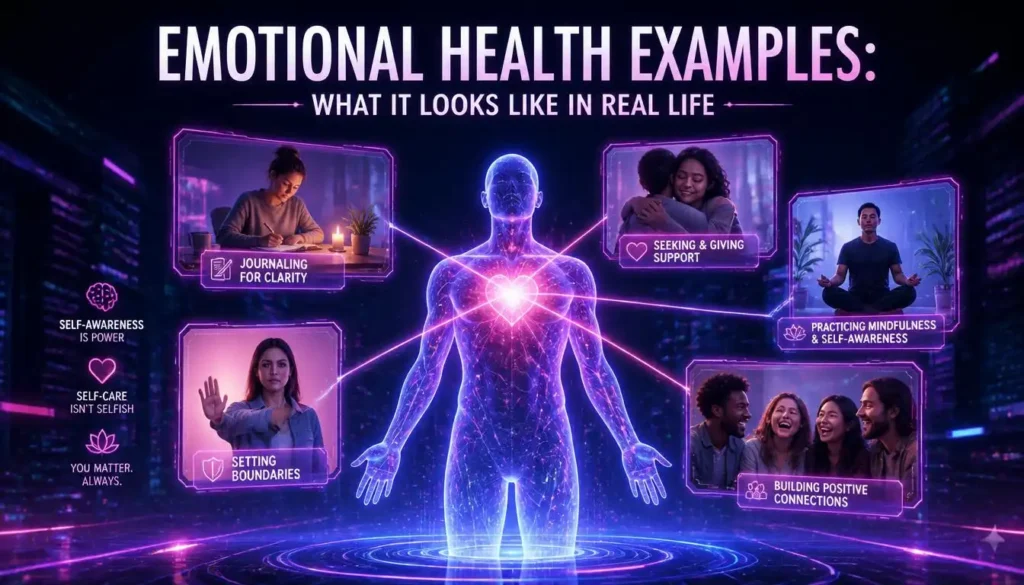

Emotional health is the ability to recognize, understand, and manage your feelings in ways that support your relationships, decisions, and overall well-being. It’s not about being happy all the time — it’s about responding to life’s ups and downs with awareness instead of being controlled by them.
Most people can easily describe physical health: eating well, exercising, and getting enough sleep. But emotional health is harder to picture because it shows up in small, everyday moments, like a calm response during an argument, the courage to say “no” without guilt, or the ability to sit with disappointment instead of numbing it out. For example, I once found myself in a tense meeting where I felt criticized by a coworker. Instead of reacting right away, I paused, noticed the frustration building up, and chose to respond calmly. That single moment made the conversation more productive and helped prevent lingering resentment. In this guide, you’ll see exactly what emotional health looks like in real life, how it differs from mental health, and practical ways to build it starting today.
What Is Emotional Health?

Emotional health refers to your capacity to identify your feelings, express them appropriately, and adapt to stress, change, and setbacks without losing your sense of stability. It includes emotional regulation, self-awareness, resilience, and the ability to maintain healthy relationships even during conflict.
Someone with strong emotional health doesn’t avoid difficult emotions — they process them. They can feel frustrated at work without snapping at a coworker, or feel anxious about a decision without letting that anxiety make the choice for them.
Emotional health rests on a few core abilities:
- Self-awareness — recognizing what you feel and why
- Emotional regulation — managing intense feelings without being overwhelmed by them
- Empathy — understanding and responding to other people’s emotions
- Resilience — recovering from setbacks without long-term derailment
- Healthy expression — communicating feelings clearly instead of suppressing or exploding
If you want a deeper foundation on how these traits fit into overall growth, our personal development guide breaks down how emotional skills connect to long-term self-improvement. To get started right now, try this: pick one moment today when you notice a strong feeling, pause, and silently name the emotion before you react. This simple habit is the first step in building self-awareness and emotional regulation.
Why Emotional Health Matters
Emotional health isn’t a “soft skill” — it shapes nearly every part of daily life, from how you handle deadlines to how your relationships hold up under pressure.
At work: Emotionally healthy people handle criticism without becoming defensive, manage workplace stress without burning out, and collaborate more effectively because they can regulate frustration.
In relationships, emotional health enables honest communication, healthy boundaries, and conflict resolution that doesn’t damage trust.
For physical health: Chronic emotional suppression and unmanaged stress are linked to issues like high blood pressure, poor sleep, and weakened immune response. The mind-body connection means emotional patterns show up physically over time.
For decision-making: People with strong emotional regulation make clearer decisions because they aren’t reacting purely out of fear, anger, or anxiety in the moment.
Understanding why this matters is the first step — our article on the importance of personal development explores how emotional growth accelerates every other area of self-improvement.
Emotional Health vs. Mental Health: What’s the Difference?
These terms are often used interchangeably, but they aren’t quite the same thing.
| Aspect | Emotional Health | Mental Health |
| Focus | How you process and express feelings | Overall psychological functioning and cognitive well-being |
| Includes | Emotional regulation, self-awareness, resilience | Mood disorders, anxiety disorders, cognitive patterns, clinical conditions |
| Can Improve Through | Self-care habits, mindfulness, boundary-setting | Therapy, medication, clinical treatment, lifestyle changes |
| Nature | A skill set that can be practiced daily | Can include diagnosable conditions requiring professional care |
| Example | Staying calm during a disagreement | Managing symptoms of depression or generalized anxiety disorder |
Can you have good emotional health if you have a mental illness?
Yes. Emotional health and mental illness aren’t mutually exclusive. A person managing anxiety or depression can still build strong emotional regulation skills, self-awareness, and healthy coping strategies — these skills often become an important part of managing a mental health condition well.
What Are 5 Examples of Emotional Health?
If you’re picturing what this looks like in practice, here are five concrete examples:
- Pausing before reacting — Taking a breath before responding to criticism instead of firing back defensively.
- Naming your emotions accurately — Saying “I feel overwhelmed by this deadline” instead of just feeling irritable without understanding why.
- Setting a boundary calmly — Telling a friend “I can’t take on this favor right now” without guilt or over-explaining.
- Asking for support — Reaching out to a friend or therapist when things feel heavy, rather than isolating.
- Bouncing back from failure — Missing a goal, feeling disappointed, and then adjusting your plan instead of spiraling into self-criticism.
These aren’t dramatic moments; they’re quiet, repeated choices that build up over time. To turn these small choices into lasting habits, try using simple strategies like setting daily reminders, keeping a habit tracker, or jotting down a quick note each time you practice one of these skills. Consistent tracking and gentle reminders make it easier for these actions to become a natural part of your routine.
What Does Emotional Health Look Like in Daily Life?
Emotional health shows up in ordinary, unremarkable moments far more than in big life events. Here’s what it looks like across different everyday contexts.
At Work
- Receiving feedback on a project without taking it personally
- Managing a heavy workload by prioritizing rather than panicking
- Speaking up in a meeting even when nervous, instead of staying silent out of fear
- Recognizing burnout signs early and adjusting your schedule before it worsens
Building these habits often starts with better daily structure. Our guide on structuring your daily tasks shows how organization reduces the emotional load of a chaotic day.
In Relationships
- Expressing disappointment directly (“I felt hurt when you canceled last minute”) instead of giving the silent treatment
- Listening to a partner’s perspective during disagreement without immediately defending yourself
- Apologizing without over-apologizing or dismissing your own needs
- Respecting a partner’s boundary even when it’s inconvenient
In Parenting
- Staying calm when a child has a meltdown, instead of escalating the situation
- Modeling healthy emotional expression (“I’m frustrated right now, so I’m going to take a minute”)
- Validating a child’s feelings even when you say no to their request
During Stressful Situations
- Recognizing physical stress signals (tight chest, racing thoughts) and using grounding techniques
- Taking a walk or stepping away before responding to a stressful email
- Reframing a setback as temporary instead of catastrophic
In Self-Care
- Prioritizing sleep even when a to-do list feels urgent
- Saying no to social plans when you’re emotionally depleted
- Journaling to process a hard day instead of suppressing it
If self-care is an area you want to strengthen, restoring energy through better self-care habits is a practical next step.
Signs of Good Emotional Health
People with strong emotional health tend to share a few recognizable patterns:
- They can identify and name their emotions specifically, rather than defaulting to vague terms like “fine” or “stressed”
- They recover from setbacks in a reasonable timeframe instead of dwelling indefinitely
- They maintain relationships through honest, respectful communication
- They can tolerate discomfort — boredom, disappointment, uncertainty — without needing to escape it immediately
- They ask for help when needed instead of insisting on handling everything alone
- They take responsibility for mistakes without collapsing into shame
How do you know if someone is emotionally healthy?
Look at how they handle stress, disagreement, and disappointment over time, not just in a single moment. Emotionally healthy people are consistent: calm under pressure, honest in conflict, and able to recover after setbacks without long-term resentment or avoidance.
If you want to do a quick self-check, try this simple reflection exercise: Think back on a recent situation where you felt challenged or upset. Ask yourself—How did I respond in the moment? Did I pause before reacting? Was I able to express how I felt without blaming others or shutting down? Taking a minute to journal about these questions can reveal helpful patterns and show you where you’re already strong or where you might want to focus next.
Signs of Poor Emotional Health
On the other end, poor emotional health often shows up as:
- Frequent emotional outbursts or shutting down completely during conflict
- Chronic avoidance of difficult conversations or feelings
- Using substances, overworking, or other distractions to numb emotions
- Difficulty maintaining relationships due to unresolved resentment or poor communication
- Physical symptoms like fatigue, tension, or sleep disruption tied to emotional stress
- A pattern of blaming others or oneself excessively after mistakes
Recognizing these patterns is often the first step toward change — not a reason for self-judgment.
Key Skills That Build Emotional Health
Emotional Regulation
This is the ability to manage the intensity of your emotional reactions. Techniques include:
- Box breathing (inhale 4 seconds, hold 4, exhale 4, hold 4) to calm the nervous system
- Cognitive reframing — challenging an unhelpful thought (“I always fail”) and replacing it with a more balanced one (“This didn’t work, but I can adjust”)
- Grounding techniques — the 5-4-3-2-1 method (naming 5 things you see, 4 you hear, 3 you feel, 2 you smell, 1 you taste) to interrupt anxiety spirals
Self-Awareness
Journaling, mood tracking, and simple daily check-ins (“What am I feeling right now, and why?”) build the habit of noticing emotions before they build up.
Setting Boundaries
Boundaries protect emotional energy. This might look like limiting time with draining people, turning off work notifications after hours, or clearly stating your limits without over-justifying them.
Active Listening
Truly hearing someone — without planning your response while they’re still talking — strengthens both empathy and relationships.
Self-Compassion
Treating yourself with the same understanding you’d offer a friend after a mistake, rather than harsh self-criticism, is strongly linked to long-term emotional resilience.
Developing these abilities is really a subset of broader self-improvement. Our roundup of essential skills to learn includes several that overlap directly with emotional intelligence.
How to Improve Your Emotional Well-Being
- Name your emotions specifically. Instead of “I’m stressed,” try “I feel anxious about this deadline and unsure if I can meet it.” Specificity reduces emotional intensity.
- Build a daily check-in habit. Spend two minutes each morning or evening asking how you’re feeling and why.
- Practice pausing before reacting. A 10-second pause before responding to conflict prevents most regrettable reactions.
- Strengthen your support system. Emotionally healthy people rarely go it alone — they lean on trusted friends, family, or professionals.
- Prioritize sleep and movement. The nervous system regulates emotion more effectively when the body is rested and active.
- Set one boundary this week. Start small — decline one request that doesn’t serve your energy or priorities.
- Consider professional support. A therapist or coach can help build these skills faster than trial and error alone.
According to the American Psychological Association, maintaining strong social support networks is one of the most effective ways to buffer against chronic stress and build long-term emotional resilience.
For a more structured approach to daily improvement, see our 30 proven self-improvement strategies and our list of practical self-development activities.
Real-World Examples of Emotional Health at Work
Workplace stress is one of the most common places emotional health is tested. A few real-life scenarios:
- Handling a tense meeting: An employee disagrees with a manager’s decision but voices the concern calmly and professionally, focusing on the issue rather than making it personal.
- Managing overwhelm: Instead of silently taking on more tasks until burnout, an employee communicates their capacity clearly and negotiates priorities.
- Recovering from a mistake: After a project error, someone acknowledges it, corrects course, and moves forward without extended self-punishment or defensiveness.
- Supporting a struggling coworker: A team member notices that a colleague seems overwhelmed and checks in privately rather than ignoring it or gossiping about it.
Research from the World Economic Forum consistently lists emotional intelligence among the top skills employers value, precisely because it directly affects collaboration, leadership, and workplace resilience.
Emotional Health Vs. Emotional Suppression
It’s easy to confuse emotional regulation with suppression, but they’re very different:
- Regulation means feeling the emotion fully, then choosing how to respond.
- Suppression means pushing the emotion down and pretending it doesn’t exist.
Suppression often feels like control in the moment but tends to resurface later as irritability, physical tension, or sudden emotional outbursts. Long-term suppression is associated with increased stress and even physical health issues, according to research summarized by the Mayo Clinic on stress management.
Real emotional health isn’t about never feeling upset — it’s about feeling the emotion and choosing a constructive response.
Emotional Agility and Adaptability
Emotional agility is the ability to move fluidly between emotional states without getting stuck. In real life, this looks like:
- Feeling disappointed about a canceled plan, allowing that feeling for a few minutes, then shifting focus to something productive
- Adjusting your approach when a strategy isn’t working, instead of rigidly sticking to a failing plan out of stubbornness
- Staying open to feedback instead of becoming defensive when a plan changes
People who develop emotional agility tend to handle uncertainty — job changes, relationship shifts, unexpected setbacks — with far less long-term distress.
The Mind-Body Connection
Emotional health isn’t only psychological — it’s physical too. Chronic stress and unprocessed emotion affect the nervous system, sleep quality, digestion, and even immune function. This is why:
- Poor sleep often follows unresolved emotional stress
- Physical tension (clenched jaw, tight shoulders) frequently accompanies suppressed anger or anxiety
- Regular movement and good sleep hygiene directly support emotional regulation, because a regulated body supports a regulated mind
Simple somatic practices — stretching, deep breathing, a short walk — can shift emotional state faster than trying to “think” your way out of a difficult feeling.
Building Emotional Health Into Daily Habits
Emotional health isn’t built through occasional big gestures — it’s built through small, repeated habits:
- A two-minute morning check-in with yourself
- A boundary you hold consistently, even when it’s uncomfortable
- A grounding technique you use during stress instead of avoidance
- A weekly conversation with someone you trust
- Consistent sleep and movement, even during busy weeks
This mirrors the same principle behind most lasting change: small, consistent actions outperform occasional big efforts. Our guide on personal development tips from experienced coaches covers this exact idea in more depth, and our productivity tools roundup can help you build the structure that supports these habits.
Frequently Asked Questions
What are 5 examples of emotional health?
Pausing before reacting, naming emotions accurately, setting boundaries calmly, asking for support when needed, and recovering from failure without extended self-criticism.
What is the difference between mental health and emotional health?
Mental health covers overall psychological functioning, including diagnosable conditions like anxiety or depression. Emotional health specifically refers to the skill of recognizing, expressing, and regulating feelings day to day.
What does emotional health look like in daily life?
It looks like calm responses during conflict, honest communication in relationships, healthy boundaries, and the ability to recover from stress or disappointment without long-term disruption.
How do you know if someone is emotionally healthy?
Look for consistency: calm responses under stress, honest communication, healthy relationships, and the ability to bounce back from setbacks without prolonged distress.
What are signs of poor emotional health?
Frequent emotional outbursts, chronic avoidance, numbing behaviors like overworking or substance use, and difficulty maintaining relationships due to unresolved conflict.
Can you have good emotional health if you have a mental illness?
Yes. Emotional health skills — like regulation and self-awareness — can be developed alongside managing a diagnosed mental health condition, and often support recovery and day-to-day coping.
Final Thoughts
Emotional health isn’t about eliminating hard feelings — it’s about building the skills to move through them without losing yourself in the process. It shows up in small daily choices: a pause before reacting, an honest conversation, a boundary held with confidence, a setback met with resilience instead of shame.
The good news is that these are skills, not fixed traits — which means they can be built at any stage of life with consistent practice.
If you’re ready to strengthen your emotional and personal growth in a structured way, explore our full personal development guide or browse our mindset and motivation category for more practical, real-life strategies. You can also visit our About page to learn more about Rise By Inches, or get in touch with any questions.


Pingback: How to Be More Self-Aware: 10 Proven Exercises That Actually Work