
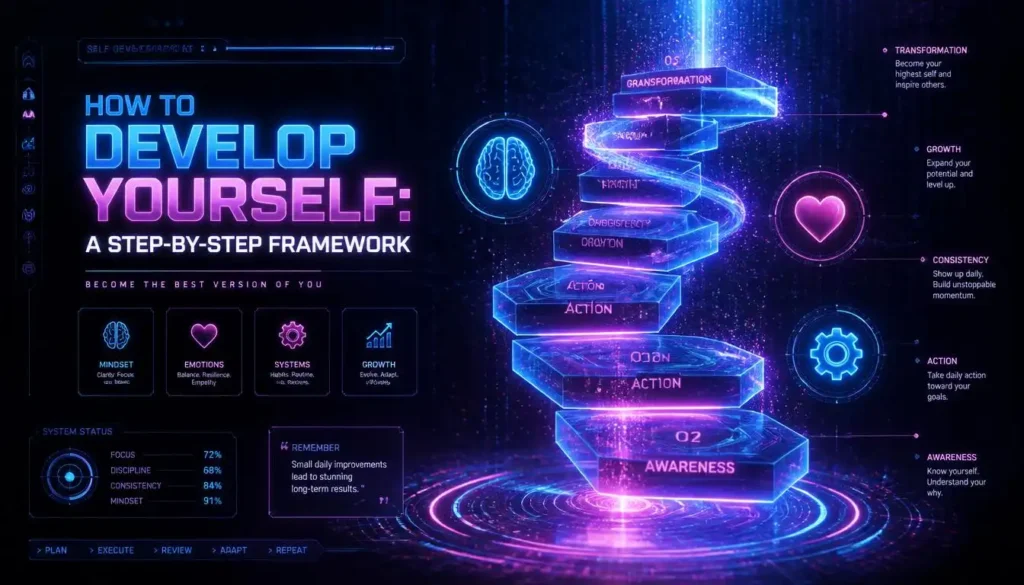

Most advice about self-development is vague. “Get out of your comfort zone.” “Believe in yourself.” None of that tells you what to do on a random Tuesday. Real development happens through a repeatable structure, not a mood. This framework breaks that structure into four stages you can start using today.
What Does It Mean to Develop Yourself?

To develop yourself means deliberately building specific skills, mindsets, and habits over time through structured practice, feedback, and reflection, rather than waiting for growth to happen passively through life experience. It’s active, not accidental. People who “develop themselves” on purpose tend to outpace people who just hope experience will eventually teach them something.
This distinction matters because most people confuse aging with growing. You can spend ten years in the same job and gain one year of real experience repeated ten times. Development requires intention layered atop time.
For a broader look at why this distinction changes outcomes, the personal development importance breakdown covers the research on intentional versus passive growth.
What Are the 4 Stages of Personal Development?
The four stages of personal development are awareness, skill acquisition, application, and integration. Each stage builds on the last, and skipping a stage is usually why development plans stall out or feel like they’re going nowhere.
Stage 1: Awareness
You can’t improve what you haven’t named. Awareness means identifying, specifically, which skill or trait needs work, and why it matters to you right now, not in some abstract future. Vague awareness (“I should be more confident”) isn’t useful. Specific awareness (“I avoid speaking up in meetings because I’m scared of being wrong in front of my manager”) is.
Building this kind of clarity often starts with structured self-awareness activities rather than passive journaling, since most people underestimate their own blind spots without a framework to surface them.
Stage 2: Skill Acquisition
Once you know what to build, you need the actual mechanics of learning it. This is where competence comes from, and competence isn’t a personality trait. According to a framework used by the University of Rochester Medical Center’s Center for Community Health, competence is one of three core psychological needs tied to sustained motivation, built through optimal challenges and clear, specific feedback rather than vague encouragement.
That means the fastest way to build a skill isn’t more motivation. It’s tighter feedback loops. If you’re building a new capability from scratch, our skills-to-learn guide breaks down which skills compound the fastest.
Stage 3: Application
Skills that stay in your head don’t count yet. Application means using the skill in real, often uncomfortable, situations before you feel ready. Confidence follows competence, not the other way around; waiting to feel confident before you act usually means waiting forever.
This is also where most people quietly quit. Applying a new skill at work, in particular, requires navigating real friction, which is covered in more depth in the “how to stay motivated at work” section.
Stage 4: Integration
The final stage is where a deliberate skill becomes an automatic trait. You stop thinking about it and just do it. This is the stage most self-help content ignores entirely, because it’s slow and unglamorous. It happens through repetition, spaced over weeks or months, not through one big breakthrough moment.
How Can I Develop Myself Daily?
You can develop yourself daily by pairing one specific micro-action with an existing routine, tracking it consistently, and reviewing progress weekly rather than trying to overhaul your entire day at once. Daily development isn’t about doing more. It’s about doing the same small thing reliably.
A workable daily structure looks like this:
- Morning: One 10-minute skill-building block tied to your current focus area
- Midday: A single moment of applied practice, even something small like giving direct feedback in a meeting instead of staying quiet
- Evening: Two minutes of reflection on what worked and what you’d adjust tomorrow
Small, structured daily blocks like this pair well with a structured daily task system, since development stalls fastest when it competes for attention with an unstructured, reactive schedule.
What Is a Structural Framework for Self-Development?
A structural framework for self-development is a repeatable system, not a one-time plan, that defines what you’re improving, how you’ll practice it, how you’ll measure progress, and when you’ll reassess the whole approach. Without structure, development relies entirely on memory and mood, which is exactly why New Year’s resolutions rarely survive February.
Framework Components
Focus area: One skill or trait at a time. Trying to develop confidence, discipline, and leadership simultaneously usually means developing none of them well.
Practice method: A specific, repeatable action. Not “work on communication,” but “ask one clarifying question in every meeting this week.”
Feedback mechanism: A way to know if it’s working. This can be self-tracking, a mentor’s input, or measurable outcomes at work.
Review cadence: A fixed weekly or biweekly checkpoint to adjust the plan based on what actually happened, not what you hoped would happen.
This four-part structure is essentially a lightweight version of the same logic behind a full personal development plan, scaled down for people who want daily traction without building an entire strategic document first.
How Do You Write a Personal Development Framework?
Write a personal development framework by identifying your current weakest link across mental, physical, emotional, social, and professional domains, picking the one with the highest impact on your goals, and building a 30-day practice cycle around it before adding a second domain. Most people try to fix everything at once and end up fixing nothing.
Step-by-Step
- Audit honestly. Rate yourself across key domains without softening the score.
- Pick the highest-leverage domain. Not the easiest one. The one blocking the most progress elsewhere.
- Define the practice. One specific, repeatable action tied to that domain.
- Set a review date. 30 days out, non-negotiable.
- Adjust and expand. Only after the first habit is holding on its own.
If personality traits like assertiveness or self-expression are your current weak link, personality development covers targeted exercises for that specific domain.
Why Rise By Inches Approaches Self-Development This Way
Rise By Inches is built on a simple premise: real change comes from inches gained consistently, not sudden transformation. This four-stage framework- awareness, skill acquisition, application, integration- isn’t a one-off article concept. It’s the same underlying architecture behind every guide on this site, whether the focus is emotional resilience, workplace performance, or daily habit design.
Instead of pushing motivational content that fades by Wednesday, Rise By Inches focuses on systems people can actually sustain. If you’re ready to apply this structure to a specific area of your life, the personal development tips hub and better yourself library are the most practical next steps on the site.
FAQ: How to Develop Yourself
What does it mean to develop yourself?
It means deliberately building skills, mindsets, and habits through structured practice and reflection, rather than passively hoping experience alone will create growth.
What are the 4 stages of personal development?
Awareness, skill acquisition, application, and integration. Each stage has to be completed before the next one holds.
How can I develop myself daily?
Pair one specific micro-action with an existing daily routine, track it consistently, and review your progress weekly rather than trying to change everything at once.
What is a structural framework for self-development?
A repeatable system defining your focus area, practice method, feedback mechanism, and review cadence, rather than a one-time list of goals.
How long does personal development take to show results?
Small shifts in behavior often show up within 2-3 weeks of consistent practice, while larger trait-level changes typically take 3-6 months of sustained effort.
Do I need a coach to develop myself effectively?
No. A coach can accelerate feedback, but the four-stage framework works with self-tracking and honest weekly review if structured consistently.
Final Thoughts: Build the System, Then Let It Run
Self-development isn’t a personality overhaul. It’s a system: notice the gap, build the skill, apply it under real pressure, let it become automatic. Repeat with the next domain. That’s the entire framework, and it’s the same one that quietly separates people who transform over the course of a year from those who feel exactly the same every January.
Start with one domain, one practice, one 30-day cycle. Explore the full framework library at Rise By Inches and build your development system one inch at a time.

Pingback: Life Is Growth: How to Embrace Continuous Self-Improvement