
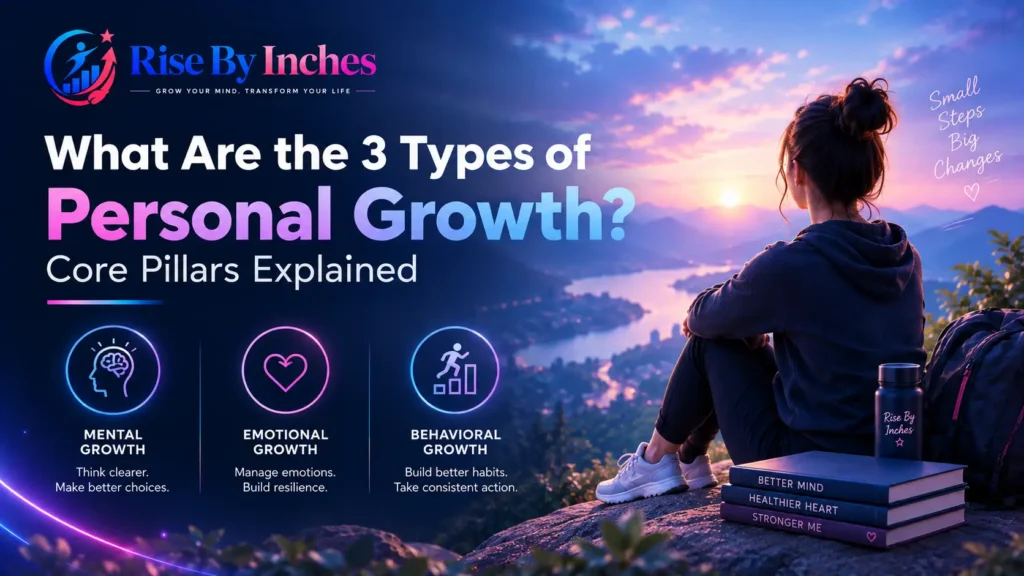

A lot of individuals see personal improvement as a nebulous, huge objective — “be better” — without any real shape. That’s why so many self-improvement projects die out by February. The truth is more straightforward and pragmatic: personal progress comes in three concrete, fixed pillars – intellectual, emotional and spiritual — and true, lasting change occurs when you focus on all three together, instead of chasing one alone. In this article, I’ll explain what each pillar actually means, how they all interact with each other, and how to construct a routine that grows all three at once.
What Are the 3 Main Pillars of Personal Growth?
The three types of personal growth are intellectual, emotional, and spiritual development, and together they cover how you think, how you feel, and why you do any of it in the first place. Intellectual growth sharpens your mind. Emotional growth steadies your reactions. Spiritual growth gives the other two a reason to matter. Skip one, and the whole structure gets wobbly.
Here’s a quick side-by-side so the differences are obvious at a glance:
| Type of Growth | Core Focus | What It Improves | Everyday Example |
| Intellectual | Cognitive development, learning | Critical thinking, skill acquisition | Reading a book outside your usual genre |
| Emotional | Emotional intelligence (EQ) | Self-awareness, emotional regulation | Pausing before reacting to criticism |
| Spiritual | Purpose and values | Existential clarity, inner alignment | Journaling about what actually matters to you |
If you’re still fuzzy on why any of this matters day-to-day, Rise By Inches’ guide to the practical payoff of personal development breaks it down in plain terms.
What Is Intellectual Growth, and Why Does It Matter?
Intellectual growth is the constant sharpening of how you think, study and problem solve. It’s the pillar most people default to when they think of “self-improvement. It includes critical thinking, acquiring skills, metacognition (thinking about your own thinking), and overall mental agility. This is the kind of progress that shows up when you finally get a subject that confused you before, or when you find yourself reasoning through a decision more carefully than before.
Cognitive development doesn’t stop at graduation. According to the National Institute on Deafness and Other Communication Disorders’ overview of neural plasticity, the brain and nervous system retain the ability to adapt and reorganize themselves in response to new conditions and learning throughout life. That’s not a metaphor. It’s a physical process, and it’s the biological reason “you can’t teach an old dog new tricks” is simply wrong.
How Do You Build Intellectual Growth Day to Day?
You don’t need a graduate degree to grow intellectually. Small, repeated friction against your current thinking does most of the work:
- Read material that challenges your existing views, not just material that confirms them
- Practice a skill in short, focused bursts rather than long, unfocused ones
- Ask “why” one more time than feels natural before accepting an explanation
- Teach something you just learned to someone else — it exposes the gaps fast
Rise By Inches has a full walkthrough on how to learn anything fast if you want a structured approach, and the piece on why you should never stop learning covers the long-game case for treating this as a lifelong habit rather than a phase.
What Is Emotional Growth, and How Does It Differ From Intellectual Growth?
Emotional growth is the development of your capacity to recognize, understand, and regulate your own emotions, and to respond well to other people’s emotions. Where intellectual growth is about processing information, emotional growth is about processing feelings — your own and everyone else’s. The difference matters because a person can be brilliant on paper and still struggle badly with conflict, criticism, or plain old stress.
This pillar centers on emotional intelligence (EQ): self-awareness, emotional regulation, empathy, and what psychologists sometimes call affective resilience — the ability to take an emotional hit without getting derailed. Self-awareness, in particular, allows the best people to walk a kind of tightrope: staying confident in their own judgment while remaining open to feedback that stings a little.
How Do You Strengthen Emotional Intelligence?
Emotional growth tends to happen through friction, not comfort. A few concrete practices:
- Name the emotion before you act on it. “I’m frustrated because I feel unheard” changes your next move more than silent stewing does.
- Build in a pause before you respond to conflict. Even ten seconds interrupts the automatic reaction.
- Ask for outside feedback regularly. Most people overestimate their self-awareness, so an outside view can catch blind spots you can’t see from inside your own head.
- Practice psychological safety with the people around you — meaning you make it safe for others to be honest with you, which in turn makes them more likely to be.
If you want a deeper starting point, the site’s guides on what it actually means to be self-aware, how to become more self-aware, and self-awareness activities for adults all work well as a next step. There’s also a practical roundup of real-life examples of emotional health that shows what this pillar looks like outside of theory.
What Is Spiritual Growth, and Why Is It Essential to Overall Self-Development?
Spiritual growth is the process of clarifying your values, sense of purpose, and inner alignment — and it doesn’t require religion to matter. This is the pillar people skip most often, usually because the word “spiritual” gets misread as strictly religious. In a personal-development context, it’s closer to existential clarity: knowing what you actually stand for and whether your daily choices align with it.
Spiritual growth is also where mindfulness lives. Attention research backs this up directly: mindfulness involves keeping attention or awareness on the present moment without making judgments, and according to the National Center for Complementary and Integrative Health, mindfulness-based practices may be as effective as established therapies like cognitive behavioral therapy for anxiety and depression. That’s a meaningful finding for anyone treating “spiritual” as fluff — the practice has measurable psychological weight.
How Do You Cultivate Spiritual Growth Without Religion?
- Journal on questions like “what would I regret not doing in five years?”
- Spend unstructured time in nature or silence — no podcast, no phone
- Identify your top three values and audit last week’s decisions against them
- Practice a short daily mindfulness session, even five minutes
Rise By Inches has two resources that pair well here: self-discovery questions for values clarification, and reflective questions for clarity for a more structured journaling practice. The inner work guide to understanding yourself goes even deeper if this pillar is new territory for you.
How Do the Three Types of Personal Growth Work Together?
None of the three pillars operates in isolation — intellectual, emotional, and spiritual growth reinforce each other through daily behavior and habit formation. Behavioral integration is what turns insight into actual change. You can understand emotional regulation intellectually and still lose your temper in traffic if you haven’t built the habit. You can feel a strong sense of purpose and still stall out if you lack the cognitive skills to plan toward it.
This is where habit formation, somatic awareness (noticing what’s happening in your body, not just your head), and lifestyle design come in. A person who sleeps badly, skips movement entirely, and never sits still long enough to think clearly is fighting an uphill battle on all three pillars at once — physical vitality underwrites the other two more than most people give it credit for.
A few ways the pillars visibly interact:
- Intellectual insight without emotional regulation often produces someone right in arguments and lonely in relationships
- Spiritual clarity without intellectual follow-through produces someone with beautiful values and no plan to act on them
- Emotional stability without purpose produces someone calm but adrift, going through the motions without direction
If you want a practical bridge between insight and habit, the guides on building self-discipline and habit change are built specifically for that gap. The 7-day mindset reset is a solid short-term framework if you want to work on all three pillars at once without immediately overhauling your entire life.
How Do You Measure Progress Across All Three Types of Personal Growth?
Progress across the three types of personal growth is measurable through a mix of self-tracking, behavioral evidence, and outside feedback — not just how you feel on a given day. Feelings are unreliable measurement tools; behavior and outcomes are not.
Here’s a simple way to track each pillar without turning it into another chore:
| Pillar | What to Track | Sign of Progress |
| Intellectual | New skills attempted, books finished, questions asked | You catch flawed reasoning faster, including your own |
| Emotional | Reaction time to conflict, feedback from others | You recover from setbacks quicker and hold fewer grudges |
| Spiritual | Alignment between stated values and calendar/spending | Fewer moments of “why did I even do that” |
A simple monthly check-in — even five bullet points per pillar — beats a vague sense that you’re “working on yourself.” The 7-day personal wellness plan and personal goals examples and resources on Rise By Inches both offer templates that make this tracking concrete rather than abstract.
Can You Focus on One Type of Personal Growth Without the Others?
Yes, you can focus on one pillar at a time, but neglecting the other two for too long usually creates a ceiling on how far any single pillar can take you. It’s normal and often smart to prioritize — someone in a mental health crisis should focus on emotional stability first, not intellectual stretch goals. But long-term sustainable growth eventually requires circling back to whichever pillar was left behind.
Think of it less like three separate projects and more like three legs of a stool. Two strong legs and one weak one still means the stool wobbles.
Frequently Asked Questions
What are the 3 main pillars of personal growth?
The three main pillars are intellectual growth (thinking and learning), emotional growth (feeling and regulating), and spiritual growth (purpose and values). Most personal-development frameworks fold everything else — physical health, career, relationships — into how these three pillars show up in daily life.
How does emotional growth differ from intellectual growth?
Intellectual growth improves how you process information and solve problems, while emotional growth improves how you process and regulate feelings. A person can be intellectually sharp and emotionally underdeveloped at the same time, which is exactly why both need separate attention.
Why is spiritual growth essential to overall self-development?
Spiritual growth supplies the “why” behind everything else — without a sense of purpose or clear values, intellectual and emotional gains tend to feel directionless. It’s also linked to lower anxiety and better emotional regulation through practices like mindfulness.
How do you measure progress across all three types of personal growth?
Track concrete behavior rather than mood: skills attempted for intellectual growth, reaction time to conflict for emotional growth, and alignment between stated values and actual choices for spiritual growth. A short monthly check-in per pillar works better than relying on how motivated you feel that day.
Can you focus on one type of personal growth without the others?
Yes, temporarily prioritizing one pillar is normal and sometimes necessary. Long-term, though, neglecting the other two tends to cap the progress the prioritized pillar can deliver.
Is personal growth the same as personal development?
They’re closely related and often used interchangeably. Still, personal growth usually refers to internal shifts (mindset, emotional maturity, values), while personal development often includes external, skill-based goals such as career advancement. The personal development guide on Rise By Inches covers how the two overlap in practice.
Bringing the Three Pillars Together
The moment you divide personal progress into intellectual, emotional and spiritual labour — three separate pillars that reinforce rather than fight for your attention – it stops feeling ambiguous. Select one obviously neglected pillar and establish one simple daily action for it this week. Then, honestly track it for thirty days. This is a lot more useful beginning point than a New Year’s goal that strives to cure everything all at once.
For more structured ways to work on all three pillars, explore Rise By Inches’ full library of self-improvement guides and start wherever feels most urgent right now.



Pingback: 10 Proven Ways to Foster Personal Growth at Work (2026)