
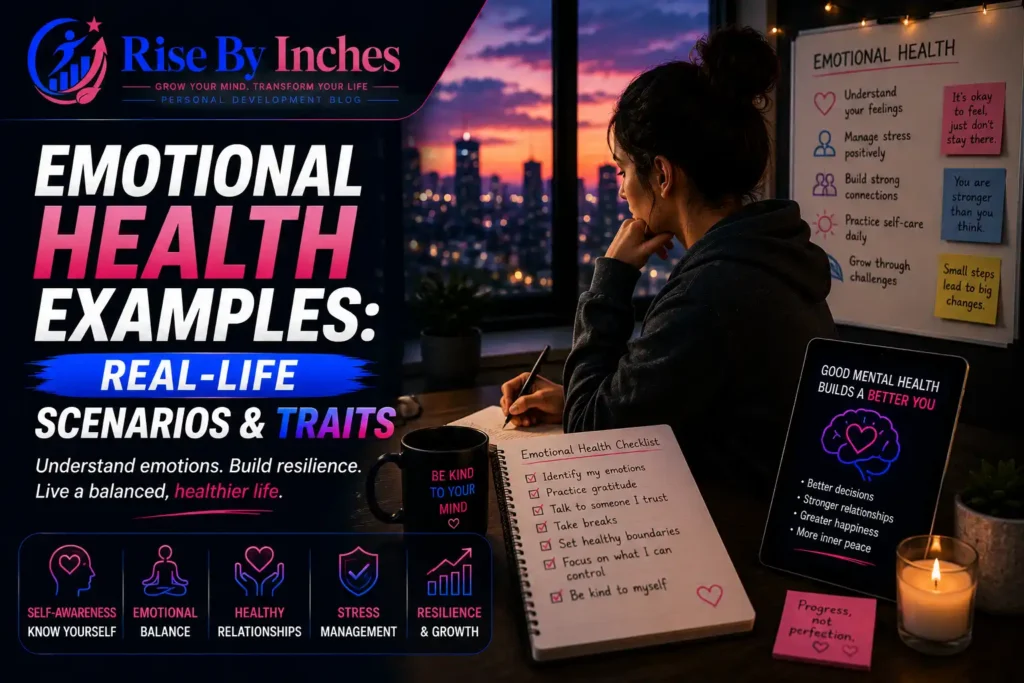

Emotional health isn’t a feeling you have once and keep forever. It shows up in small, repeated choices — how you respond when a coworker snaps at you, whether you can sit with disappointment without spiraling, how honestly you name what you’re feeling. Emotional health examples in real life include setting a boundary at work without guilt, pausing before reacting in an argument, and naming a feeling instead of suppressing it. This guide breaks down what emotional wellness actually looks like across work, relationships, and daily decisions, with concrete scenarios you can recognize in your own life.
What Are 5 Examples of Good Emotional Health in Real Life?
Five clear examples of good emotional health are: naming your emotions accurately rather than avoiding them; setting a boundary without overexplaining; recovering from a setback without spiraling into self-blame; asking for help before burning out; and staying present during conflict rather than shutting down or exploding. Each of these is observable behavior, not an abstract trait — which is exactly why they’re useful benchmarks.
Here’s how each one plays out day to day:
| Example | What It Looks Like | What Poor Emotional Health Looks Like Instead |
| Naming emotions | “I’m anxious about this deadline, not angry at you” | Snapping at someone without knowing why |
| Setting boundaries | “I can’t take this on right now” | Saying yes, then resenting the commitment |
| Recovering from setbacks | Feeling disappointed, then moving forward | Replaying the failure for days |
| Asking for help | Telling a manager you’re overloaded | Working through exhaustion in silence |
| Staying present in conflict | Listening, then responding calmly | Going silent or escalating immediately |
None of these require perfection. Emotionally healthy people still get frustrated, still have bad days — the difference is how quickly they notice what’s happening and choose a response instead of being run by the reaction.
What Is the Difference Between Mental Health and Emotional Health?
Emotional health is a specific piece of the broader concept of mental health — it refers to your ability to recognize, understand, and manage your emotions. In contrast, mental health encompasses your overall psychological, emotional, and social well-being. Think of mental health as the umbrella and emotional health as one of the ribs holding it up, alongside psychological resilience and social functioning.
The CDC defines positive emotional well-being as the ability to manage emotions well while maintaining a sense of meaning, purpose, and supportive relationships. This definition ties emotional health directly to daily functioning rather than a diagnosis or a clinical label. You can have strong emotional health and still be working through a mental health condition, and you can technically have no diagnosed condition while still struggling with emotional regulation. They’re related, but they’re not interchangeable, and confusing the two often leads people to dismiss emotional struggles as “not serious enough” to address.
How Does Emotional Health Look in Daily Decision-Making?
Emotional health shows up in daily decision-making as the pause between feeling something and acting on it — checking whether a reaction fits the situation before sending the email, making the purchase, or saying the sharp comment. This isn’t about suppressing emotion. It’s about letting emotion inform a decision without letting it hijack one.
What Does This Look Like at Work?
Real-life examples of strong emotional health at work tend to cluster around a few recurring situations:
- Receiving critical feedback — an emotionally healthy response involves feeling the initial sting, then asking a clarifying question instead of getting defensive
- Missing a deadline — owning the miss directly with a manager rather than crafting an elaborate excuse or going quiet out of shame
- Disagreeing with a colleague — stating the disagreement plainly without turning it into a personal jab
- Feeling overlooked for a promotion — acknowledging the disappointment honestly, then having a direct conversation about growth instead of quietly checking out
Psychologist Susan David, whose Harvard Business Review framework on emotional agility has become one of the most cited models in workplace psychology, describes this as the difference between being “hooked” by a thought or feeling and having the flexibility to notice it, name it, and choose a values-aligned response instead. Getting hooked looks like firing off an angry reply. Emotional agility looks like drafting the reply, sitting on it for ten minutes, and rewriting the first line.
What Does This Look Like in Personal Relationships?
How to demonstrate emotional health in personal relationships usually comes down to a handful of repeatable habits:
- Saying what you need directly instead of expecting a partner or friend to guess
- Apologizing without over-apologizing — owning a mistake without spiraling into self-flagellation that makes the other person comfort you
- Tolerating a partner’s bad mood without absorbing it as your own
- Ending conversations that have gone in circles rather than rehashing the same argument at 1 a.m.
- Celebrating someone else’s success without it triggering comparison or resentment
Rise By Inches has covered the groundwork for several of these habits in its guide to understanding yourself through inner work, since most relationship-level emotional health starts with self-awareness before it ever becomes about the other person.
What Are Healthy Coping Mechanisms in Practice?
Healthy coping mechanisms are specific, repeatable actions that help you process difficult emotions without avoiding them or taking them out on others — examples include journaling, physical movement, talking to a trusted person, and structured problem-solving rather than rumination. The key distinction from unhealthy coping isn’t the emotion itself; it’s whether the response actually resolves tension or temporarily numbs it.
A quick comparison makes the difference concrete:
| Situation | Healthy Coping | Unhealthy Coping |
| Stressful week at work | Going for a walk, talking it through with a friend | Doom-scrolling for hours, skipping meals |
| Conflict with a partner | Taking a 20-minute break, then returning to talk | Giving the silent treatment for days |
| Feeling overwhelmed | Writing down a priority list | Numbing out with excessive screen time |
| Disappointment | Naming the feeling, allowing it briefly | Immediately distracting yourself to avoid feeling it |
Cognitive behavioral therapy (CBT) — one of the most researched approaches in clinical psychology — is built around this same principle: thoughts, feelings, and behaviors are connected, and changing how you respond to a thought can break the emotional spiral that follows. You don’t need formal therapy to borrow the core idea: notice the automatic thought, question whether it’s accurate, and choose a response rather than defaulting to the first reaction.
What Does Setting Personal Boundaries Actually Look Like?
Setting personal boundaries in real life means clearly communicating a limit — on your time, energy, or emotional bandwidth — without over-justifying it or apologizing excessively for having one. Boundaries fail most often not because people don’t understand the concept, but because they dilute the boundary with guilt-driven over-explanation.
A few real-world examples:
- At work: “I can help with this next week, not today” instead of taking on an urgent task that isn’t yours while quietly resenting it
- With family: “I’m not discussing that topic at dinner” instead of enduring an uncomfortable conversation to avoid conflict
- With friends: Declining a last-minute plan without a lengthy excuse
- With yourself: Closing your laptop at a set time instead of letting work bleed into the whole evening
Boundaries are one of the clearest, most visible signs of emotional self-regulation — because holding one under social pressure requires tolerating the discomfort of someone else’s disappointment without abandoning your own limit.
What Are the Signs of Good Emotional Health?
Signs of good emotional health include self-awareness of your own emotional patterns, the ability to self-soothe without external validation, resilience after setbacks, healthy relationships built on honest communication, and the flexibility to adapt when circumstances change. These signs tend to overlap heavily with what psychologists call emotional intelligence — the capacity to perceive, understand, and manage emotions in yourself and others.
Common, observable signs include:
- Recovering from a bad day without it bleeding into the next one
- Being able to sit with uncomfortable emotions instead of immediately needing to fix or escape them
- Giving and receiving feedback without it becoming a referendum on your worth
- Noticing your triggers and having a plan for them
- Feeling equipped to handle stress without it consistently overwhelming your ability to function
If several of these feel unfamiliar rather than aspirational, that’s worth paying attention to — not as a failure, but as a starting point. Rise By Inches breaks down the foundational skill underlying most of these signs in its guide to self-awareness, since self-awareness is the prerequisite on which most of these traits build.
How Can You Build Emotional Resilience Daily?
Building emotional resilience daily comes down to small, consistent practices — checking in with your emotional state, moving your body, maintaining supportive relationships, and reflecting on setbacks without catastrophizing them — rather than any single dramatic intervention. Resilience isn’t about avoiding hard emotions. It’s about recovering from them faster each time.
A practical daily structure looks like this:
- Morning check-in — a two-minute pause to notice what you’re carrying into the day
- Midday reset — a short walk, breathing exercise, or a few minutes away from screens
- Evening reflection — briefly naming what went well and what felt hard, without over-analyzing either
- Weekly connection — maintaining at least one conversation that isn’t transactional or task-focused
The NIMH’s emotional wellness resources reinforce a similar structure — framing emotional well-being as something actively maintained through consistent, small practices rather than something you either have or don’t. Rise By Inches expands on this daily approach in its 7-day mindset reset guide, which walks through a structured week of exactly this kind of practice.
Frequently Asked Questions
What is an example of emotional wellness in a stressful situation?
An example is noticing you’re overwhelmed before a deadline, telling a manager directly instead of pushing through silently, and adjusting your workload rather than burning out. The key marker is recognizing the emotion early and acting on it constructively rather than ignoring it until it becomes a crisis.
Can someone have good emotional health but poor mental health?
Yes. Emotional health refers specifically to how well you recognize and manage emotions day to day. In contrast, mental health is broader and can include diagnosed conditions like anxiety or depression that exist independently of someone’s emotional regulation skills.
What’s a simple daily habit to improve emotional health?
A short daily check-in — pausing to name what you’re feeling without judging it — is one of the simplest, most researched habits for improving emotional self-regulation over time. It takes under five minutes and builds the same muscle used in more formal mindfulness practices.
How is emotional agility different from emotional intelligence?
Emotional intelligence is the broader capacity to perceive and understand emotions in yourself and others; emotional agility, a term coined by psychologist Susan David, refers specifically to the flexibility to notice a difficult thought or feeling without getting stuck in it.
Is it normal to struggle with emotional regulation sometimes?
Yes, entirely normal. Emotional health isn’t about never struggling — it’s about having tools to recognize the struggle and respond to it, rather than expecting to feel calm and in control at all times.
Where to Go From Here
Emotional health isn’t built in a single breakthrough moment — it’s built in the ordinary decisions: the boundary you hold, the reaction you pause before sending, the honest conversation you have instead of avoiding. Pick one example from this guide that felt closest to a situation you’re currently in, and practice just that one skill for a week before adding another.
For a deeper look at the self-awareness work underpinning most of these examples, explore Rise By Inches’ guide to personal growth and start building the habits that make emotional health feel less like theory and more like practice.