
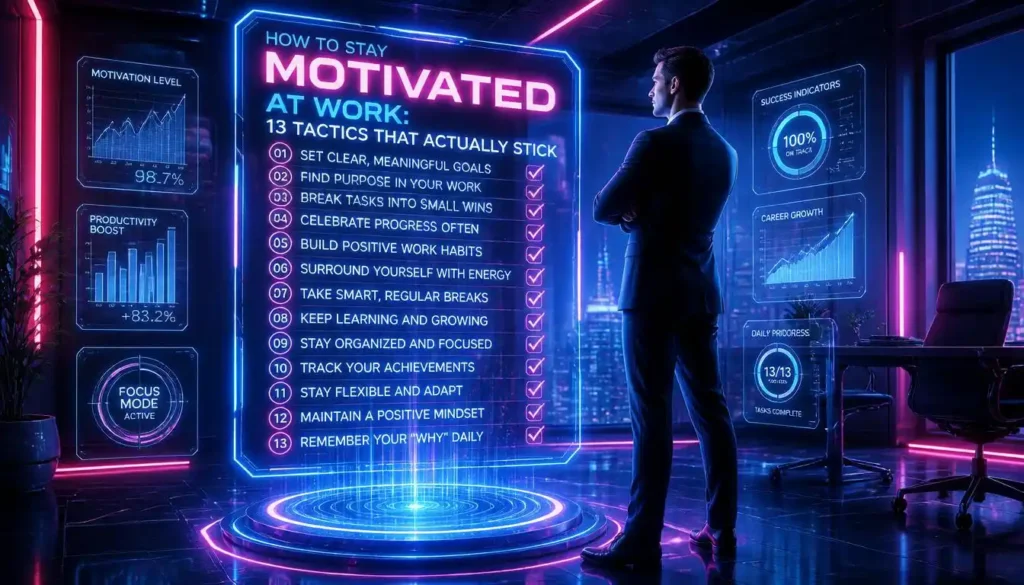

Some mornings the work just flows. Most mornings, it doesn’t. If you’re staring at your inbox wondering how to stay motivated at work when nothing about the job feels new or exciting anymore, you’re not broken — you’re running on the wrong fuel. This guide breaks down 13 tactics, grounded in behavioral psychology, that rebuild motivation from the inside out rather than papering it over with another cup of coffee.
What Causes Loss of Motivation at Work?
Loss of motivation at work usually stems from a mismatch between effort and reward, unclear goals, or accumulated cognitive fatigue — not laziness. When your brain stops seeing a clear link between what you do and what you get out of it, engagement drops fast. Burnout, monotony, and lack of autonomy are the three most common drivers, and each requires a different fix, which is exactly why generic “just push through it” advice rarely works.
1. Diagnose Before You Treat
Before trying any tactic below, spend five minutes identifying which category you’re in: bored, burned out, or blocked. Bored means the work is too easy. Burned out means you’ve been running on empty for too long. Blocked means something concrete — a bad manager, unclear expectations, a broken process — is standing in your way. The right tactic changes depending on which one you’re facing.
How Do I Find Motivation to Work Again?
Rebuilding motivation starts with reconnecting to intrinsic motivation — the internal sense of purpose, mastery, or autonomy behind a task — rather than relying on extrinsic rewards like bonuses or praise, which fade fast. This is the foundation of self-determination theory, developed by psychologists Edward Deci and Richard Ryan, which identifies autonomy, competence, and relatedness as the three psychological needs that drive sustained motivation.
2. Anchor Tasks to a Personal “Why”
Generic company mission statements don’t move the needle. What works is connecting your specific task to something you personally care about — skill-building, financial stability, proving something to yourself. Write it down next to your to-do list. It sounds small. It isn’t.
3. Use the Pomodoro Technique to Break Task Paralysis
The Pomodoro Technique — 25 minutes of focused work followed by a 5-minute break — works because it lowers the psychological barrier to starting. You’re not committing to “finish the project.” You’re committing to 25 minutes. That’s a much smaller ask, and it tricks your brain into starting, which is usually the hardest part.
4. Chase the Dopamine Hit Deliberately
Dopamine drives motivation not through reward itself, but through the anticipation of reward — meaning visible progress markers, like checking off small tasks, trigger motivation more reliably than waiting for a big payoff at the end. Break large projects into small, checkable pieces. Each checkmark is a tiny dopamine hit that keeps momentum going.
5. Set SMART Goals Instead of Vague Ones
The SMART goal framework — Specific, Measurable, Achievable, Relevant, Time-bound — turns “do better this quarter” into “submit two client proposals by Friday.” Vague goals create anxiety because there’s no clear finish line. Specific goals create momentum because you know exactly what winning looks like.
What Are the Best Practical Ways to Stay Motivated During a 9-to-5?

Practical daily motivation tactics include time-blocking, scheduled micro-breaks, and protecting your highest-energy hours for your hardest tasks, rather than letting your calendar dictate when you do deep work. These aren’t abstract psychology concepts — they’re scheduling decisions you can make before your next work day even starts.
6. Time Block Your Calendar Around Energy, Not Hours
Time blocking productivity works best when it’s built around your actual energy patterns, not an arbitrary 9-to-5 grid. If you’re sharpest at 9 a.m., that’s when your hardest task goes — not your inbox. Save email and admin work for your post-lunch dip, when cognitive fatigue naturally sets in anyway.
7. Take Micro Breaks Before You Need Them
Micro breaks — 60 to 90 seconds of standing, stretching, or looking away from the screen — prevent the kind of cognitive fatigue that makes a 4 p.m. slump feel unbearable. The mistake most people make is waiting until they’re already exhausted to take a break. By then it’s too late; the dip has already happened.
8. Beat Procrastination With the Two-Minute Rule
Tactics to beat procrastination at work usually come down to lowering the activation energy of starting. If a task takes less than two minutes, do it immediately. If it’s bigger, break off a two-minute piece — “open the document,” “write one sentence” — and just do that piece. Momentum builds from there almost every time.
9. Protect One “Flow State” Block Per Day
Flow state triggers — a clear goal, immediate feedback, and a task that matches your skill level exactly — are more likely to appear when you protect at least one uninterrupted 90-minute block daily. Turn off notifications. Close the extra tabs. Flow doesn’t happen in fragments.
How Can I Stay Focused at Work Despite Burnout?
Burnout recovery requires reducing total cognitive load before productivity tactics can work again — meaning fewer decisions, fewer context switches, and realistic boundaries around after-hours availability. No productivity hack fixes burnout. It only makes burnout look more efficient for a week before the crash comes back harder.
10. Apply Executive Dysfunction Strategies, Even If You’re Not Diagnosed
Executive dysfunction strategies — externalizing tasks onto lists, using timers instead of willpower, reducing the number of decisions you make per day — help anyone whose brain is running low on bandwidth, not just people with ADHD. Decision fatigue is real, and burnout accelerates it.
11. Rebuild Work-Life Integration, Not Just Balance
Work-life integration acknowledges that the two don’t split cleanly, especially for remote and hybrid workers. Instead of pretending you can wall off work entirely, build intentional transition rituals — a walk before logging on, a hard stop at a specific time — that signal to your brain when one mode ends and the other begins.
12. Address Workplace Motivation for Remote Employees Specifically
Workplace motivation for remote employees often collapses without the built-in social cues of an office — no one physically leaving at 5, no hallway conversation to break up the day. If you work remotely, deliberately schedule the structure an office would otherwise provide: a fixed start time, a lunch break away from your desk, a co-working space or virtual body-doubling session if isolation is part of the problem.
13. Reassess Career Burnout Honestly, Not Just Symptomatically
Sometimes the tactics above manage the symptoms of career burnout without addressing the cause. If motivation hasn’t returned after weeks of genuinely trying these strategies, it may be worth asking whether the role itself, not your habits, is the actual problem. That’s a harder conversation, but an honest one.
Where Rise By Inches Fits Into Your Motivation Reset
Most workplace advice treats motivation like a switch you flip once. It isn’t. It’s closer to a habit system, one that needs the same structure you’d apply to any other part of personal growth. That’s the lens Rise By Inches takes — motivation isn’t separate from the rest of your development; it’s connected to how you set personal development goals, how you develop a growth mindset, and how deliberately you structure your daily tasks.
If burnout is part of your story right now, our guide on restoring energy through self-care pairs directly with the recovery tactics above. And if you’ve already worked through motivation and you’re ready to build sustainable, long-term momentum, the personal development guide and personal wellness plan walk you through the next steps.
Frequently Asked Questions
How do I find motivation to work?
Start by identifying whether you’re bored, burned out, or blocked, since each requires a different fix. From there, reconnect the task to a personal reason that matters to you, and use small, visible progress markers to rebuild momentum rather than waiting for a single big win.
What causes loss of motivation at work?
Loss of motivation is typically caused by a mismatch between effort and reward, unclear goals, or cognitive fatigue from sustained overwork. It’s rarely a character flaw — it’s usually a signal that something in your workflow or expectations needs adjusting.
How do you fix lack of motivation?
Fixing lack of motivation starts with smaller, more specific goals using the SMART framework, paired with visible progress tracking and protected blocks of focused, uninterrupted work time. Larger structural issues, like burnout or role mismatch, need to be addressed separately from daily productivity tactics.
How can I stay focused at work?
Staying focused comes down to protecting your highest-energy hours for your hardest tasks, using tools like the Pomodoro Technique to reduce starting friction, and taking micro breaks before fatigue sets in, not after. Notifications and constant context-switching are the biggest silent killers of focus.
Can workplace motivation tips work for remote employees?
Yes — remote workers often need to manually recreate the structural motivation cues an office provides, like fixed start times and defined breaks, since there’s no natural end-of-day signal like colleagues leaving. Scheduling deliberate transitions between work and home life matters more for remote employees than for those in an office.
Is career burnout different from everyday lack of motivation?
Yes — everyday lack of motivation is often temporary and task-specific, while career burnout is a deeper, sustained state of emotional and cognitive exhaustion that doesn’t resolve with a single good week. Burnout usually requires reducing overall load and reassessing boundaries, not just applying more productivity tactics.
Bringing It All Together
Motivation isn’t something you either have or don’t. It’s a system, built from small, repeatable inputs — clear goals, protected focus time, honest recovery, and a reason that actually matters to you. Some days will still be hard. That’s normal. But with the right structure in place, hard days stop turning into hard months.
Ready to build the habits that keep motivation steady long after the initial push fades? Explore more strategies at Rise By Inches, or get in touch if you want a more personalized starting point.



Pingback: How to Develop Yourself: A Step-by-Step Framework 2026
Pingback: How to Change Your Mindset:Best Practical 7-Day Reset
Pingback: How to Overcome Procrastination & Laziness best Plan 2026
Pingback: 10 Proven Ways to Foster Personal Growth at Work (2026)