
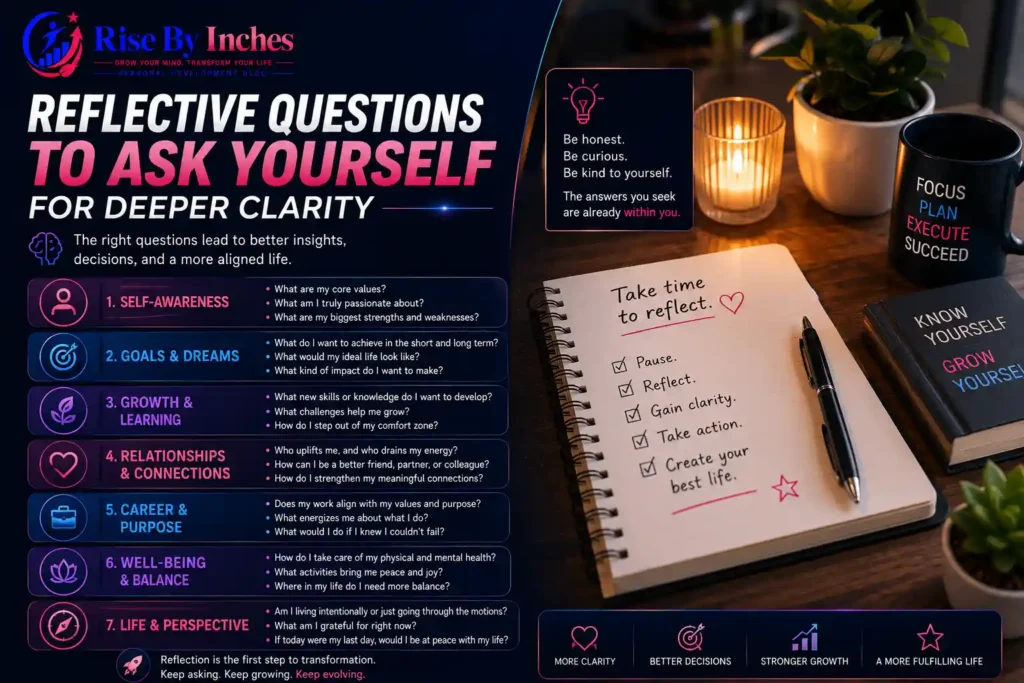

Most people move through their week reacting to whatever lands in front of them, never pausing to ask whether any of it actually matters. Reflective questions cut through that noise by forcing a direct, honest look at what you’re doing and why, which is the fastest route to real clarity. This guide covers the specific questions worth asking, when to ask them, and how to turn scattered thinking into a repeatable self-inquiry habit.
What Are Reflective Questions, and Why Do They Work?
Reflective questions work because they interrupt automatic thinking and force deliberate examination of your assumptions, motives, and patterns. Unlike casual self-talk, a reflective question has a specific job: to surface something you weren’t consciously aware of a minute ago.
Cognitive psychology draws a clear line between rumination — circling the same worry without resolution — and genuine reflection, which moves toward insight. A well-formed question does the second thing. It doesn’t just ask “what’s wrong,” it asks “what pattern keeps showing up, and what’s driving it.” Harvard Business School research led by Francesca Gino found that reflecting on completed work measurably improves how well people perform that same work in the future. The mechanism isn’t magic — it’s that reflection converts raw experience into something you can actually learn from.
At Rise By Inches, self-inquiry work like this connects directly to the deeper self-awareness practices that tend to produce lasting behavior change rather than a one-time insight that fades by Thursday.
What Are 5 Deep Reflective Questions to Ask Yourself?
Five reflective questions that consistently yield useful clarity target avoidance, values, patterns, fear, and true motivation rather than surface-level facts. These aren’t meant to be answered in one sitting — sit with discomfort if it shows up.
- What am I avoiding right now, and what would happen if I stopped avoiding it?
- When did I last feel genuinely energized, and what was actually happening in that moment?
- What decision have I been putting off because I’m afraid of the answer?
- Whose expectations am I currently living by — mine, or someone else’s?
- If I had to explain my current choices to my future self in five years, what would I say?
These map closely to guidance from Harvard Business Review’s Jennifer Porter, who recommends starting reflection with a handful of genuinely important questions rather than a vague intention to “think more.” Specificity is what separates a productive question from a mental loop.
How Does Self-Reflection Lead to Personal Clarity?
Self-reflection leads to clarity by making the implicit explicit — turning vague unease or excitement into a named, examined thought you can actually act on. Clarity isn’t a feeling that arrives on its own; it’s the output of a process.
The process generally moves through three stages:
| Stage | What Happens | Example |
| Noticing | You register that something feels off or unresolved | “I keep dreading Monday mornings” |
| Naming | You put language to the specific cause | “It’s not the job — it’s this one recurring meeting” |
| Deciding | You choose a concrete response | “I’ll propose changing the meeting format this week” |
Skipping straight from noticing to deciding — without naming — is where most people get stuck. They know something’s wrong but act on a guess instead of the actual cause, which usually solves the wrong problem. A 2018 meta-analysis published in the journal Mindfulness found that interventions built around mindful awareness measurably improved people’s ability to identify and describe their own internal emotional states — which is exactly the “naming” stage above.
What Is the Best Way to Practice Self-Inquiry for Life Direction?
The best self-inquiry practice for life direction combines a fixed time, a written format, and a short list of recurring questions, since consistency matters more than any single “perfect” question. Sporadic deep-thinking sessions rarely produce the same clarity as a regular practice.
A workable structure:
- Pick a cadence. Weekly works better than daily for direction-level questions; daily works better for immediate stressors.
- Write, don’t just think. Writing forces you to finish a thought instead of drifting to the next one.
- Reuse a core set of questions. Answering the same 3–4 questions over months reveals patterns a single session never will.
- Separate reflection from planning. Reflect first, plan second — mixing them turns reflection into a to-do-list exercise and kills insight.
For life-direction questions specifically, pair this practice with a written life-planning guide, which gives the reflective insight a concrete place to go instead of evaporating after the journal entry.
How Can Journal Prompts Help With Mental Clarity?
Journal prompts help with mental clarity because writing forces sequential, linear thought, which slows down the scattered, associative way the mind normally jumps between worries. The physical act of writing is real cognitive work, not just recording.
Useful prompt categories to rotate through:
Daily clarity prompts
- What’s the one thing that would make today feel successful?
- What am I carrying into today that belongs to yesterday?
Weekly pattern prompts
- What kept coming up this week that I haven’t addressed?
- Where did I feel most like myself?
Decision-clarity prompts
- What’s the actual decision I’m avoiding, stated in one sentence?
- What would I tell a friend in this exact situation?
Research on expressive writing consistently links this kind of structured, written reflection to reduced anxiety and improved mood over time when practiced regularly. If mental clutter is the main driver behind wanting this practice, the habit change guide covers how to build journaling into something that survives past the first two weeks.
How Do Reflective Questions Work at Work vs. in Personal Life?
Reflective questions at work tend to focus on performance, boundaries, and impact, while personal reflective questions tend to focus on values, relationships, and meaning — but the underlying mechanism is identical. Knowing which category you’re in helps you pick the right question instead of a generic one that doesn’t quite fit.
At work, useful questions include:
- What am I doing that no longer needs to be done by me?
- Where am I saying yes out of habit rather than actual priority?
- What feedback have I received but not actually acted on?
In personal life, useful questions shift toward:
- What relationship in my life needs more attention than I’m giving it?
- What would I regret not doing this year?
- What version of “successful” am I actually chasing, and is it mine?
Workplace-specific reflection pairs naturally with goal structure. If you’re using self-inquiry to sharpen actual targets rather than process feelings, the reflective questions built into SMART goal-setting walk through that more tactical application.
What Blocks Clarity, and How Do You Work Around It?
The biggest blocker to clarity isn’t a lack of good questions — it’s answering too fast, before sitting with any real discomfort the honest answer might bring. Most people ask themselves a hard question and immediately supply a comfortable, half-true answer to end the discomfort.
Common blockers:
- Answering to feel better, not to be accurate. Notice when your answer arrives suspiciously fast and sounds a little too tidy.
- Reflecting only when things go wrong. This trains your brain to associate self-inquiry with crisis, so you avoid it otherwise.
- No follow-through. An insight that never leads to changed action is just an interesting thought, not clarity.
- Doing it entirely in your head. Unwritten reflection loops rather than resolves.
The University of Florida’s Klodiana Lanaj and colleagues found that a brief, structured daily reflection focused on personal strengths led leaders to report less depletion and greater engagement, with effects lasting into the evening — evidence that even short, consistent reflection beats occasional long sessions. If procrastination is the real blocker behind avoiding this practice altogether, overcoming procrastination addresses that root cause directly.
How Do You Build Reflective Questions Into a Daily Routine?
Building reflection into a daily routine works best when it’s attached to an existing habit — like morning coffee or the evening commute — rather than treated as a separate task competing for willpower. Habit stacking removes the “will I remember to do this” problem entirely.
A simple three-step build:
- Anchor it. Attach a 5-minute reflection window to something you already do without thinking, like brewing coffee or closing your laptop.
- Cap the question count. Two or three questions max daily — more than that turns into avoidance disguised as thoroughness.
- Track your answers somewhere. A simple notes app or notebook works fine; the goal is being able to look back in a month and spot patterns.
For structuring this alongside the rest of a working day, the structure daily tasks and organize your day guides both offer frameworks that leave room for a reflection block without crowding out actual work.
FAQ: Reflective Questions for Clarity
What are 5 deep reflective questions to ask yourself?
Strong starting questions include what you’re avoiding, when you last felt genuinely energized, what decision you keep delaying, whose expectations you’re actually living by, and how you’d explain your current choices to your future self.
How does self-reflection lead to personal clarity?
Self-reflection converts a vague feeling of unease or excitement into a specific, named cause you can act on, moving through noticing, naming, and deciding rather than jumping straight from discomfort to a guessed solution.
What is the best way to practice self-inquiry for life direction?
A weekly written practice with a small, recurring set of questions yields more insight over time than sporadic, unstructured deep-thinking sessions.
How can journal prompts help with mental clarity?
Writing forces linear, sequential thought instead of the mind’s normal scattered pattern, and research on expressive writing links this kind of structured reflection to reduced anxiety and improved mood.
Do reflective questions work differently for work versus personal life?
The mechanism is the same, but work-focused questions tend to target performance and boundaries, while personal questions lean toward values and relationships — picking the right category matters more than the exact wording.
What’s the biggest mistake people make with self-reflection?
Answering too quickly with a comfortable half-truth instead of sitting with an honest, sometimes uncomfortable answer — speed is usually a sign the answer isn’t the real one.
Where to Go From Here
Clarity isn’t something you stumble into — it’s built through consistent, specific questions asked on a schedule you actually keep. Pick two or three questions from this guide, attach them to something you already do daily, and write the answers down instead of just thinking them. Revisit your answers in a month and look for the pattern you didn’t expect.
As a next step, to turn this kind of insight into a structured plan rather than a standalone habit, Rise By Inches’ personal development guide and resources on understanding yourself both build directly on the self-inquiry work covered here.