
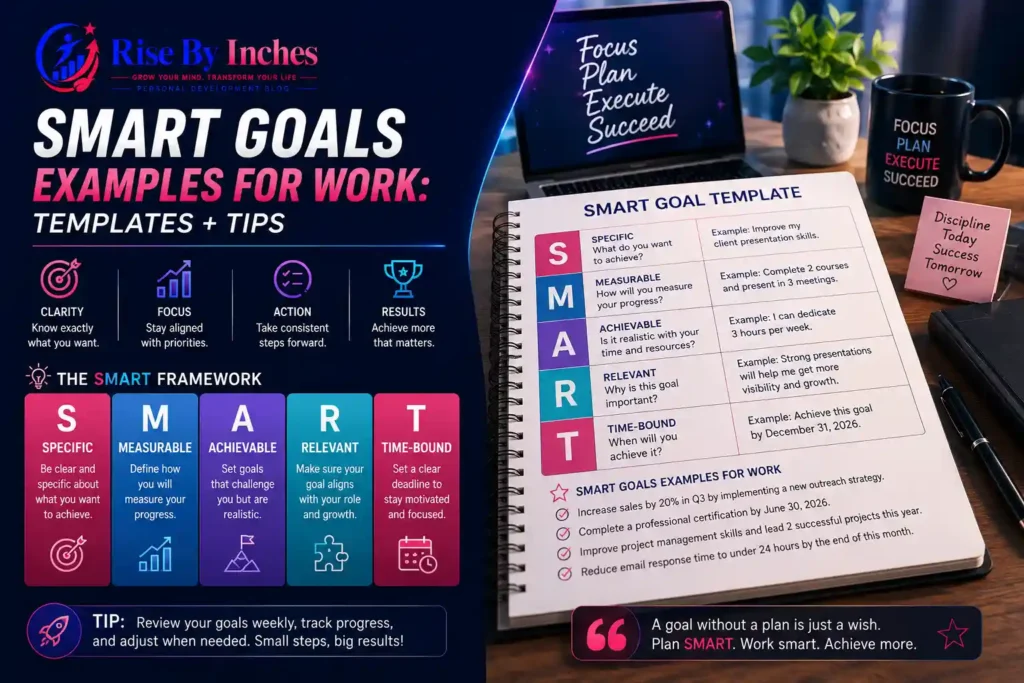

Setting a goal at work often means typing “improve performance” into a doc and calling it done. Then three months pass, and nothing measurable happened. The SMART framework addresses this by applying five filters to every goal: specific, measurable, achievable, relevant, and time-bound. This guide breaks down real workplace examples, a ready-to-use action plan template, and reflective questions that help you set goals you’ll actually finish.
What Are SMART Goals, and Why Do They Matter at Work?
SMART goals matter because vague intentions rarely survive a busy quarter, while structured ones do. The framework traces back to management theorist George Doran’s 1981 article and was later built on Locke and Latham’s goal-setting research, which found that specific, challenging goals consistently outperform “do your best” instructions. At work, SMART goals turn abstract ambitions into something you can track on a dashboard or bring up in a one-on-one.
Each letter solves a different failure point:
| Letter | Question It Answers | Common Failure Without It |
| Specific | What exactly will I do? | Goals stay fuzzy and open to interpretation |
| Measurable | How will I know it’s done? | No way to confirm progress or completion |
| Achievable | Is this realistic given my resources? | Burnout or abandoned goals |
| Relevant | Does this matter to my role or team? | Effort spent on low-impact work |
| Time-bound | When is the deadline? | Goals drift indefinitely |
If you want a deeper breakdown of what separates a durable goal from a wish list item, Rise By Inches has a full guide on the characteristics of strong goals worth bookmarking alongside this one.
What Are 5 SMART Goal Examples for Work?
Five practical SMART goal examples span sales, project management, customer service, marketing, and administrative roles, each built around a concrete metric and deadline. Below, vague versions sit next to their SMART rewrite so you can see exactly what changes.
1. Sales
Vague: “Sell more this quarter.”
SMART: “Close 12 new client contracts by December 31, tracked weekly in the CRM pipeline, by making 15 outbound calls per day.”
2. Project Management
Vague: “Finish the project faster.”
SMART: “Reduce average project delivery time from 6 weeks to 4.5 weeks by Q3 by implementing a two-week sprint review cycle.”
3. Customer Service
Vague: “Improve customer satisfaction.”
SMART: “Raise the customer satisfaction score from 82% to 90% within 90 days by resolving first-contact tickets within 24 hours.”
4. Marketing
Vague: “Grow the email list.”
SMART: “Grow the newsletter subscriber list by 2,000 contacts in 60 days through two lead-magnet campaigns launched by week three.”
5. Administrative/Operations
Vague: “Get more organized.”
SMART: “Digitize and file 100% of paper records into the shared drive by the end of next month, processing 25 files per week.”
For a broader set of role-specific frameworks focused on professional advancement rather than on single projects, see the SMART career objectives guide.
How Do You Structure a SMART Action Plan Template?
A SMART action plan template works best as five columns: the goal statement, the metric, the deadline, the weekly milestones, and the resources needed. Writing the goal alone rarely gets it done — the plan turns intention into a repeatable habit you can check each week.
A simple version looks like this:
| Field | What to Fill In |
| Goal statement | One sentence, SMART-compliant |
| Success metric | The number or outcome that proves completion |
| Deadline | A specific date, not “soon” or “this quarter” |
| Milestones | 3–5 checkpoints with their own mini-deadlines |
| Resources needed | Tools, training, budget, or people required |
| Review cadence | Weekly, biweekly, or monthly check-in |
Copy that structure into a spreadsheet or project tool and reuse it for every goal you set — the format stays constant even as the content changes. If your team struggles to keep plans like this alive past week one, the work organization tips article covers systems to make a plan stick day to day.
What Is a SMART Goal for Time Management at Work?
A time management SMART goal targets a specific behavior change with a measurable output, such as reducing meeting hours or protecting focus blocks, rather than the vague goal of “managing time better.” Time is the resource most people waste without realizing it, so specificity here matters more than in almost any other category.
Example: “Reduce total weekly meeting time from 14 hours to 9 hours within 30 days by declining or shortening recurring meetings that lack a clear agenda, tracked using calendar audit reports.”
Another version for individual contributors: “Complete daily priority tasks before 11 a.m. on at least 4 out of 5 workdays for the next month by blocking the first two hours of each day as meeting-free focus time.”
Time management goals pair well with a structured daily routine. The time management skills and structured daily tasks guide both, walking through techniques that make these targets realistic rather than aspirational.
How Do Reflective Questions Bring Clarity to Goal Setting?
Reflective questions bring clarity by surfacing the gap between what you say you want and what your actual behavior supports, which prevents goals built on assumptions rather than evidence. Skipping this step is the most common reason SMART goals still fail even when they’re technically well written.
Before setting a work goal, ask:
- What outcome would actually change my day-to-day experience at work?
- What have I tried before that didn’t work, and why?
- What resources or support am I assuming I’ll have?
- Who else does this goal depend on?
- What would make me abandon this goal in week three?
That last question matters more than people expect. Research from the American Psychological Association found that people who frequently monitor and record their progress are significantly more likely to reach their goals than those who set a target and check back only at the deadline. Reflective questions are how you build that monitoring habit before the goal even starts.
Why Is Self-Reflection Necessary Before Setting SMART Goals?
Self-reflection matters because a technically SMART goal can still be the wrong goal if it doesn’t connect to your actual priorities, workload capacity, or career direction. SMART only checks the structure of a goal, not whether it’s worth pursuing.
Three quick self-checks before finalizing any workplace goal:
- Capacity check — Does this fit realistically alongside my current workload, or am I stacking it on top of an already full plate?
- Alignment check — Does this align with how my manager or team actually measures success?
- Motivation check — Am I setting this because it matters to me, or because it sounded good in a meeting?
If you’re working through this at a career level rather than a single quarterly goal, the career plan guide and professional development plan resources both walk through longer-term reflection frameworks that pair naturally with SMART goal-setting.
How Do SMART Goals Work for Remote and Hybrid Teams?
Remote and hybrid SMART goals need to lean harder on the measurable and time-bound elements, since managers can’t rely on visual cues of activity to gauge progress. Output and documented milestones replace “seeing someone at their desk” as the trust signal.
Practical adjustments for distributed teams:
- Replace “be more responsive” with a specific response-time SLA, such as replying to Slack messages within 4 business hours.
- Set async check-in goals: “Post a written weekly progress update every Friday by 3 p.m., covering completed tasks, blockers, and next-week priorities.”
- Tie goals to shared dashboards (Asana, Jira, or a shared sheet) rather than manager observation, so progress is visible without a status meeting.
Remote workers also benefit from tighter time-management goals, since the boundary between “working” and “available” blurs easily. The work-life balance guide addresses this boundary problem directly if it’s part of what’s driving the goal.
What Are Common Mistakes to Avoid When Setting Workplace SMART Goals?
The most common mistake is writing a goal that’s measurable on paper but impossible to act on day-to-day because it lacks a concrete first step. SMART goals fail less often due to bad intentions and more often due to structural gaps.
Watch for these five patterns:
- Setting too many goals at once. Three focused goals outperform ten scattered ones.
- Making the metric a vanity number. “Increase social media followers” rarely tracks business impact; “increase qualified leads from social” does.
- Skipping the milestone breakdown. A 90-day goal with no 30-day checkpoint invites procrastination.
- Ignoring dependencies on other people. A goal reliant on someone else’s approval needs their buy-in built into the timeline, not assumed.
- Confusing “achievable” with “easy.” A goal with zero stretch rarely produces growth, and research on goal-setting theory consistently shows difficult, specific goals outperform easy ones when resources support them.
For a closer look at what separates goals that actually move the needle on performance from ones that look good in a review, Top Performer Goals is a useful companion read.
How Do SMART Goals Fit Into Performance Reviews and OKRs?
SMART goals serve as the individual building blocks that feed into larger frameworks like OKRs and KPI dashboards, providing performance reviews with concrete evidence rather than subjective impressions. They’re not a competing system — they’re the mechanism that makes those bigger systems auditable.
In a performance review context, a manager evaluating “did this employee grow this quarter” needs specifics to point to. According to the U.S. Office of Personnel Management’s performance management guidance, effective performance plans require measurable, results-oriented goals that align individual work with organizational objectives — the same logic SMART goals apply at the individual level. When your quarterly SMART goals map directly onto your formal review criteria, the review becomes a formality rather than a negotiation.
If your organization runs on OKRs specifically, treat each SMART goal as a “key result” under a broader objective — the specificity of SMART slots naturally into that structure. For examples tied to formal review cycles, a career development plan shows what this looks like in writing.
FAQ: SMART Goals for Work
What are 5 SMART goal examples for work?
Common examples include closing a set number of sales contracts by a fixed date, reducing project delivery time by a measurable percentage, raising a customer satisfaction score to a specific target within 90 days, growing an email list by a set number of subscribers, and completing a records digitization project by a fixed deadline.
How do reflective questions bring clarity to goal setting?
Reflective questions help you determine whether a goal aligns with your real capacity, priorities, and motivation before you commit to it, preventing you from setting a technically correct SMART goal that doesn’t actually serve your work.
What is a SMART goal for time management at work?
A time management SMART goal targets a measurable behavior, such as reducing weekly meeting hours from 14 to 9 within 30 days, rather than a vague intention like “manage time better.”
How do you structure a SMART action plan template?
A working template includes the goal statement, the success metric, the deadline, a milestone breakdown, needed resources, and a review cadence — five to six fields kept consistent across every goal you set.
Why is self-reflection necessary before setting SMART goals?
Because SMART checks the structure of a goal but not its relevance, self-reflection confirms that the goal fits your workload and actually matters to your role before you invest time in structuring it.
Can SMART goals work for team-wide objectives, not just individuals?
Yes — team SMART goals follow the same five criteria but require an added layer of clarity on who owns each milestone, since ambiguous ownership is the most common reason team goals stall.
Putting It Into Practice
A SMART goal isn’t a magic formula — it’s a checklist that catches the vague language before it costs you a quarter. Start with one goal, not five. Write it against the five criteria, build the action plan template, and revisit the reflective questions before you finalize it. Then set a review date and actually keep it.
If you’re building out a fuller set of goals across your role — not just one quarterly target — the work development goals and self-improvement plan guides on Rise By Inches walk through that longer arc in detail.



Pingback: Best Reflective Questions for Deeper Clarity Guide 2026
Pingback: Leadership Skills & Training Guide 2026