

Your heart is beating faster. Your thoughts are racing. You have an important meeting in five minutes, and you can feel the pressure building.
Sometimes, the most useful thing you can do is pause and pay attention to your breathing.
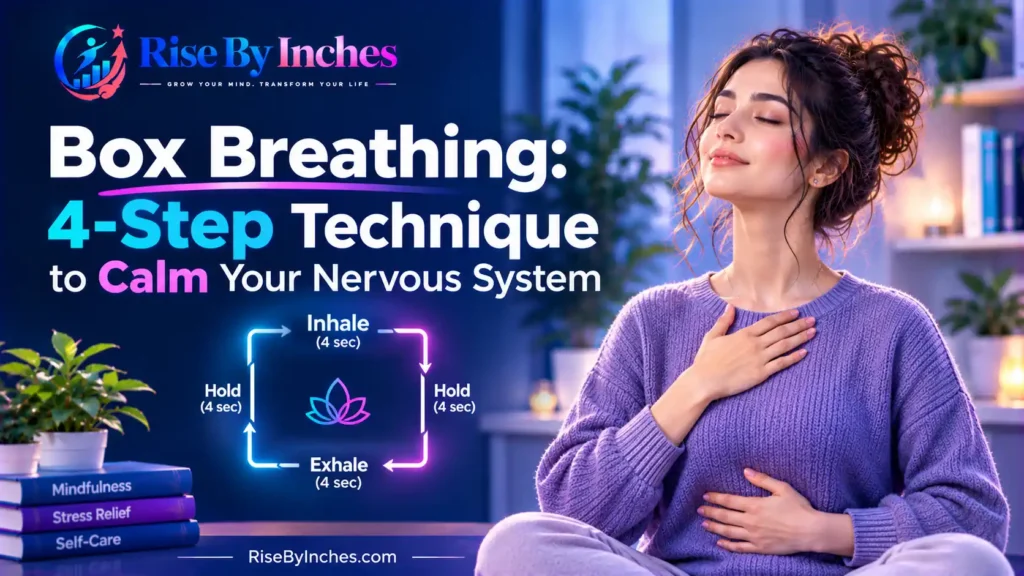
Box breathing is a simple breathing exercise that follows four equal steps: inhale, hold, exhale, and hold again. Each step usually lasts four seconds, creating a steady 4-4-4-4 pattern.
Also called square breathing or four-square breathing, this technique gives your attention something simple to follow while encouraging a slower, more controlled breathing rhythm.
In this guide, you will learn how box breathing works, how to practise it correctly, when to use it, how it compares with other breathing techniques, and what scientific research actually says about its benefits. You will also find a beginner routine, a self-check quiz, and practical templates to help you build a consistent habit.
What Is Box Breathing?
Box breathing is a controlled breathing technique that divides one breathing cycle into four equal phases:
- Inhale for four seconds.
- Hold your breath for four seconds.
- Exhale for four seconds.
- Hold your breath again for four seconds.
The pattern creates a mental image of a square, with each side representing one phase of breathing.
One complete cycle takes 16 seconds. Repeating the cycle creates a predictable rhythm that can help you focus when you feel distracted, tense, or overwhelmed.
Box breathing is also known as:
- Square breathing
- Four-square breathing
- 4×4 breathing
- 4-4-4-4 breathing
The technique is associated with controlled breathing practices and is often discussed in connection with tactical training and stress management. Similar practices also appear in traditional breathing disciplines, including yogic pranayama.
However, the names and methods used in different traditions are not always identical. Some equal-breathing exercises do not include breath holds.
Why Does Counting Your Breathing Help?
Stress can make your breathing faster, shallower, or less regular. When you deliberately slow down and organise your breathing, you give yourself a simple physical task instead of allowing your attention to remain fixed on stressful thoughts.
Two things happen during the exercise:
1. Your attention has a clear focus.
Counting each phase gives your mind something specific to follow. Instead of repeatedly thinking about an upcoming meeting, difficult conversation, or unfinished task, you concentrate on the next part of the breathing cycle.
2. You practise controlling your breathing rhythm.
Slow, comfortable breathing can influence how your body responds to stress. Research on controlled breathing has found associations with changes in heart-rate patterns, relaxation, and emotional state.
The effect is not identical for everyone. Some people find the technique calming, while others prefer breathing exercises without holds.
How Does Box Breathing Affect the Nervous System?
Box breathing may support relaxation by encouraging a slower and more controlled breathing pattern. Breathing is unusual because it happens automatically, but you can also change its rhythm intentionally.
That gives you a practical way to influence one of the body’s automatic functions.
What Are the Two Main Branches of the Autonomic Nervous System?
The autonomic nervous system helps regulate functions such as heart rate, digestion, and breathing. Two important branches are involved in the body’s response to stress and recovery.
| Branch | Main role | What it does |
| Sympathetic nervous system | Mobilises the body | Supports alertness and the fight-or-flight response |
| Parasympathetic nervous system | Supports recovery | Helps regulate rest, digestion, and recovery processes |
These branches do not work like a simple on-and-off switch. Both remain active, and their activity varies according to your body’s needs.
When you feel threatened or under pressure, sympathetic activity can increase. A comfortable breathing exercise may help you settle your breathing and feel more in control.
That is a more accurate way to understand box breathing than saying it instantly switches off stress.
What Is the Connection Between Box Breathing and the Vagus Nerve?
The vagus nerve is an important part of the parasympathetic nervous system. It carries signals between the brain and several organs, including the heart and lungs.
Breathing rhythm and heart rate are connected through a natural process called respiratory sinus arrhythmia (RSA). In many people, heart rate tends to rise slightly during inhalation and fall during exhalation.
This pattern is one reason researchers study breathing when examining heart-rate variability (HRV).
A systematic review published in Frontiers in Human Neuroscience examined research on slow breathing and its psychological and physiological effects. It reported associations among slow breathing, changes in HRV, respiratory sinus arrhythmia, and relaxation-related measures.
Read the research: How Breath-Control Can Change Your Life: A Systematic Review on Psycho-Physiological Correlates of Slow Breathing.
An important distinction: This review examined slow-breathing techniques in general. It does not prove that every four-second box-breathing cycle produces the same physiological response or directly increases vagal tone.
Does Box Breathing Lower Cortisol and Anxiety?
Box breathing may help some people manage short-term stress, but it should not be described as a proven treatment for anxiety disorders or a guaranteed way to lower cortisol.
A 2023 randomized controlled study published in Cell Reports Medicine compared several five-minute breathing exercises with mindfulness meditation over a one-month period. The breathing exercises included box breathing, cyclic sighing, and cyclic hyperventilation with retention.
The researchers reported improvements in mood and reductions in physiological arousal across the breathing interventions. However, cyclic sighing, which emphasised longer exhalations, showed particularly strong results for mood and respiratory rate.
The study supports the potential value of structured breathing exercises, but it does not establish that box breathing is the best method for everyone.
Read the study: Brief Structured Respiration Practices Enhance Mood and Reduce Physiological Arousal.
A systematic review published in 2026 also examined randomized controlled trials specifically involving box breathing. Its findings suggest that some studies report short-term benefits for perceived stress, anxiety, or mood, but physiological results are mixed and the evidence remains limited.
Read the review: Systematic Review of Randomised Controlled Trials Evaluating Box Breathing for Stress, Autonomic, and Clinical Outcomes.
The practical takeaway: Box breathing is a useful technique to experiment with for short-term stress management. It is not a guaranteed nervous-system reset, a cortisol treatment, or a replacement for professional care.
What Are the Four Steps of Box Breathing?
The four steps are inhale, hold, exhale, and hold again. Beginners can start with a comfortable count of two or three seconds before progressing to the traditional four-second pattern.
Step-by-Step Box Breathing for Beginners
Before starting, find a comfortable position. You can sit in a chair, stand with your feet supported, or sit somewhere quiet.
Keep your shoulders relaxed. Avoid taking unusually large breaths. Let your breathing remain gentle.
| Step | Action | Count | What to focus on |
| 1 | Inhale gently | 1-2-3-4 | Allow your abdomen and lower ribs to expand comfortably |
| 2 | Hold your breath | 1-2-3-4 | Keep your body relaxed; do not strain |
| 3 | Exhale slowly | 1-2-3-4 | Let your shoulders and abdomen soften |
| 4 | Pause after exhaling | 1-2-3-4 | Keep the pause comfortable, without forcing it |
Repeat the sequence for a few cycles.
One complete cycle takes 16 seconds. Four cycles take approximately 64 seconds, while eight cycles take just over two minutes.
You do not need to complete a particular number of cycles to succeed. Comfort matters more than reaching a target.
Box Breathing Pattern: Visual Guide
Imagine tracing a square clockwise:
| Phase | Direction | Breathing action |
| 1 | Across the top | Inhale for four seconds |
| 2 | Down the right side | Hold for four seconds |
| 3 | Across the bottom | Exhale for four seconds |
| 4 | Up the left side | Hold after exhaling for four seconds |
You can picture a square in your mind or trace its sides with your finger.
This visual method is optional. Counting alone works just as well if you find it easier.
What If Four Seconds Feels Too Long?
You do not need to force the traditional count.
Try a shorter pattern if four seconds feels uncomfortable:
| Pattern | Inhale | Hold | Exhale | Hold |
| Beginner | 2 sec | 2 sec | 2 sec | 2 sec |
| Gentle | 3 sec | 3 sec | 3 sec | 3 sec |
| Traditional | 4 sec | 4 sec | 4 sec | 4 sec |
If holding your breath makes you uncomfortable, stop the exercise and breathe normally. You can try a gentler breathing technique without breath holds instead.
If you become dizzy, faint, unusually short of breath, or experience chest discomfort, stop immediately.
Common Box Breathing Mistakes to Avoid
A simple breathing exercise can become uncomfortable when you try too hard to perform it correctly.
Avoid these common mistakes:
- Taking huge breaths: Breathe gently rather than trying to fill your lungs as much as possible.
- Forcing the holds: A breath hold should feel comfortable, not like a test of endurance.
- Tensing your shoulders: Keep your upper body relaxed.
- Rushing the count: Count at a natural, steady pace.
- Expecting immediate results: You may feel calmer, but there is no guaranteed response or fixed time.
- Ignoring discomfort: Stop if the exercise makes you feel worse.
The purpose is to practise a comfortable rhythm, not to push your body beyond its limits.
Why Is Box Breathing Used in High-Pressure Situations?
Box breathing is often associated with tactical training because it is simple, portable, and requires no equipment. It can be practised while seated or standing and does not require a special environment.
The technique is also discussed in connection with military and emergency-response settings, where people may need simple ways to manage their attention under pressure.
However, it is important not to confuse its popularity in high-pressure environments with proof that it improves performance in every situation.
What Is Stress Inoculation?
Stress inoculation is a training approach in which people practise coping skills under manageable levels of stress before facing more difficult situations.
For example, a person preparing for public speaking might practise a breathing routine during ordinary preparation sessions. Repeating the routine can make it more familiar when nervousness appears before a presentation.
The same idea can apply to box breathing.
You do not have to wait until you feel overwhelmed to practise. You can learn the pattern when you are already comfortable, making it easier to remember later.
When Can Everyday People Use Box Breathing?
You can experiment with the technique during ordinary situations, such as:
- Before a presentation or interview.
- Before an important meeting.
- After a stressful conversation.
- During a short break between tasks.
- While preparing for an examination.
- When you notice yourself becoming distracted or tense.
If public speaking makes you nervous, explore our guide to building confidence in public speaking.
For difficult workplace conversations, our guide to conflict resolution strategies offers additional practical techniques.
Is Box Breathing Better Than 4-7-8 Breathing?
Neither technique has been established as universally better. They use different breathing patterns, and people may find one more comfortable than the other.
Box breathing uses four equal phases. The 4-7-8 method uses a longer exhalation and a longer breath hold.
Box Breathing vs. 4-7-8 Breathing vs. Other Techniques
| Feature | Box breathing | 4-7-8 breathing | Cyclic sighing | Diaphragmatic breathing |
| Pattern | Inhale, hold, exhale, hold | Inhale 4, hold 7, exhale 8 | Inhale, second short inhale, long exhale | Gentle breathing using the diaphragm |
| Breath holds | Two | One | No required hold | No required hold |
| Main focus | Even rhythm and attention | Longer exhalation | Extended exhalation | Comfortable breathing |
| Useful for | Practising a steady rhythm | A structured wind-down routine | Exploring exhale-focused breathing | Beginners and general breathing practice |
| Difficulty | Easy to moderate | May be challenging for beginners | Easy to moderate | Usually easy |
Which Breathing Technique Should You Choose?
Your comfort is more important than following a popular technique.
- Want a predictable rhythm? Try box breathing.
- Prefer a longer exhalation? Explore 4-7-8 breathing.
- Do breath holds make you uncomfortable? Try gentle diaphragmatic breathing.
- Want to experiment with a research-studied exhale-focused technique? Learn about cyclic sighing.
You do not need to combine different methods in one session. Start with one comfortable technique and notice how you respond.
How Long Should You Practise Box Breathing?
For beginners, a short practice of one to five minutes is a reasonable starting point if the exercise feels comfortable.
No universally established duration guarantees a nervous-system reset or a specific reduction in heart rate.
The right amount depends on your comfort, breathing pattern, and reason for practising.
| Goal | Suggested starting point | How to approach it |
| Brief pause during stress | 1 minute | Try a few comfortable cycles |
| Break between tasks | 2 minutes | Practise without rushing |
| Build familiarity | 3-5 minutes | Use a comfortable count |
| Evening relaxation | A few gentle minutes | Stop if breath holds feel uncomfortable |
The 2023 controlled breathing study used five-minute daily sessions over one month. That is a research protocol, not a prescription that everyone must follow.
When Is the Best Time to Practise?
Choose a time that fits naturally into your routine.
You might practise:
- After getting out of bed.
- Before opening your work email.
- After finishing an important task.
- Before a presentation.
- During a quiet evening break.
Connecting the practice to an existing routine can make it easier to repeat. Our guide to making new habits stick can help you build that consistency.
Is Box Breathing Safe for Everyone?
Box breathing is a gentle exercise for many people, but breath holding is not comfortable or appropriate for everyone.
Never force yourself to complete the full four-second pattern. If you have a respiratory or cardiovascular condition, a history of fainting, or another health concern that could make breath holding difficult, ask a qualified healthcare professional whether this technique is suitable for you.
Keep these precautions in mind:
- Stop if you feel dizzy or faint: Return to normal breathing rather than trying to complete another cycle.
- Do not practise while driving or swimming: Your attention needs to remain on the activity and your surroundings.
- Do not force breath holds: Shorten or skip them if they cause discomfort.
- Be mindful of panic symptoms: Focusing on breathing can feel uncomfortable for some people. A grounding exercise or normal, unforced breathing may be a better starting point.
- Seek professional support when needed: Repeated panic attacks, persistent anxiety, or breathing difficulties deserve appropriate assessment.
For information about anxiety disorders and treatment, visit the National Institute of Mental Health.
For a general overview of relaxation techniques, see the National Center for Complementary and Integrative Health.
This article is educational and is not a substitute for medical or mental-health advice.
Interactive Module 1: Box Breathing Myth-Buster Quiz
Test what you have learned. Choose your answers before checking the explanations.
Question 1: Every phase of box breathing must last exactly four seconds.
- A. True
- B. False
Question 2: Box breathing is a proven cure for panic disorder.
- A. True
- B. False
Question 3: Holding your breath for longer always makes the exercise more effective.
- A. True
- B. False
Question 4: Breathing is an automatic body function that people can also control intentionally.
- A. True
- B. False
Answer Key
Question 1: B — False.
Four seconds is the traditional count, not a strict requirement. A shorter, comfortable rhythm may be more suitable for beginners.
Question 2: B — False.
Box breathing may be a useful coping technique, but it is not a cure or replacement for professional treatment.
Question 3: B — False.
Longer holds can create discomfort or air hunger. Comfortable breathing is more important than extending the count.
Question 4: A — True.
Breathing happens automatically, but you can also change its rhythm intentionally. This is one reason controlled breathing is studied in relation to stress and physiological responses.
Your Score
- 4/4: Excellent. You understand the basic method and its limitations.
- 2-3/4: Good start. Review the beginner instructions and safety section.
- 0-1/4: Revisit the four steps and practise with a shorter, comfortable count.
Interactive Module 2: Which Stress Response Do You Notice First?
Different people notice stress in different ways. Choose the description that sounds most familiar and use the suggested starting point.
A. My Thoughts Race and Keep Repeating
Your pattern: The Overthinker
Your attention may be getting caught in repeated thoughts.
Try a gentle breathing rhythm while silently counting each phase. If holding your breath feels uncomfortable, use normal breathing and focus on counting your exhales instead.
You may also find our guide to cognitive and behavioural psychology useful for understanding thought patterns.
B. My Body Feels Tense or Restless
Your pattern: The Physical Stress Responder
You notice tension before you fully recognise the thoughts behind it.
Sit comfortably, relax your jaw and shoulders, and try a few gentle breaths. Do not force the four-second holds. Stop if the exercise makes you feel uncomfortable.
C. I Struggle to Switch Off at Night
Your pattern: The Evening Overthinker
You may find it difficult to move from an active day into a restful routine.
Try a quiet wind-down activity and gentle breathing without forcing long breath holds. If focusing on your breath increases discomfort, switch to another relaxing activity.
D. I Freeze or Feel Overwhelmed
Your pattern: The Shutdown Responder
You may need a simple grounding exercise before attempting structured breathing.
Keep your eyes open, place your feet on the floor, and identify three things you can see. Then allow your breathing to return to a comfortable rhythm.
The purpose of this matcher is to help you notice your preferences, not to diagnose a stress condition or assign a psychological label.
Practical Tool 1: Your Box Breathing Practice Plan
A simple plan can help turn an occasional exercise into a repeatable habit.
Copy the template below into your notes app or journal.
| Part of the plan | Your entry | Example |
| My practice trigger | When will I practise? | Before opening my work email |
| My breathing count | Which count feels comfortable? | 3-3-3-3 |
| My duration | How long will I practise? | 1-2 minutes |
| My position | Where will I practise? | Seated, feet supported |
| My stress level before | Rate from 1-10 | 7 |
| My stress level after | Rate from 1-10 | 5 |
| My alternative | What if holds feel uncomfortable? | Return to normal breathing |
| My weekly goal | How often will I practise? | Three comfortable sessions |
A Gentle Four-Week Practice Plan
You do not need to increase the duration every week. The aim is to become familiar with the technique without creating discomfort.
| Week | Practice | Focus |
| 1 | Try 2-2-2-2 or gentle breathing | Learn the sequence |
| 2 | Try 3-3-3-3 if comfortable | Find a natural rhythm |
| 3 | Try 4-4-4-4 if comfortable | Practise relaxed breathing |
| 4 | Continue at your preferred count | Notice when the technique is useful |
If a count feels uncomfortable, return to the previous one or choose a breathing method without holds.
Practical Tool 2: The Stress and Breathing Reflection Log
A short reflection log can help you understand how you respond to different situations.
| Date | Situation | What I noticed | What I tried | How I felt afterward |
| Monday | Before a meeting | Racing thoughts | Three comfortable breathing cycles | More focused |
| Wednesday | After a difficult conversation | Tight shoulders | Relaxed breathing and a short walk | Less tense |
| Friday | Before bedtime | Difficulty switching off | Quiet wind-down routine | More settled |
How to Use Your Log
- Situation: Write down what happened before you practised.
- Physical response: Note what you noticed, such as tension or a faster heartbeat.
- Practice: Record the breathing technique or alternative you used.
- Result: Describe how you felt afterward.
- Reflection: Notice which approaches felt comfortable and which did not.
Do not treat the stress rating as a medical measurement. It is simply a way to reflect on your own experience.
For more structured reflection exercises, explore our self-awareness activities for adults.
How Does Box Breathing Fit Into the RiseByInches Approach?
At RiseByInches, personal growth is built through small, repeatable actions rather than dramatic changes that are difficult to maintain.
Box breathing fits this approach because it gives you a simple technique to practise when you want to pause and regain your attention.
You do not need to master every breathing method. You can start by learning one comfortable pattern and noticing when it helps.
As you build your routine, you can explore other areas of personal development:
- Develop greater self-understanding with our guide to becoming more self-aware.
- Explore practical ways to communicate more confidently through assertiveness training.
- Learn to manage disagreements through conflict resolution strategies.
Small improvements become meaningful when you practise them consistently.
Frequently Asked Questions About Box Breathing
What is box breathing and how does it work?
Box breathing is a four-part breathing technique involving an inhale, a breath hold, an exhale, and another breath hold. Each phase traditionally lasts four seconds. The steady rhythm gives your attention a clear focus and encourages controlled breathing.
What are the four steps of box breathing?
The four steps are:
- Inhale for four seconds.
- Hold for four seconds.
- Exhale for four seconds.
- Hold after exhaling for four seconds.
Repeat at a comfortable pace. You can shorten the counts if necessary.
How does box breathing affect the nervous system?
Controlled breathing can influence heart-rate patterns and physiological responses associated with relaxation. However, the specific effects of box breathing are still being studied, and it should not be described as a guaranteed way to switch the nervous system into a particular state.
Does box breathing stimulate the vagus nerve?
Breathing rhythm is connected to heart-rate regulation through processes involving the autonomic nervous system, including respiratory sinus arrhythmia. However, the exact effect of the traditional box-breathing pattern on vagal activity is not fully established.
Why is box breathing associated with Navy SEALs?
Box breathing is widely discussed in connection with tactical stress-management training because it is simple, portable, and requires no equipment. Its popularity in tactical settings does not, by itself, establish clinical effectiveness.
Is box breathing better than 4-7-8 breathing?
Neither method is proven to be universally better. Box breathing uses equal phases, while 4-7-8 breathing uses a longer exhalation. Choose the method that feels comfortable and suits your purpose.
How long should you practise box breathing?
One to five minutes is a practical starting point for many beginners. No guaranteed duration works for everyone. Stop if you feel dizzy, faint, or uncomfortable.
Can box breathing help with anxiety?
It may help some people manage short-term stress or nervousness. However, it is not a substitute for professional treatment for anxiety disorders or panic attacks.
Conclusion: Start With One Comfortable Breathing Cycle
Box breathing is a simple technique built around four steps: inhale, hold, exhale, and hold again.
Its value is not that it can instantly remove stress or fix every difficult situation. It gives you a structured way to pause, focus your attention, and practise controlling your breathing.
Start with a comfortable count. Keep your body relaxed. Stop if the exercise causes discomfort, and remember that you can use gentler breathing methods without breath holds.
Your next steps are simple:
- Today: Try a few comfortable breathing cycles.
- This week: Choose one regular moment to practise.
- Over time: Notice which breathing pattern feels most useful in different situations.
Calm does not have to begin with a dramatic change. Sometimes it starts with one small pause, one steady breath, and one intentional step forward.
One inch at a time.
Explore more practical personal-growth guides at RiseByInches.com.
Sources and Further Reading
These sources support the scientific and safety-related discussion in this article:
- Dujawara, A., Ali, K., & Kumari, S. (2026). Systematic Review of Randomised Controlled Trials Evaluating Box Breathing for Stress, Autonomic, and Clinical Outcomes. Applied Psychophysiology and Biofeedback.
- Balban, M. Y., et al. (2023). Brief Structured Respiration Practices Enhance Mood and Reduce Physiological Arousal. Cell Reports Medicine.
- Zaccaro, A., et al. (2018). How Breath-Control Can Change Your Life: A Systematic Review on Psycho-Physiological Correlates of Slow Breathing. Frontiers in Human Neuroscience.
- National Center for Complementary and Integrative Health — Relaxation Techniques.
- National Institute of Mental Health — Anxiety Disorders.