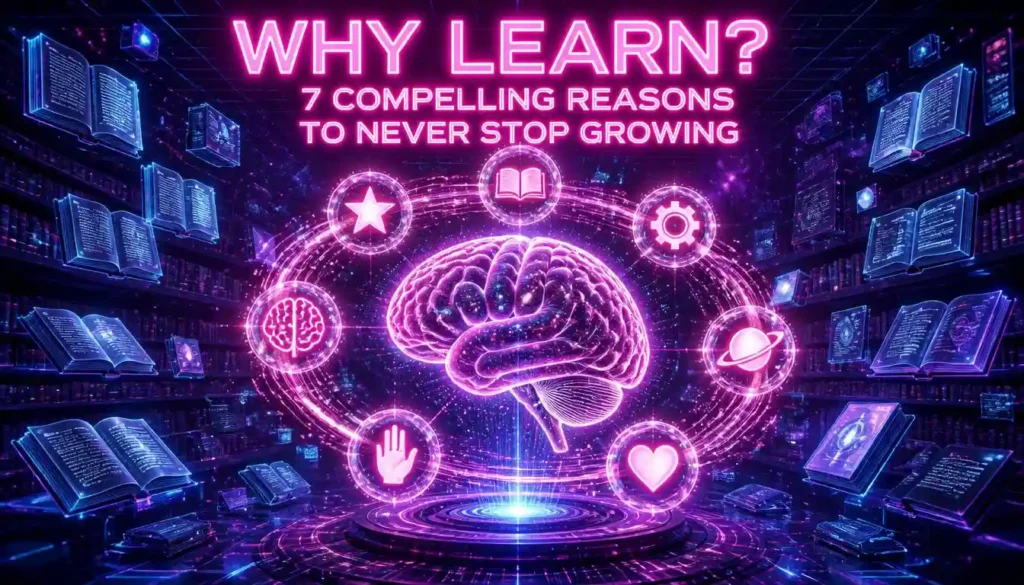

You hit a plateau. The job feels familiar, the routine feels flat, and some part of you suspects there’s more available if you just knew how to reach it. That instinct is correct. The evidence on lifelong learning is not vague self-help noise — it’s neuroscience, labor economics, and psychology all pointing the same direction. Below are seven concrete, research-backed reasons continuous learning changes your brain, your career, and your sense of self, plus how actually to build the habit.
Why is continuous learning essential for personal and professional growth?
Continuous learning keeps your brain adaptable, your skills market-relevant, and your sense of identity flexible instead of fixed. It rewires neural pathways through neuroplasticity, builds what researchers call cognitive reserve, and gives you an adaptability quotient (AQ) that matters more than raw intelligence when industries shift overnight. People who stop learning don’t just stagnate professionally — they lose mental sharpness measurably faster.
1. Neuroplasticity: Your Brain Physically Rewires Itself When You Learn
Neuroplasticity is the brain’s ability to reorganize itself by forming new neural connections throughout life — not just in childhood, as older models assumed. Every time you learn a new skill, whether it’s a language, an instrument, or a new software tool, you’re strengthening synaptic plasticity: the connections between neurons get faster and more efficient with repeated use.
This isn’t metaphorical. Neuroplasticity describes the nervous system’s capacity to change its activity in response to intrinsic or extrinsic stimuli by reorganizing its structure, functions, or connections, and this happens at scales ranging from individual neurons to whole-brain networks. Learning something genuinely new — not passively consuming content, but actively practicing a skill — is one of the most reliable triggers for this rewiring.
Practical example: adults who take up a musical instrument in their 40s and 50s show measurable improvements in working memory and processing speed within months. The brain doesn’t ask permission before adapting. It just responds to demand.
2. Cognitive Reserve: Learning Builds a Buffer Against Age-Related Decline
Cognitive reserve is the brain’s resilience against damage or decline — essentially a buffer built from a lifetime of mental engagement. People with higher cognitive reserve can sustain more neurological wear before symptoms of decline become noticeable. Two people can have identical levels of brain pathology and show completely different symptoms, because one has spent decades stacking cognitive reserve through learning and the other hasn’t.
This is what researchers mean when they talk about strengthening cognitive reserve through lifelong learning, and it matters directly for dementia prevention.. Complex mental activity — learning a new language, mastering a craft, studying a technical subject — appears to be one of the more actionable levers available to protect long-term brain health, alongside diet and exercise. Continuous learning isn’t just about staying “sharp” in an abstract sense. It’s preventive medicine for your future self.
3. Growth Mindset: Learning Rewires How You Interpret Failure
Psychologist Carol Dweck’s research on growth mindset draws a sharp line between two belief systems: a fixed mindset, where you believe ability is static, and a growth mindset, where you believe ability develops through effort and strategy. People with a growth mindset don’t experience failure as a verdict on their worth — they experience it as data.
This is where continuous learning becomes self-reinforcing. The more you deliberately put yourself in situations where you don’t yet know the answer, the more your brain gets practice treating “I don’t know this yet” as a temporary state rather than a permanent limitation. If you want a structured way to build this out, our guide on how to develop a growth mindset breaks down specific daily practices.
4. Upskilling and Reskilling: Learning Is Now a Career Survival Skill
What is the difference between upskilling and lifelong learning? Upskilling means deepening skills within your current role or field to stay competitive. At the same time, lifelong learning is the broader, ongoing habit of acquiring knowledge across your entire life — upskilling is one specific application of it. Reskilling, a related term, means learning an entirely new skill set to pivot into a different role or industry.
The job market doesn’t wait for anyone to catch up voluntarily. Roles that existed five years ago have been restructured or eliminated; roles that didn’t exist are now hiring aggressively. Workers who treat their skill set as a fixed asset — something they built once in school and coast on — are the ones who get blindsided. Workers who treat skills as a living, updating portfolio adapt without panic.
If you’re building this into a formal plan rather than reacting ad hoc, a professional development plan or a career development plan example gives you a framework instead of a vague intention.
5. Self-Actualization: Learning Satisfies a Core Psychological Need
Abraham Maslow placed self-actualization at the top of his hierarchy of needs — the drive to realize your full potential, to become the most complete version of what you’re capable of. Learning is one of the most direct paths to that state, because it’s one of the few activities that combines intrinsic motivation (you’re doing it because it’s inherently satisfying) with visible, trackable progress.
This is different from external validation. A promotion or a certificate is nice, but the internal experience of watching yourself get measurably better at something — a language, a craft, a body of knowledge — produces a kind of satisfaction that external rewards can’t fully replicate. If you’re mapping out what that looks like concretely, personal growth goals examples can help translate the abstract idea into something trackable.
6. Adaptability Quotient (AQ): Learning Speed Now Outweighs Static Knowledge
Adaptability Quotient (AQ) measures how quickly and effectively someone can adjust to new information, tools, and circumstances — and in fast-changing fields, it’s becoming a stronger predictor of long-term success than IQ or existing expertise. Static knowledge has a shelf life. The specific software you learned, the specific regulations you memorized, the specific tools you mastered — all of it degrades in relevance over time.
What doesn’t degrade is your practiced ability to learn something new quickly. That capacity is trainable, and it’s trained the same way any skill is trained: through repetition. People who learn constantly get measurably faster at learning. The first new skill you pick up as an adult might take months. The tenth one takes weeks, because you’ve built meta-skills around how you personally absorb information best.
7. Micro-learning and Self-Directed Learning Make the Habit Sustainable
How can adults build a daily continuous learning habit? Most adults abandon learning goals not because they lack discipline, but because they structure the habit like a full-time class instead of a sustainable practice. Micro-learning — breaking knowledge acquisition into short, focused sessions of 10-20 minutes — solves this. Self-directed learning (SDL), where you choose your own material and pace rather than following someone else’s curriculum, solves the motivation half of the equation.
Andragogy, the study of how adults learn differently from children, backs this up: adults learn best when the material is immediately relevant to a problem they’re actually facing, self-paced, and tied to their existing experience rather than delivered as abstract theory. This is why blended learning — mixing e-learning modules with real-world application — tends to outperform pure classroom instruction for working adults.
For a practical starting point, the best online courses for skill development in 2026 and new skills to learn in 2026 give you concrete entry points rather than an open-ended search.
How does lifelong learning help you adapt to changing job markets?
Lifelong learning builds a transferable skill set and a demonstrated learning track record, both of which matter more to employers than any single credential as job markets shift faster than formal education can keep pace. Someone who has visibly reskilled once is far more employable during the next disruption than someone whose resume shows one skill set frozen in time. Continuous professional development (CPD) — the structured, ongoing habit of tracking and building skills throughout a career — has moved from “nice to have” to a baseline expectation in most competitive fields.
What are the physical and mental health benefits of learning new things?
Beyond cognitive reserve, active learning is linked to reduced anxiety, better mood regulation, and a stronger sense of purpose, because it reliably produces small wins your brain registers as progress. Depression and stagnation often reinforce each other — a flat routine with no forward motion tends to deepen low mood, while visible skill progress tends to counteract it. This isn’t a replacement for treatment when it’s needed, but it is a meaningful complement to overall mental wellness. If you want to build this into a broader routine, our personal wellness plan covers how learning fits alongside sleep, movement, and stress management.
How Rise By Inches Helps You Build a Real Learning Habit
Most advice about “becoming a lifelong learner” stops at the motivational stage — it tells you learning is good and leaves you to figure out the rest. Rise By Inches exists specifically to close that gap. Instead of vague encouragement, the site is built around structured, testable frameworks. How to structure your daily tasks so learning has a real slot in your week, how to stay motivated at work when the payoff feels distant, and how to translate personal development into concrete outcomes rather than good intentions. If you’ve read this far and you’re convinced but unsure where to start, that’s the exact problem Rise By Inches is designed to solve — one small, deliberate step at a time.
Frequently Asked Questions
What is the fastest way to start a lifelong learning habit?
Pick one skill, commit to 15-20 minutes daily, and track it visibly. Consistency in small doses beats occasional long sessions for both retention and motivation.
Does lifelong learning really prevent cognitive decline?
It builds cognitive reserve, which delays the onset of noticeable symptoms even when underlying brain changes occur. It’s not a guarantee, but it’s one of the more actionable protective factors available.
Is upskilling the same as lifelong learning?
No. Upskilling is a career-focused subset — deepening skills for your current field. Lifelong learning is the broader, ongoing habit across your whole life, career included.
What’s the difference between micro-learning and traditional courses?
Micro-learning breaks material into short, focused sessions built for retention and daily consistency. Traditional courses are longer and more structured but harder to sustain around a full schedule.
Can self-directed learning work without a teacher or formal course?
Yes. Adult learning theory shows adults often learn better self-directed, especially when material is tied to a real problem they’re solving rather than a generic curriculum.
How long does it take to notice cognitive benefits from learning something new?
Some studies show measurable changes in working memory and processing speed within a few months of consistent, deliberate practice — though benefits compound significantly over years.
The Bottom Line
None of this requires reinventing your life. It requires treating learning as infrastructure — something you maintain the same way you maintain physical health — rather than a phase you complete once and move past. Your brain rewards the habit whether you’re 25 or 65. Start your journey to improve yourself with Rise By Inches, one deliberate skill at a time.

Pingback: Top Development Skills Every Professional Needs in 2026
Pingback: Corporate Training in 2026: What Works & Drives ROI
Pingback: What Are the three Types of Personal Growth? Best Guide 2026