

You’ve tried the apps. You’ve color-coded the calendar. And somehow the to-do list still wins.
That’s not a discipline problem. It’s a framework mismatch. Every time management system was built for a specific type of brain, a specific type of work, and a specific type of chaos — and most people never get told which one actually fits them. This guide breaks down every major method, ranks them by real-world effectiveness, and helps you pick the one that will actually stick.
What Are the Best Time Management Methods Ranked by Effectiveness?
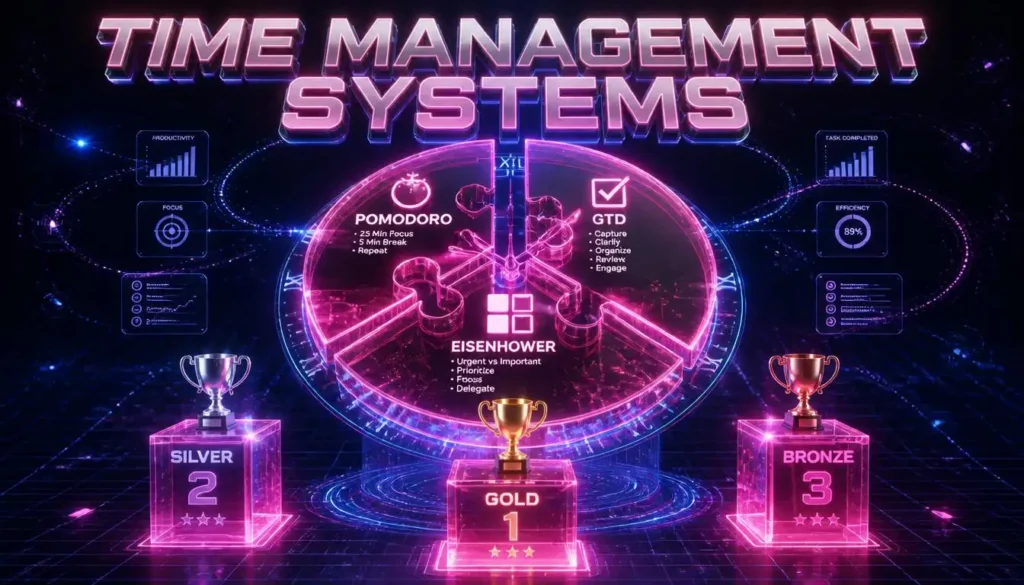
The most effective time management systems, ranked, are: Time Blocking, the Eisenhower Matrix, Getting Things Done (GTD), the Pomodoro Technique, Timeboxing, Chronotype Alignment, the Kanban Method, the Pareto Principle, Eat That Frog, and the ABCDE Method. This ranking reflects adoption data, cognitive science backing, and adaptability across job types — not just popularity.
Here’s the short version before the deep dive:
- Time Blocking — best all-around system for people with variable schedules
- Eisenhower Matrix — best for prioritization under pressure
- Getting Things Done (GTD) — best for people juggling dozens of open loops
- Pomodoro Technique — best for focus and procrastination
- Timeboxing — best for deadline-driven, output-based work
- Chronotype Alignment — best complement to any system above
- Kanban Method — best for visual thinkers and team workflows
- Pareto Principle (80/20 Rule) — best for prioritizing outcomes over tasks
- Eat That Frog — best for chronic procrastinators
- ABCDE Method — best for simple, list-based prioritization
Now let’s go through each one properly, because the difference between “time blocking” and “timeboxing” alone trips up half the people searching for these terms.
What Is Time Blocking and Why Do Executives Use It?
Time blocking means assigning every hour of your calendar to a specific task or category of work, rather than working from an open-ended to-do list. Instead of a list that says “write report, answer emails, review budget,” your calendar shows 9–10:30 a.m. for the report, 10:30–11 for email, and so on.
This is the method most associated with high-output professionals — Cal Newport has written extensively about it as a core discipline of deep work, and plenty of founders and executives credit it with cutting their reactive, meeting-driven days down to something they actually control. The core benefit is structural: it forces you to confront how much time you actually have, instead of assuming you’ll “get to it.”
Ideal user: people with unpredictable calendars — executives, freelancers, parents — who need a visual anchor for the day. If you already keep a professional development plan, time blocking is usually the easiest system to layer on top of it, since your growth goals need dedicated calendar time or they quietly disappear.
Learning curve: medium. The hard part isn’t scheduling the blocks — it’s protecting them when a meeting invite tries to eat one.
What Is Getting Things Done (GTD) and Who Created It?
Getting Things Done, created by David Allen in 2001, is a five-step system — capture, clarify, organize, reflect, engage — designed to get every task and idea out of your head and into a trusted external system. The core premise is that your brain is for having ideas, not holding them, and that unresolved commitments create background stress even when you’re not actively thinking about them.
GTD is heavier than most systems on setup. You build “buckets” — inbox, next actions, waiting-for, projects, someday/maybe — and process everything into them on a regular cadence. That’s also its biggest criticism: people abandon it because the weekly review step gets skipped, and the whole system degrades without it.
Ideal user: people managing high volumes of small commitments — consultants, project managers, anyone with 40+ open tasks at any given time. Software ecosystem: Todoist, Notion, and OmniFocus all have GTD-native templates.
Learning curve: high. This is the one system on this list that genuinely requires reading the book or a solid guide before implementation, not just a quick explainer.
What Is the Eisenhower Matrix and How Does It Work?
The Eisenhower Matrix, also called the Eisenhower Decision Matrix, sorts every task into one of four quadrants based on urgency and importance: do now, schedule later, delegate, or eliminate. It’s named after Dwight D. Eisenhower, who reportedly said, “What is important is seldom urgent, and what is urgent is seldom important” — a line that captures the entire logic of the system.
The four quadrants:
- Urgent + Important → Do it now
- Important, Not Urgent → Schedule it
- Urgent, Not Important → Delegate it
- Neither → Cut it
Most people’s actual problem isn’t a lack of time management — it’s living permanently in quadrant one, reacting to fires instead of working on quadrant two, the stuff that actually moves the needle. The matrix is less a scheduling tool and more a triage tool, which is why it pairs so well with time blocking rather than replacing it.
Ideal user: anyone drowning in competing priorities with no clear filter for what matters. Cognitive impact: reduces decision fatigue by giving you a repeatable sorting rule instead of re-litigating priority every morning.
Time Blocking vs. Timeboxing: What’s the Difference?
Time blocking assigns tasks to fixed calendar slots for the day, while timeboxing assigns a strict, non-negotiable time limit to a single task regardless of whether it’s finished. They look similar but solve different problems.
Time blocking answers: “What am I doing during this hour?”
Timeboxing answers: “How long am I allowed to spend on this before I stop, whether it’s done or not?”
A timeboxed task ends when the clock runs out — full stop, no extension. That constraint is the entire point: it fights perfectionism and scope creep, particularly for work that could theoretically expand forever (research, editing, “just one more revision”). Time blocking, by contrast, is about allocation, not a hard cutoff.
In practice, most sustainable systems use both: block the hour on your calendar, then timebox the task inside it. If you’re building out a structure for your daily tasks, this combination is usually the fastest way to stop over-committing to any single item.
What Is the Pareto Principle (80/20 Rule) in Time Management?
The Pareto Principle holds that roughly 80% of your results come from 20% of your efforts, meaning most productivity gains come from correctly identifying which small slice of tasks actually drives outcomes. Named after economist Vilfredo Pareto, who observed the pattern in wealth distribution in Italy, it’s since been applied everywhere from sales pipelines to personal task lists.
This isn’t a scheduling method in the traditional sense — it’s a filtering lens you apply before you plan your day. Before time blocking your calendar or building a GTD inbox, ask: which 20% of what’s on this list, if done well, makes the other 80% less important or unnecessary? That question alone eliminates a surprising amount of busywork.
Ideal user: freelancers and business owners juggling client work, where not all clients or tasks generate equal value. Cognitive impact: shifts focus from “getting more done” to “doing the right things,” which is a different — and often more useful — problem.
What Is the Kanban Method and How Is It Used for Tasks?
Kanban is a visual workflow method that moves tasks through columns — typically To Do, In Progress, and Done — so you can see workload and bottlenecks at a glance. Originally developed at Toyota for manufacturing, it was adapted for knowledge work and is now the backbone of tools like Trello and Notion boards.
Kanban’s real strength is limiting work-in-progress. Most boards enforce a cap — say, no more than three cards in “In Progress” at once — which stops the common failure mode of starting six things and finishing none. It’s inherently collaborative, which makes it a natural fit for teams, but solo users also benefit from the visual clarity it gives to otherwise invisible workloads.
Ideal user: visual thinkers, engineering and design teams, anyone who thinks in stages rather than time slots. Software ecosystem: Trello, Notion, Asana all default to a kanban-style board view.
What Is the ABCDE Method for Prioritizing Tasks?
The ABCDE Method ranks each task on your list with a letter — A for must-do, B for should-do, C for nice-to-do, D for delegate, E for eliminate — creating an instant priority order without a matrix or software. Productivity author Brian Tracy popularizes it as a lightweight alternative to more structured systems like GTD.
Within each letter, tasks get numbered too (A1, A2, A3), so you always know exactly what to do next without re-deciding. It’s essentially a simplified, pen-and-paper version of the Eisenhower Matrix — same logic, less setup.
Ideal user: people who want prioritization without adopting new software or a multi-step process. Learning curve: low — this is often the first system recommended to someone overwhelmed by more complex frameworks.
What Is “Eat That Frog” and Why Does It Work for Procrastination?
Eat That Frog is a productivity principle, popularized by Brian Tracy’s book of the same name, that says you should complete your most difficult or most avoided task first thing in the day — before anything else has a chance to derail you. The name comes from a Mark Twain line about eating a live frog first thing in the morning so nothing worse can happen to you that day.
This method directly targets a specific failure pattern: using easy, low-value tasks (email, minor admin) to avoid the one task that actually matters, which then gets pushed later and later until it’s rushed or skipped. Willpower is highest early in the day for most people, which is exactly why this sequencing works.
Ideal user: chronic procrastinators and anyone who notices their hardest task keeps sliding to “tomorrow.” It pairs naturally with a broader career development plan, since the tasks people avoid most are often the ones tied to actual growth, not maintenance.
What Is Chronotype Alignment and Why Does It Matter for Productivity?
Chronotype alignment means scheduling demanding, focus-heavy work during your personal peak energy window — determined by your natural circadian rhythm — rather than fighting against it with sheer willpower. Not everyone peaks at 9 a.m. Some people do their best cognitive work at 6 a.m.; others hit their stride closer to 8 p.m.
This is the method most people skip entirely, and it’s arguably the biggest force multiplier on this list, because it doesn’t replace any other system — it makes all of them work better. A time-blocked calendar or a timeboxed sprint scheduled during your energy trough will underperform the same block scheduled during your peak, regardless of how well-designed the system is.
Ideal user: literally everyone, but especially people who’ve tried multiple systems and still feel like they’re “forcing” productivity at certain hours. Cognitive impact: reduces the context-switching penalty by matching task difficulty to available mental bandwidth instead of the clock.
Which Time Management Method Is Scientifically Proven to Be the Most Effective?

No single method has definitive experimental proof of superiority. Still, research consistently supports the mechanisms behind time blocking and prioritization matrices — specifically, that externalizing commitments and reducing context-switching lowers stress and improves performance. Research on time management behavior has found that perceived control of time correlates with better performance evaluations and lower job-induced tension — which is the underlying mechanism nearly every method on this list is trying to engineer, just through different mechanics. You can review the APA’s own teaching resources on time management and stress for a deeper look at that research base.
In plain terms: the science supports the principles — externalizing tasks, reducing decision fatigue, aligning effort with energy — far more than it supports any single branded system.
How Do I Choose a Productivity System That Fits My Personality?
Choose based on your primary failure point, not the system’s popularity: pick time blocking if you overcommit, GTD if you forget things, the Eisenhower Matrix if you can’t prioritize, and Pomodoro if you can’t focus. Most people don’t need a new system — they need to diagnose which specific breakdown they’re experiencing correctly.
A quick self-check:
- Do you say yes to too much? → Time Blocking, because it makes your actual capacity visible.
- Do things fall through the cracks? → GTD, because it captures everything in one trusted place.
- Do you spend your day on the wrong things? → Eisenhower Matrix or the Pareto Principle.
- Do you struggle to start? → Pomodoro or Eat That Frog.
- Do you work best on a screen full of visual progress? → Kanban.
If you’re not sure which failure point applies to you, it’s worth revisiting your personal goals first — the right time management system depends heavily on what you’re actually optimizing for, not just on managing a to-do list.
Why Do Standard Time Management Systems Fail for Remote Workers?
Standard time management systems often fail remote and asynchronous teams because they assume shared working hours, which don’t exist across time zones — leading to constant context-switching between overlapping and non-overlapping windows. A time-blocked calendar built for a 9-to-5 office doesn’t account for a teammate in a different time zone pinging you at what is, for them, the middle of the workday.
The fix isn’t a new framework — it’s an added layer. Remote and distributed teams generally need to combine a visual system like Kanban (so async status is always visible without a meeting) with explicit “core overlap hours” carved out via time blocking, and chronotype alignment applied individually rather than as a team-wide schedule. Trying to force one shared rhythm onto a distributed team is usually where these systems break down first.
How Rise By Inches Helps You Build a System That Actually Sticks
Reading about ten frameworks is the easy part. The hard part is implementation — and that’s where most people quietly go back to reacting instead of planning.
Rise by Inches exists for exactly that gap. Instead of a one-size-fits-all productivity template, the site walks through how to combine these methods with the rest of your personal growth — pairing a personal development guide with practical productivity tools and planning apps that actually support whichever system you land on. The goal isn’t to add another framework to your list. It’s to help you pick one, adapt it to your actual life, and stop rebuilding your system every few months.
Frequently Asked Questions
Which time management method is scientifically proven to be the most effective?
No single method has been proven definitively superior in controlled research. However, the underlying principles behind time blocking and prioritization systems — externalizing tasks and reducing context-switching — do have consistent research support.
What is the difference between time blocking and timeboxing?
Time blocking assigns tasks to specific calendar slots. Timeboxing sets a strict time limit on a single task, forcing it to stop when time runs out, whether finished or not.
How do I choose a productivity system that fits my personality?
Identify your main failure point first — overcommitting, forgetting tasks, poor prioritization, or procrastination — then match the system built to solve that specific problem rather than picking the most popular one.
Why do standard time management systems fail for remote workers?
They typically assume shared working hours, which break down across time zones. Remote teams need visual status systems like Kanban combined with individually aligned focus hours rather than one shared schedule.
Is the Pomodoro Technique effective for ADHD?
Many people with ADHD respond well to Pomodoro because the short, timed intervals reduce the overwhelm of open-ended tasks and create built-in accountability checkpoints every 25 minutes.
Do I need to use just one time management method?
No. Most sustainable systems combine two or three — commonly time blocking for structure, the Eisenhower Matrix for prioritization, and chronotype alignment to place demanding work at the right hour.
The Bottom Line
There’s no universal winner here — just a better or worse fit for the specific way your day tends to fall apart. Time blocking and the Eisenhower Matrix cover the widest range of people. GTD and Kanban solve very specific volume and visibility problems. Chronotype alignment quietly improves whichever system you pick.
Pick the one that matches your actual failure point, run it for two weeks before judging it, and adjust from there. Start your journey to improve yourself with Rise by Inches.



Pingback: How to Overcome Procrastination & Laziness best Plan 2026
Pingback: How to Organize Your Day: Top Practical Plan 2026
Pingback: 10 Best Free Productivity Apps of 2026 (Tested & Ranked)
Pingback: Best Time Management Tools for Every Work Style (2026 Guide)
Pingback: Time Management Goals: Best Key Qualities Guide 2026
Pingback: Time Management Goals: Key Qualities best guide 2026