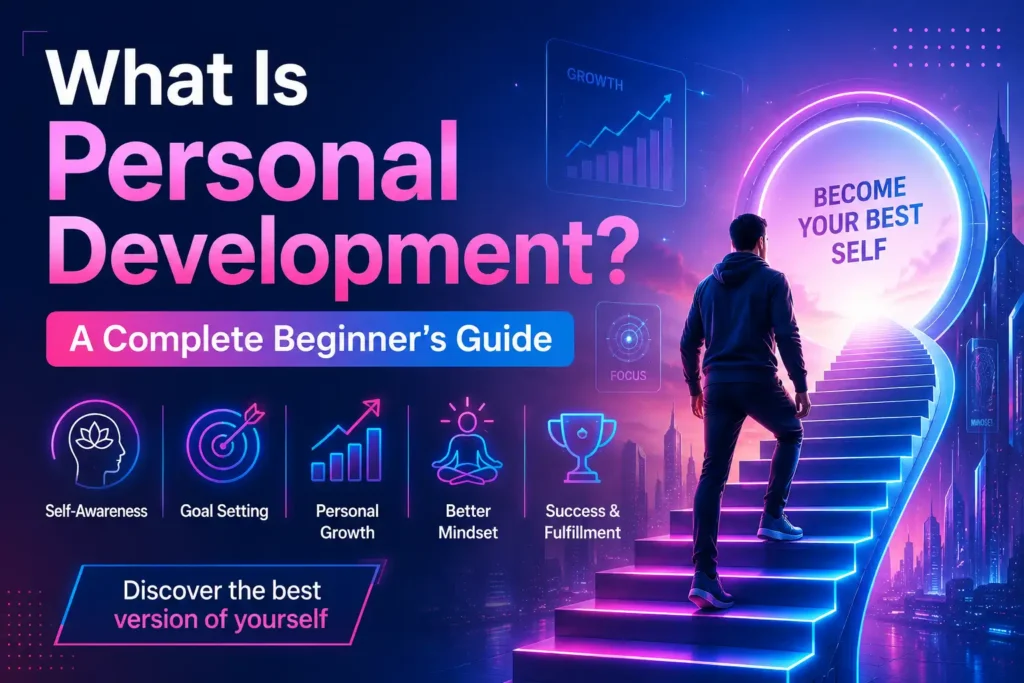

What Is Personal Development?
Personal development is defined as the ongoing process of improving your skills, mindset, habits, and self-awareness to reach your fullest potential both personally and professionally. It’s not a one-time event or a New Year’s resolution. It’s a continuous journey of self-improvement that touches every part of your life, from your career and relationships to your emotional wellbeing and physical health.
At its core, personal development is about closing the gap between who you are today and who you want to become. It involves setting goals, building new habits, gaining knowledge, and consistently taking small steps toward growth.
Many people confuse personal development with self-help, but there’s a subtle difference. Self-help usually refers to specific tools, books, or techniques used to solve a particular problem (like managing stress or overcoming procrastination). Personal development, on the other hand, is the bigger picture the overall lifelong process that self-help resources support.
Why Is Personal Development Important?
Personal development matters because it directly impacts your confidence, career growth, relationships, and overall happiness. When you invest in yourself, you’re better equipped to handle challenges, adapt to change, and make decisions that align with your goals and values.
Here’s why personal development deserves a place in your daily life:
- Boosts self-confidence – As you build new skills and achieve small wins, your belief in your own abilities grows.
- Improves career prospects – Employers actively look for people who show initiative, adaptability, and a growth mindset.
- Strengthens relationships – Better self-awareness and emotional intelligence lead to healthier communication with others.
- Increases resilience – Personal growth helps you bounce back faster from setbacks and failures.
- Enhances mental wellbeing – Working on yourself often reduces anxiety and increases a sense of purpose.
- Encourages lifelong learning – It keeps your mind active, curious, and open to new opportunities.
According to research from the American Psychological Association, individuals who actively pursue self-improvement and maintain a growth mindset tend to show greater resilience and adaptability when facing setbacks. This reinforces just how much personal growth can shape not just your career, but your overall quality of life.
The Key Areas of Personal Development
Personal development isn’t limited to just “being more productive” or “reading more books.” It spans several interconnected areas of life. Understanding these areas helps you identify where you need to focus your energy.
1. Mental Development
This involves sharpening your thinking, expanding your knowledge, and improving problem-solving skills. Reading, learning new skills, and challenging your assumptions all fall under this category.
2. Emotional Development
Emotional development is about understanding and managing your emotions often referred to as emotional intelligence (EQ). It includes self-awareness, empathy, and the ability to regulate your reactions in stressful situations.
3. Physical Development
Your physical health directly affects your energy, focus, and mood. This area covers exercise, nutrition, sleep, and overall self-care habits.
4. Social Development
Social development focuses on communication skills, relationship-building, networking, and how you interact with others both personally and professionally.
5. Spiritual Development
This doesn’t necessarily mean religion. Spiritual development is about finding purpose, meaning, and alignment with your core values and beliefs.
6. Career/Professional Development
This includes building job-specific skills, expanding your knowledge in your field, and working toward career advancement and long-term goals.
Key Skills You Build Through Personal Development
Personal development helps you build both hard and soft skills that are valuable in every area of life. Some of the most important skills include:
- Goal setting – Learning to set SMART goals (Specific, Measurable, Achievable, Relevant, Time-bound)
- Time management – Prioritizing tasks and using your time more effectively
- Emotional intelligence – Understanding your emotions and the emotions of others
- Communication skills – Expressing yourself clearly and listening actively
- Self-discipline – Staying consistent even when motivation runs low
- Critical thinking – Making better decisions through logical analysis
- Adaptability – Adjusting to change with a positive mindset
- Resilience – Recovering quickly from setbacks and failures
Benefits of Personal Development
The benefits of personal development go far beyond just “feeling better about yourself.” Here’s what consistent personal growth can do for you:
- Career growth – People who focus on self-improvement are often first in line for promotions and new opportunities.
- Better decision-making – Increased self-awareness leads to smarter, more intentional choices.
- Stronger relationships – Improved communication and emotional intelligence build deeper connections.
- Higher productivity – Better habits and time management mean you get more done with less stress.
- Improved mental health – A sense of progress and purpose can reduce feelings of anxiety and stagnation.
- Greater life satisfaction – Working toward meaningful goals gives your life direction and fulfillment.
Types of Personal Development Goals (With Examples)
Not sure where to start? Personal development goals typically fall into a few categories. Here are some real-world examples for each:
Career Goals
- Learn a new professional skill (e.g., public speaking, project management)
- Get a certification in your field
- Improve your leadership abilities
Health & Fitness Goals
- Exercise three times a week
- Improve sleep quality
- Build healthier eating habits
Emotional & Mental Goals
- Practice mindfulness or meditation daily
- Work on managing stress more effectively
- Build higher self-esteem
Relationship Goals
- Improve active listening skills
- Set healthier boundaries
- Strengthen communication with family or colleagues
Financial Goals
- Create and stick to a monthly budget
- Build an emergency savings fund
- Learn the basics of investing
How to Create a Personal Development Plan (Step-by-Step)
A personal development plan (PDP) is a structured action plan that helps you set clear goals and track your progress. Here’s how to build one, step by step:
Step 1: Self-Assessment Start by honestly evaluating where you currently stand. What are your strengths? What areas need improvement? Journaling or taking a personality/skills assessment can help.
Step 2: Set SMART Goals Turn vague ideas (“I want to be more confident”) into specific, measurable goals (“I will speak up at least once in every team meeting for the next 30 days”).
Step 3: Identify Resources Figure out what tools, courses, books, or mentors can help you reach your goals faster.
Step 4: Create an Action Plan Break your goals into small, manageable daily or weekly actions. Small consistent steps beat big, overwhelming leaps.
Step 5: Track Your Progress Use a journal, app, or spreadsheet to monitor your growth. Reviewing your progress keeps you motivated and accountable.
Step 6: Review and Adjust Personal development isn’t linear. Revisit your plan every month and adjust your goals as needed.
How to Start Personal Development As a Beginner
If you’re just getting started, don’t try to overhaul your entire life overnight. Here are simple, beginner-friendly steps:
- Start with one small habit (like reading 10 pages a day)
- Set a single, clear goal instead of ten vague ones
- Track your progress weekly, not daily, to avoid burnout
- Surround yourself with people who support your growth
- Be patient — real change takes weeks and months, not days
Personal Development Tools & Resources
There are countless free and paid resources available to support your growth journey:
Free Resources
- YouTube channels focused on self-improvement and productivity
- Free courses on platforms like Coursera and edX
- Podcasts on personal growth, psychology, and productivity
- Journaling apps and habit trackers
Paid Resources
- Books by respected authors in psychology and self-improvement
- Online certification courses
- Personal coaching or mentorship programs
- Structured development programs, such as those offered through professional training providers
If you’re looking for structured, expert-led guidance rather than trying to piece everything together yourself, working with a dedicated growth and training partner like Leads 360 LLC can help you build a personalized plan backed by real strategy and support.
Real-World Examples of Personal Development in Action
Personal development looks different for everyone. Here are a few relatable, real-world examples:
- A shy employee joins a public speaking club and gradually becomes confident presenting in meetings.
- A recent graduate sets a goal to read one industry-related book per month to stay competitive in their field.
- Someone struggling with time management starts using a planner and reports feeling less overwhelmed within weeks.
- A manager works on emotional intelligence and notices improved trust and communication within their team.
These small, consistent actions are what personal development looks like in everyday life not dramatic overnight transformations, but steady, intentional progress.
Personal Development and Career Opportunities
Employers today value more than technical skills they want employees who show self-awareness, adaptability, and a genuine willingness to grow. This makes personal development directly relevant to career advancement.
Professionals who actively work on their personal growth often see:
- Faster promotions and career advancement
- Stronger workplace relationships
- Better performance under pressure
- Increased leadership opportunities
Investing in your personal development isn’t just self-care it’s a smart career strategy. If you’re looking to take your growth further with structured, expert-guided support, you can explore Advanced Services at Leads 360 LLC to build both your professional and personal skill set with expert guidance.
Common Mistakes to Avoid in Personal Development
- Trying to change everything at once – This leads to burnout. Focus on one area at a time.
- Comparing your progress to others – Everyone’s journey looks different.
- Not tracking progress – Without tracking, it’s hard to see how far you’ve come.
- Giving up too soon – Real growth takes consistency over weeks and months, not days.
- Setting vague goals – “Be better” isn’t a goal. “Read 20 minutes a day” is.
Frequently Asked Questions (FAQs)
What is personal development in simple words? Personal development is the process of improving yourself — your skills, mindset, habits, and self-awareness to become a better, more capable version of who you are today.
Why is personal development important? It’s important because it improves your confidence, career opportunities, relationships, and overall mental wellbeing by helping you grow continuously rather than staying stagnant.
What are the 5 areas of personal development? The five core areas are mental, emotional, physical, social, and career/professional development. Some frameworks also include spiritual development as a sixth area.
How do I start my personal development journey? Start small. Choose one specific goal, create a simple action plan, and track your progress weekly. Consistency matters more than intensity.
Is personal development the same as self-help? Not exactly. Self-help refers to specific tools or techniques used to solve a problem, while personal development is the broader, ongoing lifelong process of growth.
How long does personal development take? Personal development is a lifelong process. However, noticeable changes in habits and mindset can often be seen within a few weeks to a few months of consistent effort.
Conclusion: Start Your Personal Development Journey Today
Personal development isn’t about becoming a completely different person overnight it’s about consistently choosing growth, one small step at a time. Whether you’re working on your confidence, career, relationships, or mindset, every effort you put into bettering yourself compounds over time.
The best time to start is now. Set one clear goal, take one small action today, and build from there.
If you want expert guidance to accelerate your growth journey, book a seat at Advanced Services offered by Leads 360 LLC and take the next confident step toward becoming the best version of yourself.
