
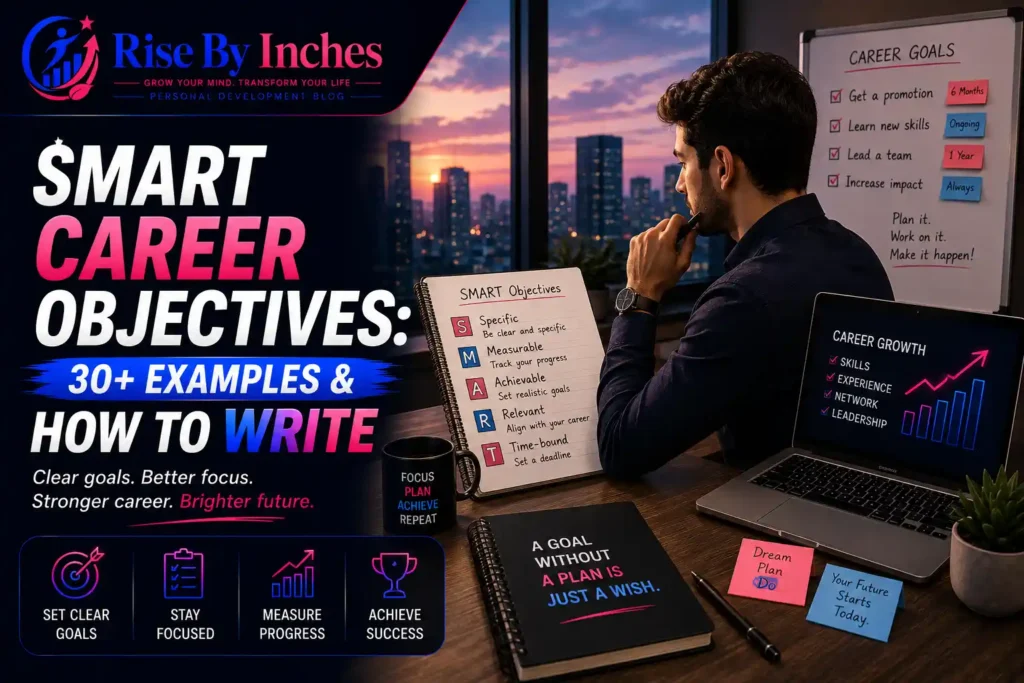

A weak resume objective wastes the six seconds a recruiter actually spends on your resume. A SMART career objective is a one-to-two-sentence statement that uses the Specific, Measurable, Achievable, Relevant, and Time-bound framework to show exactly what you offer and what you’re targeting, instead of vague filler like “seeking a challenging position.” This guide breaks down the SMART framework, gives you 30+ ready-to-adapt examples across industries and career stages, and shows you how to get past applicant tracking systems and in front of a human.
What Is a SMART Career Objective?
A SMART career objective is a resume opening statement built around five criteria — Specific, Measurable, Achievable, Relevant, and Time-bound — that replaces generic ambition with concrete, verifiable direction. Instead of saying you want “a rewarding career,” a SMART objective specifies the role you want, the skill or result you bring, and the timeframe or context that frames the goal.
The SMART framework itself originated in management literature as a goal-setting tool, and it translates directly to resume writing because hiring managers are essentially screening for one thing: can this person clearly state what value they add and where they’re headed? A vague objective signals a vague candidate. A specific one signals someone who has already thought through the role.
Should I Even Include a Career Objective on My Resume?
Yes, but selectively: career objectives work best for entry-level candidates, career changers, and people applying to a role outside their most recent job title, while established professionals with a clear track record often benefit more from a professional summary. The distinction matters because the two formats serve different purposes.
| Format | Best For | Focuses On |
| Career Objective | Freshers, career switchers, students, remote job seekers | What you want and what you bring |
| Professional Summary | Mid-to-senior professionals with 5+ years experience | What you’ve already achieved |
If your resume has a clear, obvious career trajectory, a summary of accomplishments usually outperforms an objective. If you’re pivoting industries, entering the workforce, or your job history doesn’t immediately explain why you’re a fit, a well-written objective closes that gap before the hiring manager has to guess.
What’s the Difference Between a Resume Objective and a Summary Statement?
A resume objective states your career goals and what you’re seeking, while a professional summary states your existing accomplishments and proven track record. An objective is forward-looking; a summary is backward-looking, built from measurable results.
Objective example: “Detail-oriented marketing graduate seeking an entry-level Digital Marketing Coordinator role to apply SEO and content strategy skills within a growth-focused team.”
Summary example: “Digital marketer with 6 years of experience driving 40% average organic traffic growth across SaaS clients.” Confusing the two is one of the most common resume mistakes — using a summary format on a resume that actually needs an objective (or vice versa) makes the opening line miss its purpose entirely.
How Do You Write a SMART Career Objective Step by Step?
Writing a SMART career objective means running your draft through all five SMART criteria before finalizing it, because skipping even one criterion — usually “measurable” or “time-bound” — is what makes most objectives sound generic. Here’s the breakdown:
- Specific — Name the exact role, department, or industry. “A position in marketing” is not specific. “An entry-level Content Marketing Specialist role” is.
- Measurable — Attach a skill, metric, or scope that can be evaluated. This might be a certification, years of experience, or a quantifiable strength.
- Achievable — Match the objective to your actual qualifications. Don’t state a goal your resume can’t back up two lines later.
- Relevant — Tie the objective directly to the employer’s needs, not just your own career wishes.
- Time-bound — Frame a timeframe or context, such as “within my first 90 days” or “for the upcoming fiscal year.”
A quick way to self-audit: read your draft and ask whether it could apply to literally any candidate applying to any job. If yes, it’s not SMART yet.
For readers building a broader career roadmap around this resume work, our career development plan example and professional development plan guides pair well with this step.
How Do Applicant Tracking Systems Affect Your Career Objective?
Applicant Tracking Systems (ATS) parse resume text for keyword matches against the job description, meaning a career objective that mirrors the language of the posting has a measurably better chance of surfacing to a human reviewer. Guidance from Harvard’s Office of Career Services advises tailoring a resume to the specific position you’re seeking rather than sending a generic version to every employer, since your resume should reflect the skills and impact that particular employer values. UConn’s career center similarly notes that over 90% of Fortune 500 companies now use ATS software to scan resumes for keywords tied to the job description before a human ever reviews them.
Practical ATS tips for your objective line:
- Mirror the exact job title used in the posting, not a close synonym
- Include 1–2 hard skills or tools named in the job description
- Avoid graphics, tables, or unusual formatting within the objective itself — ATS parsers can misread these
- Keep the objective in standard resume fonts and plain text, even if the rest of your resume has design elements
30+ SMART Career Objective Examples by Category
Below are ready-to-adapt SMART objectives grouped by career stage and industry. Swap in your specific skills, target company type, or timeframe.
Entry-Level and Fresher Career Objectives
- Recent Computer Science graduate seeking an entry-level Software Developer role to apply Python and SQL skills toward building scalable backend systems within a collaborative engineering team.
- Detail-oriented Business Administration graduate pursuing a Junior Financial Analyst position to apply Excel modeling and forecasting coursework within a growth-stage company.
- Motivated Communications graduate seeking an entry-level Public Relations Assistant role to apply media relations training and grow into a client-facing position within 12 months.
- Recent nursing graduate pursuing an entry-level Registered Nurse position in a pediatric unit to apply clinical rotation experience and patient care training.
- Organized Human Resources graduate seeking a Junior HR Coordinator role to apply onboarding and employee relations coursework within a mid-sized organization.
Career Change and Career Switcher Objectives
- Former retail manager with 5 years of team Leadership experience transitioning into Project Management, seeking a Junior Project Coordinator role to apply organizational and stakeholder communication skills.
- Teacher with 7 years of curriculum development experience pivoting into Instructional Design, seeking an entry-level role to apply learning-outcomes expertise to corporate training programs.
- Sales professional with 4 years of B2B experience transitioning into Customer Success, seeking a Customer Success Associate role to apply relationship-management skills toward reducing client churn.
- Military veteran with 6 years of logistics coordination experience seeking a Supply Chain Analyst role to apply operational planning skills within a civilian manufacturing environment.
- Graphic designer with 3 years of freelance experience transitioning into UX Design, seeking a Junior UX Designer role to apply visual design skills toward user-centered product work.
Mid-Level Professional Career Objectives
- Marketing professional with 4 years of content strategy experience seeking a Senior Content Marketing role to drive a 25% increase in organic traffic within the first two quarters.
- Software engineer with 5 years of full-stack experience seeking a Backend Engineer position to lead API architecture improvements for a scaling SaaS platform.
- Accountant with 6 years of reconciliation and reporting experience seeking a Senior Staff Accountant role to streamline month-end close processes within a fast-growing firm.
- Operations coordinator with 4 years of vendor management experience seeking an Operations Manager role to reduce procurement costs by identifying supply chain efficiencies.
- Registered nurse with 5 years of ICU experience seeking a Charge Nurse role to mentor incoming staff while maintaining direct patient-care responsibilities.
Management and Leadership Career Objectives
- Results-driven team lead with 8 years of retail operations experience seeking a Store Manager role to improve staff retention and drive quarterly sales targets within a multi-location environment.
- Engineering manager with 6 years of cross-functional Leadership seeking a Director of Engineering role to scale a 15-person team while maintaining sprint velocity during rapid product growth.
- Finance professional with 10 years of budgeting experience seeking a Finance Manager role to lead annual forecasting cycles for a mid-market organization.
- HR generalist with 7 years of policy and compliance experience seeking an HR Business Partner role to align talent strategy with departmental growth goals.
- Marketing lead with 9 years of brand strategy experience seeking a Marketing Director role to expand market share in two new regional territories within 18 months.
Remote and Work-From-Home Career Objectives
- Customer support specialist with 3 years of chat and email support experience seeking a fully remote Customer Support Lead role to maintain a 95%+ satisfaction rating across distributed teams.
- Content writer with 4 years of freelance and agency experience seeking a remote Senior Copywriter role to produce SEO-optimized content for a distributed marketing team.
- Project coordinator with 5 years of cross-timezone collaboration experience seeking a remote Project Manager role to lead asynchronous teams across three time zones.
- Software developer with 3 years of remote-first experience seeking a fully distributed Full-Stack Developer role to contribute to a globally dispersed engineering team.
- Virtual assistant with 4 years of administrative support experience seeking a remote Executive Assistant role to manage scheduling and communications for a C-suite executive.
Industry-Specific Career Objectives
- Data analyst with 3 years of SQL and Tableau experience seeking a Business Intelligence Analyst role to build dashboards that reduce reporting turnaround by 30%.
- Civil engineer with 4 years of structural design experience seeking a Project Engineer role to support municipal infrastructure projects within a growing engineering firm.
- Paralegal with 5 years of litigation support experience seeking a Senior Paralegal role to manage case documentation for a mid-sized litigation practice.
- Hospitality manager with 6 years of front-of-house operations experience seeking a General Manager role to improve guest satisfaction scores at a boutique hotel property.
- IT support specialist with 4 years of helpdesk and network administration experience seeking a Systems Administrator role to reduce average ticket-resolution time within an enterprise environment.
- Social media manager with 3 years of platform-growth experience seeking a Social Media Strategist role to grow follower engagement by 20% within two quarters for a consumer brand.
What Are the Most Common Career Objective Mistakes?
The most common mistakes are writing an objective too generic to distinguish you from other applicants, focusing only on what you want instead of what you offer, and exceeding two sentences. Recruiters skim resumes in seconds, and a bloated or vague opening line burns that time without giving them a reason to keep reading. The University of Illinois Chicago’s career services office makes a similar point about specificity: naming exact tools and skills (like “Adobe Photoshop” instead of “image-editing software”) performs better with ATS parsing than vague generalizations, a principle that applies directly to how specific your objective statement should be.
Other frequent errors:
- Using outdated phrasing like “seeking a challenging position that will utilize my skills”
- Listing soft skills with no evidence (“hardworking,” “team player”) instead of specific, verifiable strengths
- Failing to update the objective for each application, resulting in a mismatch with the job description
- Writing an objective identical to the summary section elsewhere on the resume
Research from career-services literature consistently finds that resumes tailored to the specific job posting outperform generic, one-size-fits-all versions across nearly every industry and seniority level. A quick edit pass targeting the job title and 1–2 required skills usually fixes most of these issues.
Frequently Asked Questions
What is an example of a SMART career objective?
A strong example: “Marketing graduate seeking an entry-level Social Media Coordinator role to apply content-scheduling and analytics skills toward growing brand engagement within the first six months.” It’s specific to the role, measurable through the named skills, and time-bound.
Should I include a career objective on my resume?
Include one if you’re entry-level, changing careers, or your work history doesn’t clearly explain your target role. Established professionals with a strong track record generally benefit more from a professional summary instead.
What’s the difference between a resume objective and a summary statement?
An objective is forward-looking and states your goals; a summary is backward-looking and highlights measurable past achievements. Use whichever format matches your career stage.
How long should a SMART career objective be on a CV?
One to two sentences, roughly 25–40 words. Anything longer starts to compete with the summary or experience sections for the reader’s attention.
Do career objectives still matter with modern ATS software?
Yes. ATS software parses the objective for keyword matches against the job description, so a well-tailored objective can directly improve how your resume ranks in automated screening.
Turning Your Objective Into an Interview
A SMART career objective isn’t a formality — it’s the first data point a recruiter uses to decide whether the rest of your resume is worth reading. Pick the example closest to your situation from the list above, adjust it with your specific skills and target role, and run it through the five SMART checkpoints before you submit it. At Rise By Inches, we’ve seen that candidates who tailor this one line per application consistently get more callbacks than those who leave it generic. Update your objective for your next application today, and treat it as a five-minute task worth doing every time.



Pingback: 12 Work Development Goals to Level Up Fast (2026 Guide)
Pingback: Mental Health Internships 2026: Salary & Career Guide