
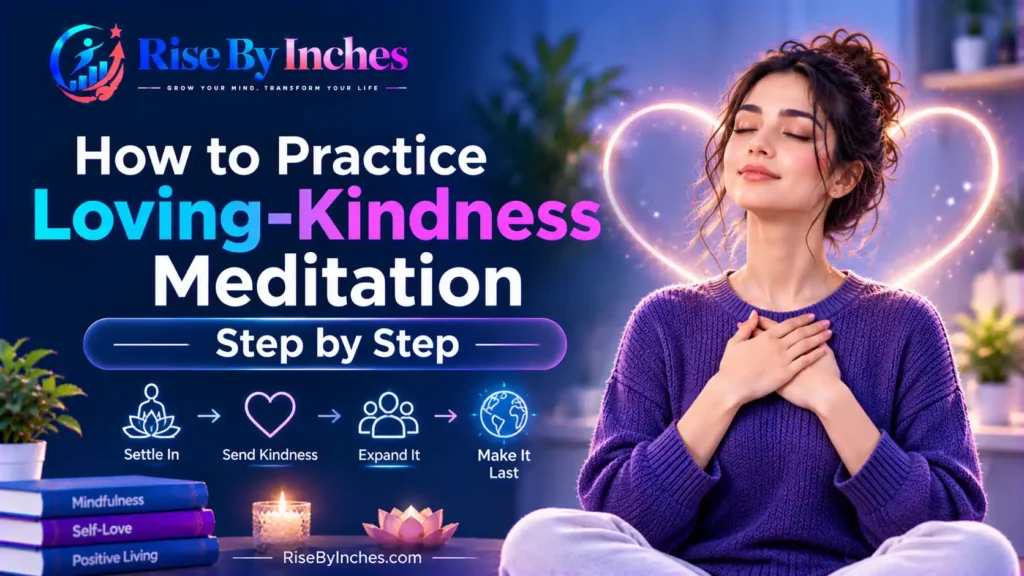

Loving-kindness meditation, also known as metta meditation, is a practice of directing kind and compassionate wishes toward yourself and other people. You silently repeat simple phrases such as “May I be safe,” “May I be happy,” and “May I live with ease.”
Unlike meditation practices that focus mainly on observing thoughts, loving-kindness meditation gives your attention a specific intention: developing goodwill.
You do not need to feel instantly peaceful, naturally compassionate, or completely free from negative thoughts to begin. You practise repeating the phrases and gently returning your attention whenever it wanders.
In this guide, you will learn what loving-kindness meditation means, how to practise it step by step, what phrases to use, how to approach difficult emotions, and what scientific research actually says about its potential benefits.
What Is Loving-Kindness Meditation?
Loving-kindness meditation is a contemplative practice in which you intentionally cultivate goodwill toward yourself and others. It involves silently repeating well-wishing phrases while directing your attention to different people or groups.
The practice comes from Buddhist traditions, where it is commonly known as metta bhavana, meaning the cultivation or development of loving-kindness.
The Pāli word metta is often translated as goodwill, friendliness, or benevolence. It describes an attitude of wishing well to living beings without requiring them to earn your kindness.
In a traditional practice, you gradually extend these wishes to different people:
- Yourself.
- Someone who has supported or helped you.
- A close friend or loved one.
- A person you feel neutral about.
- Someone you find mildly difficult.
- All living beings.
The sequence can vary between teachers and traditions. You can also adjust it to make the practice emotionally manageable.
What Are the Four Brahma-viharas?
In Buddhist teachings, loving-kindness is one of four qualities known as the Brahma-viharas, often translated as the divine abodes or immeasurable qualities.
| Quality | Meaning |
| Metta | Goodwill and wishing others well |
| Karuna | Compassion and the wish to ease suffering |
| Mudita | Sympathetic joy in another person’s happiness |
| Upekkha | Equanimity and balanced understanding |
These qualities are related, but they are not interchangeable. Metta focuses on goodwill, while karuna responds more directly to suffering.
How Is Loving-Kindness Different From Mindfulness?
Mindfulness involves paying attention to present-moment experiences with an attitude of openness and reduced judgment. You might notice your breathing, thoughts, emotions, or physical sensations without immediately reacting to them.
Loving-kindness meditation has a more specific focus. Instead of primarily observing what is happening, you intentionally repeat phrases of goodwill.
For example:
- In mindfulness, you might notice that you feel irritated.
- In loving-kindness meditation, you might acknowledge that irritation and practise wishing yourself and others well.
Both practices can support greater awareness, but they train attention in different ways.
If you are new to meditation, you can also explore our guide to healthy meditation practices.
What Are the Benefits of Loving-Kindness Meditation?
Loving-kindness meditation may support positive emotions, compassion, self-kindness, and psychological well-being. However, its effects vary, and it should not be treated as a guaranteed solution for anxiety, depression, trauma, or other mental health concerns.
A 2024 systematic review and meta-analysis examined 23 randomized controlled studies of loving-kindness interventions. The researchers found benefits across several mental health outcomes when these interventions were compared with passive control conditions. However, the effects were not statistically significant compared with active control groups or alternative treatments.
This means the research is encouraging, but it does not establish that loving-kindness meditation is better than other helpful approaches.
1. It May Encourage More Positive Emotions
Repeatedly directing attention toward goodwill may help you become more aware of positive feelings such as warmth, appreciation, and connection.
You might notice small changes in everyday situations, such as feeling pleased when someone succeeds or responding less harshly when a mistake happens.
These changes are not guaranteed, but they are useful experiences to observe during regular practice.
2. It May Support Self-Compassion
Some people find it easier to encourage a friend than to speak kindly to themselves.
For example, imagine making a mistake at work. Your immediate reaction might be:
“I always mess things up.”
A more compassionate response could be:
“I made a mistake, but I can learn from it.”
Loving-kindness phrases can provide a simple way to practise this shift without pretending that everything is perfect.
3. It May Strengthen Compassion Toward Others
The practice encourages you to consider people beyond your immediate circle of family and friends.
For example, you might extend goodwill toward a stranger, a neighbour, or someone whose experiences are very different from yours.
This does not mean you must agree with everyone. It means practising the intention to wish others well while still recognising differences, disagreements, and boundaries.
4. It May Support Emotional Well-Being
Some research suggests that loving-kindness interventions can improve certain measures of positive and negative psychological well-being.
However, the results depend on the comparison being made, the study design, and the participants involved. More rigorous research is needed to understand who benefits most and how lasting those benefits may be.
For this reason, it is better to describe loving-kindness meditation as a potentially helpful well-being practice rather than a treatment or cure.
Research note: Petrovic and colleagues’ 2024 systematic review and meta-analysis is a useful starting point for understanding the current evidence. Read the research review.
What Do You Need Before Starting?
You do not need special equipment, a meditation cushion, or previous experience. A comfortable place and a few minutes of uninterrupted time are enough.
Prepare the following:
- A comfortable position: Sit on a chair, cushion, or other stable surface.
- A quiet environment: Choose a place where interruptions are less likely.
- A short time limit: Begin with five minutes if ten minutes feels difficult.
- Your phrases: Choose three or four wishes before starting.
- A gentle attitude: Do not expect yourself to feel a particular emotion.
You can close your eyes or keep them slightly open. Rest your hands comfortably and allow your breathing to remain natural.
You may use your breath as an anchor, but you do not have to breathe in a particular way or concentrate on a specific area of your body.
How to Practice Loving-Kindness Meditation Step by Step
A common beginner-friendly approach uses six stages: settling your attention, directing goodwill toward yourself, extending it to a benefactor and friend, including a neutral person, approaching a mildly difficult person, and finally widening your wishes to all beings.
You can spend one or two minutes on each stage. If you have only five minutes, use fewer stages rather than rushing through all of them.
Step 1: Settle Into a Comfortable Position
Sit comfortably and allow your shoulders, hands, and face to relax.
Take a few natural breaths. Notice the feeling of breathing without trying to control it.
If thoughts appear, acknowledge them and gently return your attention to the present moment.
You do not need to empty your mind. You aim to become settled enough to begin.
Step 2: Direct Goodwill Toward Yourself
Start by offering kind wishes to yourself.
Silently repeat:
May I be safe.
May I be happy.
May I be healthy.
May I live with ease.
Pause briefly between each phrase.
You might feel peaceful, uncomfortable, neutral, or distracted. All of these experiences are possible.
If directing kindness toward yourself feels difficult, do not force it. You can begin with someone who makes you feel safe and appreciated, then return to yourself later.
The purpose is not to convince yourself that everything is wonderful. It is to practise treating yourself with goodwill.
Step 3: Think of Someone Who Has Supported You
Bring to mind a person whose kindness you appreciate.
This could be a teacher, mentor, family member, friend, or someone who helped you during a difficult period.
Choose someone whose presence feels reasonably comfortable to remember.
Silently repeat:
May you be safe.
May you be happy.
May you be healthy.
May you live with ease.
You do not need to create a detailed mental picture. Simply remembering the person is enough.
Step 4: Extend Goodwill to a Close Friend
Now think of someone you care about.
It could be a sibling, close friend, partner, or another person whose well-being matters to you.
Bring their name or face to mind and repeat the same phrases.
If it helps, remember a small moment when they made you smile or offered support.
The goal is to extend the intention of goodwill, not to manufacture an intense emotional experience.
Step 5: Include a Neutral Person
Choose someone you recognise but do not know well.
For example:
- A shopkeeper you see regularly.
- A neighbour you rarely speak to.
- A colleague from another department.
- Someone you often see on your commute.
You probably know very little about this person’s life. That is what makes the stage useful.
Remind yourself that this person has their own responsibilities, challenges, relationships, and hopes.
Repeat:
May you be safe.
May you be happy.
May you be healthy.
May you live with ease.
You are practising goodwill without relying on a close personal connection.
Step 6: Approach a Mildly Difficult Person
This stage can be challenging, so choose carefully.
Think of someone who occasionally irritates you or with whom you have a manageable disagreement. Do not begin with someone who has seriously harmed, threatened, or abused you.
Offer the phrases gently:
May you be safe.
May you find peace.
May your suffering be eased.
If you notice anger or resistance, acknowledge it without judging yourself.
You can return to a previous stage whenever you need to. There is no requirement to include a difficult person in every session.
Remember: wishing someone well does not mean approving of their actions, forgiving them, trusting them, or allowing them back into your life.
Step 7: Extend Goodwill to All Beings
Finally, widen your attention beyond individual people.
You might begin with people in your home, then your neighbourhood, community, country, and the wider world.
Repeat:
May all beings be safe.
May all beings be happy.
May all beings be healthy.
May all beings live with ease.
Allow the phrases to become broader without forcing a particular feeling.
When you are ready, stop repeating them and sit quietly for a few moments.
Notice how you feel. You do not need to rate your experience or decide whether the session was successful.
What Phrases Should You Use During Loving-Kindness Meditation?
The phrases are simple wishes that express goodwill. Different teachers and traditions use different translations, so you do not have to follow one exact set of words.
A common set is:
May I be safe.
May I be happy.
May I be healthy.
May I live with ease.
You can replace the words with phrases that feel more natural.
| Intention | Example phrase |
| Safety | May I feel safe and protected |
| Happiness | May I experience happiness |
| Health | May I enjoy good health |
| Peace | May I live with peace |
| Ease | May I meet life with greater ease |
| Compassion | May I be gentle with myself |
How Do You Choose the Right Phrases?
Use these simple guidelines:
- Keep the wording short. Long sentences can make it difficult to maintain attention.
- Choose language that feels natural. If a phrase sounds uncomfortable, change it.
- Avoid turning wishes into demands. “May I find peace” is a wish, not an order to stop feeling upset.
- Use the same phrases for a while. Repetition can make the practice easier to follow.
- Allow mixed feelings. You can repeat a phrase even when you do not feel particularly warm or happy.
The most important thing is to practise with a gentle intention rather than trying to force an emotional response.
What If You Feel Angry or Unable to Show Kindness to Someone?
It is normal to experience anger, discomfort, sadness, or resistance during loving-kindness meditation.
You are not failing because you cannot immediately wish someone well. You are noticing your actual emotional response.
Try these adjustments.
If You Feel Angry
Pause the phrases and take a few natural breaths.
Acknowledge the feeling:
“Anger is present right now.”
Then return to a person who feels easier to include, or offer yourself a few kind wishes.
You can try again another day.
If You Cannot Feel Kindness Toward Yourself
Begin with a benefactor or close friend.
Sometimes it is easier to remember what kindness feels like when you think of someone who has treated you well.
Once you feel more comfortable, return to the self-directed phrases.
If You Feel Nothing
Do not force warmth or happiness.
You can repeat the words slowly and treat them as intentions rather than statements about how you currently feel.
Feeling neutral does not automatically mean the practice is useless.
If You Feel Overwhelmed
Stop the session if it becomes distressing. Open your eyes, notice your surroundings, and return to an activity that helps you feel grounded.
If meditation repeatedly brings up intense distress, trauma-related memories, or difficult emotions, consider speaking with a qualified mental health professional.
You can also keep your practice short and avoid the difficult-person stage.
Does Loving-Kindness Meditation Mean Forgiving Someone?
No. Loving-kindness meditation does not require forgiveness, reconciliation, or renewed contact.
You can wish someone well while deciding that a relationship is unhealthy or unsafe.
For example, imagine that a former colleague treated you unfairly. You might practise wishing them peace without agreeing with their behaviour or returning to a working relationship.
Similarly, if a family member repeatedly violates your boundaries, you can maintain distance.
Kindness and boundaries can exist together.
If you want to understand how to protect your time and emotional space, read our guide to essential boundary types.
Why Can Loving-Kindness Meditation Feel Difficult at First?
The practice may feel unfamiliar because it asks you to direct attention toward goodwill rather than criticism, resentment, or everyday worries.
Some people also find self-directed kindness uncomfortable because they are more accustomed to judging their mistakes than acknowledging their needs.
Here are a few common difficulties and practical responses.
| Difficulty | What you can try |
| Your mind keeps wandering | Return gently to the next phrase |
| The words feel unnatural | Replace them with simpler language |
| You feel emotionally neutral | Continue without forcing a feeling |
| You become irritated | Return to an easier stage |
| You feel sleepy | Sit upright or keep your eyes slightly open |
| You become upset | Stop, ground yourself, and shorten future sessions |
| You struggle with self-kindness | Begin with a supportive person |
Remember that meditation is not a performance. There is no need to achieve a perfect state of mind.
A Simple 10-Minute Loving-Kindness Meditation Routine
If you want a clear routine to follow, use the schedule below.
You can adjust the timing according to your experience. Beginners may prefer a shorter session, and it is entirely reasonable to omit the difficult-person stage.
| Time | Practice | Focus |
| 0:00–1:00 | Settle | Natural breathing |
| 1:00–3:00 | Self | Offer goodwill to yourself |
| 3:00–4:00 | Benefactor | Remember someone supportive |
| 4:00–5:00 | Friend | Include someone you care about |
| 5:00–6:30 | Neutral person | Extend goodwill to an acquaintance |
| 6:30–8:00 | Difficult person | Include someone mildly challenging, if comfortable |
| 8:00–9:30 | All beings | Widen your wishes |
| 9:30–10:00 | Close | Sit quietly and notice your experience |
Your Personal Metta Preparation Sheet
Before beginning, write down your choices.
| Preparation | My choice |
| My four phrases | __________________ |
| Person who has supported me | __________________ |
| Close friend | __________________ |
| Neutral person | __________________ |
| Mildly difficult person (optional) | __________________ |
| My daily practice time | __________________ |
| My preferred practice length | __________________ |
Choose a time that fits naturally into your day, such as after waking up, before bed, or after finishing work.
If you miss a day, begin again the next time you have an opportunity.
How to Bring Loving-Kindness Into Everyday Life
Formal meditation is only one way to practise goodwill. You can also use the same intention in ordinary situations.
Try these examples:
When someone makes a mistake: Instead of immediately criticising them, pause and respond constructively.
When a friend succeeds, give yourself a moment to appreciate their achievement without comparing it to your own.
When you feel frustrated: Notice the emotion before deciding how to respond.
When you make a mistake, speak to yourself as you would to someone you care about.
When you meet a stranger: Remember that they have their own experiences and difficulties, even if you know nothing about them.
These small actions do not replace meditation. They give you opportunities to apply its intention outside your practice.
A Simple Daily Reflection Log
A short reflection can help you notice how you respond to situations during the day.
Use this table in the evening. You do not need to record every event; one meaningful example is enough.
| Date | Situation | What I felt | How I responded | One thing to practise |
| Monday | A colleague interrupted me | Frustrated | Paused before replying | Speak calmly and clearly |
| Tuesday | A friend shared good news | Happy | Congratulated them sincerely | Practise appreciation |
| Wednesday | I made a mistake | Disappointed | Avoided harsh self-talk | Respond with patience |
| Thursday | __________________ | __________________ | __________________ | __________________ |
When reviewing your entries, look for patterns rather than judging yourself.
Ask:
- Which situations make it difficult to remain kind?
- Do I speak to myself more harshly than I speak to others?
- Can I recognise another person’s perspective without ignoring my own needs?
- What small response would I like to practise tomorrow?
Test Your Understanding: Four Loving-Kindness Meditation Myths
Use this short quiz to check whether you understand the practice.
1. You must feel happy and loving immediately for meditation to work.
- A) True
- B) False
2. Loving-kindness meditation has roots in Buddhist traditions.
- A) True
- B) False
3. Wishing a difficult person well means accepting their harmful behaviour.
- A) True
- B) False
4. Research proves that loving-kindness meditation cures depression and anxiety.
- A) True
- B) False
Answers
- B — False. You can practise the phrases without experiencing a strong emotional response.
- A — True. Metta meditation has a long history in Buddhist traditions.
- B — False. Goodwill does not require approval, forgiveness, trust, or renewed contact.
- B — False. Research suggests potential benefits, but it does not establish loving-kindness meditation as a cure.
Frequently Asked Questions About Loving-Kindness Meditation
What is loving-kindness meditation?
Loving-kindness meditation, or metta meditation, is a practice of silently repeating phrases expressing goodwill toward yourself and others. It commonly moves from yourself to loved ones, neutral people, difficult people, and all beings.
How long should I practise loving-kindness meditation?
Start with five minutes a day. You can gradually increase the time to ten or fifteen minutes if it feels comfortable. Consistency is more important than following a fixed duration.
What should I say during loving-kindness meditation?
A common set of phrases is: “May I be safe. May I be happy. May I be healthy. May I live with ease.” You can adapt the words to suit your own language and experience.
Can I practise loving-kindness meditation without being Buddhist?
Yes. The practice has Buddhist roots, but it is also taught in secular settings. You do not need to adopt a religious belief to use the basic technique.
What if I cannot feel love toward myself?
You do not have to force an emotion. Try beginning with a supportive person and gradually return to yourself. You can also use neutral phrases such as “May I treat myself with patience.”
Should I include someone who has hurt me?
You do not have to. If thinking about someone brings up intense distress, leave that person out of the practice. Choose a mildly difficult person only when you feel ready.
Does loving-kindness meditation improve mental health?
Research suggests that loving-kindness interventions may support some aspects of psychological well-being. However, results vary, and the practice should not replace professional mental health treatment.
Can I practise loving-kindness meditation before sleeping?
Yes. You can practise it in the evening if that suits your routine. Sit comfortably or use a relaxed posture and repeat your chosen phrases gently.
Is loving-kindness meditation the same as compassion meditation?
They are related but have different emphases. Loving-kindness focuses on goodwill and wishing others well. Compassion focuses more directly on recognising suffering and wishing for it to be relieved.
What should I do if my mind keeps wandering?
Notice that your attention has wandered and gently return to the phrase. You do not need to become frustrated or restart the session.
Final Thoughts: Build Kindness One Small Practice at a Time
Loving-kindness meditation is not about becoming cheerful every day, ignoring difficult emotions, or pretending that every relationship is healthy.
It is about practising a different intention: treating yourself and others with goodwill while remaining honest about your feelings and maintaining appropriate boundaries.
You can begin with five minutes, a comfortable seat, and four simple phrases.
Some days the words may feel natural. On other days, they may feel unfamiliar. Both experiences are part of learning.
Choose your phrases, set aside a few quiet minutes, and begin with yourself. Let the practice develop gradually.
At RiseByInches, lasting growth begins with small, repeatable actions. Practise a little kindness today, and allow yourself to build on it tomorrow.
Sources and Further Reading
- Petrovic, J., Mettler, J., Cho, S., & Heath, N. L. (2024). The effects of loving-kindness interventions on positive and negative mental health outcomes: A systematic review and meta-analysis. Clinical Psychology Review, 110, 102433. Read the research.
- Spirit Rock Meditation Center. The Four Divine Abodes. Read the practice guide.
- Yale Buddhist Life. Meditation Instruction on Metta for All Beings. Read the meditation handbook.
- National Center for Complementary and Integrative Health. Meditation and mindfulness.
Editorial note: This article is educational and is not a substitute for professional mental health care.